• GL Assessments Explained: A Parent’s Guide to Understanding GL Tests

    IIf your child attends an international school or is preparing to join one, you’ve probably come across the term GL Assessments. For many parents, those two words immediately raise questions.

    What exactly are GL Assessments?

    Why does my child’s school use them?

    Should I be helping my child prepare?

    Having worked with many children preparing for GL Assessments in both the UK and international schools, I’ve found that these assessments often worry parents far more than they worry children. In reality, GL Assessments are simply one way of understanding how a child is progressing and identifying where they may need additional support.

    Let’s take a closer look at what they involve and how you can help your child approach them with confidence.

    What Are GL Assessments?

    GL Assessment is an educational organisation that develops standardised assessments used by schools across the UK and throughout the world.

    Many international schools in countries such as the UAE, Saudi Arabia, Singapore, Malaysia and Thailand use GL Assessments to monitor academic progress and compare a child’s performance against age-related expectations.

    Rather than testing how well a child has memorised facts the night before, GL Assessments are designed to measure the skills they have developed over time.

    Schools often use the results to identify strengths, highlight areas requiring additional support and monitor progress from year to year.

    What Subjects Do GL Assessments Cover?

    Although each school chooses the assessments that best suit its pupils, GL Assessments commonly include:

    Reading

    Reading papers often assess:

    • Reading comprehension
    • Vocabulary knowledge
    • Inference skills
    • Retrieval of information
    • Understanding of language

    Rather than simply finding answers in a text, children are encouraged to think carefully about meaning and evidence.

    English

    English assessments may include:

    • Grammar
    • Punctuation
    • Spelling
    • Sentence structure
    • Vocabulary
    • Writing conventions

    Many questions focus on understanding how language works rather than simply recalling rules.

    Mathematics

    Mathematics assessments usually explore:

    • Number skills
    • Arithmetic
    • Problem solving
    • Mathematical reasoning
    • Fractions, decimals and percentages
    • Measurement and geometry

    Children are expected to apply mathematical knowledge rather than complete repetitive calculations alone.

    Verbal Reasoning

    Verbal reasoning assesses how children think using language.

    Questions may involve:

    • Word relationships
    • Vocabulary
    • Letter patterns
    • Logical thinking
    • Sequences

    Strong reading habits often help children perform well in verbal reasoning.

    Non-Verbal Reasoning

    Non-verbal reasoning focuses on visual and spatial thinking.

    Children might complete:

    • Pattern recognition
    • Shape sequences
    • Rotations
    • Analogies
    • Visual problem solving

    These assessments measure reasoning ability without relying heavily on language.

    Why Do Schools Use GL Assessments?

    Schools use GL Assessments for several reasons.

    They provide a consistent way of monitoring progress while helping teachers identify both strengths and areas where additional support may be beneficial.

    For international schools, they also offer valuable information when children arrive from different educational systems.

    Rather than replacing teacher judgement, the assessments provide another useful piece of the puzzle.

    Should Parents Be Worried?

    In short, no.

    One of the biggest misconceptions surrounding GL Assessments is that they are something children need to revise intensively for.

    In my experience, confidence has a much greater impact than last-minute cramming.

    Children who regularly read, enjoy learning and have secure foundations in English and mathematics usually approach these assessments far more confidently than children who spend hours memorising practice questions without fully understanding the underlying skills.

    How Can Parents Help?

    The best preparation begins long before the assessment itself.

    Encourage Regular Reading

    Reading widely improves vocabulary, comprehension and inference skills naturally.

    Discuss stories together, ask questions about characters and encourage your child to explain their thinking.

    Make Maths Part of Everyday Life

    Cooking, shopping, measuring and budgeting all help develop mathematical reasoning.

    Real-life maths often feels much less intimidating than worksheets.

    Build Vocabulary

    Children with a broad vocabulary tend to feel more confident across many different assessment areas.

    Talking together, reading aloud and introducing interesting new words all make a difference.

    Keep Learning Enjoyable

    Some children become anxious the moment they hear the word “test.”

    Whenever possible, try to frame GL Assessments as an opportunity to show what they already know rather than something to fear.

    Games, puzzles and interactive learning activities are often far more effective than endless practice papers.

    Supporting Neurodivergent Learners

    Many children with ADHD, dyslexia, dyscalculia or autism also complete GL Assessments successfully.

    What often matters most is helping them access learning in ways that suit their individual strengths.

    Over the years, I’ve found that many neurodivergent learners benefit from:

    • Breaking learning into manageable chunks
    • Building confidence gradually
    • Using visual resources
    • Incorporating movement into lessons
    • Revisiting concepts through games and discussion

    Every child learns differently, and preparation should reflect that.

    Common Questions Parents Ask

    Do Children Need Tutoring Before GL Assessments?

    Not necessarily.

    Many children simply benefit from continuing to develop their everyday English and mathematics skills.

    However, if a child lacks confidence or has gaps in their understanding, personalised support can help reduce anxiety whilst strengthening the underlying skills being assessed.

    Are GL Assessments Difficult?

    The level of challenge depends on a child’s age and the assessment being used.

    Generally, they are designed to reflect the skills children should be developing through their normal education.

    Can Children Prepare?

    Yes—but preparation should focus on building long-term confidence and understanding rather than memorising answers.

    Regular reading, mathematical reasoning, vocabulary development and problem-solving activities all contribute to success.

    Final Thoughts

    GL Assessments can initially sound intimidating, but they are simply one way of measuring a child’s progress.

    The strongest preparation isn’t endless revision.

    It’s helping children become curious, confident learners who enjoy reading, solving problems and thinking independently.

    When children feel relaxed, supported and confident in their abilities, they are far more likely to perform at their best—not just in GL Assessments, but throughout their education.


    Wondering How We Can Help?

    Whether you’re exploring tuition options, looking for specialist support or simply have a question, we’d love to hear from you. Tell us a little about your child and what you’re looking for, and we’ll be in touch as soon as possible.


    Current Availability

    Super Summer Learning (August): Good availability throughout the holiday

    Weekday daytime tuition (from September): Good availability for international students, home-educated learners and families with flexible schedules

    🗓️ After-school, Saturday & Sunday morning tuition (from September): Waiting list currently in operation


    Please include Area Code if Outside UK

    Related Posts

  • British Curriculum Tuition for Families in Thailand

    Moving to Thailand can be an exciting adventure for families. Whether you are relocating for work, joining an international school community or already settled in Bangkok, Phuket, Chiang Mai or elsewhere in the country, one thing many parents have in common is wanting their children to continue making good progress with the British Curriculum.

    Over the years, I have had the pleasure of supporting students living in Thailand through personalised online English and maths tuition. Every family’s situation is different, but the questions I receive are often remarkably similar.

    Will my child keep up with the UK curriculum?

    How can we prepare for iGCSEs whilst living overseas?

    What happens if my child needs extra support or has ADHD, dyslexia or another additional learning need?

    The good news is that with the right support, children can thrive wherever they are in the world.

    Why Families in Thailand Choose British Curriculum Tuition

    Thailand has a large number of excellent international schools, many of which follow the English National Curriculum or offer qualifications such as iGCSEs and A Levels.

    Even within these schools, however, children sometimes benefit from additional one-to-one support.

    Some need help filling small gaps in their understanding before those gaps become larger. Others want to build confidence in English or mathematics, prepare for GL Assessments or strengthen their reading and writing skills.

    Many parents simply value having an experienced tutor who understands the British education system and can provide consistent support throughout the academic year.

    Personalised Learning Makes a Difference

    One of the greatest advantages of one-to-one tuition is that every lesson can be tailored to the individual learner.

    No two children learn in exactly the same way.

    Some children enjoy discussion-based lessons, whilst others prefer visual resources, games or practical activities. Some thrive with structure and routine, whilst others benefit from a more flexible approach that follows their interests whilst still meeting curriculum objectives.

    Having worked with children from a variety of international schools, I have found that adapting to each learner is often far more important than following a rigid teaching plan.

    When children feel comfortable asking questions and making mistakes, confidence begins to grow naturally.

    Supporting Neurodivergent Learners

    Many of the students I support have ADHD, dyslexia, dyscalculia, autism or other learning differences.

    As someone who was diagnosed with ADHD as an adult, I understand both personally and professionally that neurodivergent learners are incredibly diverse. There is no single “ADHD learner” or “dyslexic learner”. Every child has their own strengths, challenges and preferred ways of learning. This understanding has shaped my tutoring approach, focusing on flexibility, encouragement and building confidence alongside academic skills.
    Rather than expecting children to fit a particular method of teaching, I adapt lessons to suit the child sitting in front of me.

    This might involve:

    • Breaking tasks into manageable steps.
    • Using multi-sensory activities.
    • Building working memory strategies.
    • Encouraging movement and interaction where appropriate.
    • Celebrating progress, however small.

    When children feel understood rather than judged, they often make remarkable progress.

    English and Maths Tuition for the British Curriculum

    I currently support learners across a wide age range, helping them develop confidence in both English and mathematics.

    English lessons may include:

    • Reading comprehension
    • Creative writing
    • Grammar and punctuation
    • Vocabulary development
    • Spelling
    • Functional Skills English
    • iGCSE English Language preparation

    Mathematics tuition can cover:

    • Number and calculation
    • Fractions, decimals and percentages
    • Problem solving
    • Reasoning
    • Algebra
    • Geometry
    • Functional Skills Maths
    • iGCSE Maths support

    Every lesson is adapted to the student’s current level and long-term goals.

    Preparing for GL Assessments and iGCSEs

    Many British international schools in Thailand use GL Assessments to monitor progress.

    Preparation is rarely about memorising endless facts. Instead, it focuses on developing secure reading, mathematical reasoning, grammar, vocabulary and problem-solving skills.

    Likewise, students preparing for iGCSE examinations benefit from steady, confidence-building practice rather than last-minute cramming.

    Having supported many learners through these assessments, I have found that children perform best when they understand the concepts, feel prepared and enjoy the learning process rather than fearing it. This approach reflects the way I work with international school students across the world.

    Learning Across Time Zones

    One of the advantages of online tuition is flexibility.

    Thailand is several hours ahead of the UK, depending on the time of year, but lessons can be arranged to fit around school, extracurricular activities and family life.

    Many families appreciate being able to access specialist British Curriculum tuition without needing to find local support that may not fully align with their child’s educational programme.

    Whether your child attends an international school, is home educated or is preparing to relocate to another country, regular online tuition provides continuity and reassurance.

    Building Confidence for the Future

    Academic progress is important, but confidence is equally valuable.

    Many children begin tuition believing they “aren’t good at English” or “just can’t do maths”. Over time, those beliefs often begin to change.

    As understanding grows, confidence follows.

    Children become more willing to ask questions, attempt challenging tasks and celebrate their own achievements.

    Those moments are often the most rewarding part of tutoring.

    Final Thoughts

    Living overseas should never limit a child’s educational opportunities.

    With personalised British Curriculum tuition, children in Thailand can continue developing strong English and mathematics skills whilst enjoying all the opportunities that international life has to offer.

    Whether your child needs ongoing academic support, preparation for GL Assessments or iGCSEs, or specialist tuition for ADHD, dyslexia, dyscalculia or autism, the right one-to-one support can make a lasting difference.


    Wondering How We Can Help?

    Whether you’re exploring tuition options, looking for specialist support or simply have a question, we’d love to hear from you. Tell us a little about your child and what you’re looking for, and we’ll be in touch as soon as possible.


    Current Availability

    Super Summer Learning (August): Good availability throughout the holiday

    Weekday daytime tuition (from September): Good availability for international students, home-educated learners and families with flexible schedules

    🗓️ After-school, Saturday & Sunday morning tuition (from September): Waiting list currently in operation


    Please include Area Code if Outside UK

    Related Posts

  • ADHD in Dubai Schools: Ways Students Can Thrive

    Moving to Dubai can be an exciting new chapter for families. The city is home to some of the world’s leading international schools, offering British, American, IB and other internationally recognised curricula. For many children, the transition brings new friendships, opportunities and experiences.

    However, for students with ADHD, starting or attending an international school can present some additional challenges. New routines, unfamiliar expectations and the fast pace of school life can all place extra demands on executive functioning skills.

    The good news is that children with ADHD can absolutely thrive in international schools when they receive the right understanding and support. As someone who was diagnosed with ADHD as an adult and who has spent many years supporting neurodivergent learners both in the UK and overseas, I’ve seen first-hand just how transformative the right environment can be.

    ADHD Looks Different in Every Child

    One of the biggest misconceptions surrounding ADHD is that every child experiences it in the same way.

    Some children are highly energetic and impulsive, whilst others appear quiet, thoughtful and easily distracted. Some excel academically but struggle with organisation, whilst others find traditional classroom learning difficult from an early age.

    My own experience taught me this lesson. I loved learning, achieved well at school and was often described as organised, yet I also experienced distractibility, impulsivity and difficulties with attention that weren’t recognised until adulthood. ADHD is incredibly diverse, and understanding that diversity is often the first step towards effective support.

    Rather than asking, “Does this child look like someone with ADHD?” it is far more helpful to ask, “How does this particular child’s brain work best?”

    Why International Schools Can Be Both Wonderful and Challenging

    Dubai’s international schools are incredibly diverse. Children often learn alongside classmates from dozens of different nationalities, creating rich cultural experiences that many ADHD learners genuinely enjoy.

    At the same time, international education often involves:

    • High academic expectations.
    • Frequent assessments.
    • Busy timetables.
    • Large social environments.
    • Transitions between different curricula.

    Executive functioning skills such as organisation, working memory, planning and time management are essential for navigating these demands. These are precisely the areas where many ADHD learners need additional support.

    When schools recognise these differences and adapt accordingly, children often flourish.

    Creating Predictable Routines

    Children with ADHD generally cope far better when they know what to expect.

    Predictable classroom routines reduce uncertainty and free up mental energy for learning. Visual timetables, written instructions and clear expectations can make an enormous difference.

    Many international schools in Dubai already make excellent use of technology. Homework platforms, digital calendars and online learning systems can all become valuable organisational tools when used consistently.

    Consistency between school and home also helps children feel secure.

    Supporting Executive Function Skills

    Executive functioning is often described as the brain’s management system.

    Students with ADHD may know exactly what they need to do but struggle to begin, remember instructions or organise materials efficiently.

    Practical strategies include:

    • Breaking larger tasks into manageable sections.
    • Providing checklists.
    • Using colour coding for subjects.
    • Allowing extra planning time.
    • Teaching organisation explicitly rather than assuming children naturally acquire these skills.

    These strategies benefit many learners, not just those with ADHD.

    Movement Helps Learning

    One of the greatest myths surrounding education is that good learning always happens whilst sitting perfectly still.

    Many ADHD learners actually concentrate better when movement is incorporated into their day.

    Simple adjustments might include:

    • Standing while completing part of a task.
    • Short movement breaks.
    • Stretching between activities.
    • Using discreet fidget tools where appropriate.
    • Interactive learning activities.

    Looking back, many of my happiest learning experiences involved active participation rather than simply listening. For many children, movement supports attention rather than distracting from it.

    Confidence Is Just as Important as Academic Support

    Perhaps the greatest danger facing many ADHD learners isn’t the ADHD itself.

    It’s losing confidence.

    Children who regularly forget homework, misplace equipment or struggle to complete tasks may begin believing they’re lazy or incapable.

    Nothing could be further from the truth.

    Many ADHD learners are incredibly creative, curious and imaginative. They often ask insightful questions, think laterally and approach problems from fresh perspectives.

    The role of parents and teachers is to ensure these strengths are recognised alongside the challenges.

    A child who believes in themselves is far more likely to persevere through difficult moments.

    Working Together Makes the Difference

    The strongest outcomes happen when parents, teachers and tutors communicate openly.

    This is particularly valuable in international schools where families may also be adapting to life in a new country.

    Regular conversations about:

    • What is working well.
    • Current challenges.
    • Helpful classroom strategies.
    • Emotional wellbeing.
    • Academic progress.

    allow everyone to support the child consistently.

    When children receive the same messages of encouragement both at home and at school, their confidence often grows remarkably quickly.

    Online Tuition Can Complement International School Learning

    Many families in Dubai choose online tuition to reinforce learning without adding unnecessary pressure.

    One-to-one lessons provide opportunities to revisit concepts, strengthen executive functioning skills and build confidence in a calm environment.

    Because lessons are personalised, they can adapt to the individual learner rather than expecting the learner to adapt to a rigid teaching style.

    This flexibility is particularly valuable for ADHD learners, who often benefit from engaging, interactive lessons that match their interests and learning preferences.

    Final Thoughts

    Children with ADHD don’t need to become different learners.

    They need learning environments that recognise how their brains naturally work.

    International schools in Dubai already offer exceptional educational opportunities. When these are combined with understanding, flexible teaching and strong communication between home and school, ADHD learners can achieve remarkable things.

    Most importantly, children need to know that ADHD is not a limitation on their potential. Every learner’s strengths and challenges are unique, and with the right support they can develop the confidence, resilience and skills to flourish both academically and personally.


    Wondering How We Can Help?

    Whether you’re exploring tuition options, looking for specialist support or simply have a question, we’d love to hear from you. Tell us a little about your child and what you’re looking for, and we’ll be in touch as soon as possible.


    Current Availability

    Super Summer Learning (August): Good availability throughout the holiday

    Weekday daytime tuition (from September): Good availability for international students, home-educated learners and families with flexible schedules

    🗓️ After-school, Saturday & Sunday morning tuition (from September): Waiting list currently in operation


    Please include Area Code if Outside UK

    Related Posts

  • Does Dyslexia Affect GL Assessment Scores? A Guide for Parents

    If your child has dyslexia and is preparing for GL Assessments, it’s completely natural to wonder whether their diagnosis will affect their results.

    Over the years, this is one of the questions I’ve been asked most often by parents whose children attend international schools. Many worry that a lower score might mean their child isn’t capable academically.

    The reassuring news is this: dyslexia can affect GL Assessment scores, but it does not measure intelligence or potential.

    Why can dyslexia affect GL Assessments?

    Many GL Assessments include tasks involving reading, comprehension, spelling, grammar and written language. Whilst these assessments are designed to measure attainment, children with dyslexia often have to work much harder to access the questions in the first place.

    Imagine two children who understand exactly the same concept.

    One child reads the question quickly and begins answering almost immediately.

    The other child has to spend extra time decoding unfamiliar words before they can even begin thinking about the answer.

    Although both children may have the same understanding, the second child has already used valuable time and mental energy.

    This is why dyslexia can sometimes affect assessment performance.


    Which areas are most affected?

    Depending on the assessment, dyslexic learners may find some sections more challenging than others.

    These can include:

    • Reading comprehension
    • Grammar and punctuation
    • Spelling
    • Vocabulary
    • Timed written tasks

    Children may know the answers but struggle to work at the same speed as their peers.

    Many dyslexic learners also experience slower processing speed or reduced working memory, making timed assessments particularly demanding.

    What about reasoning tests?

    One thing I always enjoy telling parents is that dyslexia does not affect every area equally.

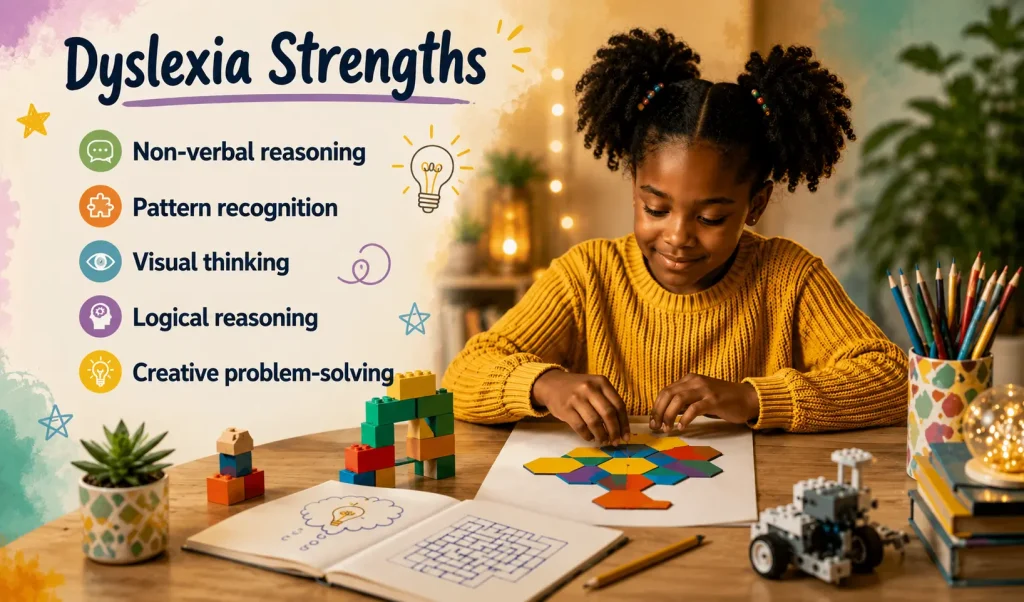
    Many children with dyslexia perform extremely well in:

    • Non-verbal reasoning
    • Pattern recognition
    • Visual thinking
    • Logical reasoning
    • Creative problem-solving

    In fact, many dyslexic learners have exceptional strengths in these areas.

    Every child has a unique profile of strengths and challenges, which is why one assessment score should never define their ability.

    A young girl enjoys a colourful pattern-building activity at a cosy learning table beside an illustrated list of dyslexia strengths, including non-verbal reasoning, pattern recognition, visual thinking, logical reasoning and creative problem-solving.

    Can children receive extra support?

    If a child has a formal diagnosis of dyslexia, schools may be able to apply for access arrangements, depending on the type of GL Assessment being used and the school’s policies.

    These might include:

    • Extra time
    • Supervised rest breaks
    • A reader for certain assessments
    • Other reasonable adjustments where appropriate

    If your child has recently been diagnosed, it’s always worth speaking with their school well before the assessment date to discuss what support may be available.

    Preparation is about confidence, not cramming

    One of the biggest misconceptions about GL Assessments is that children need endless practice papers.

    In my experience, this rarely produces the best results.

    Children tend to perform much better when they understand the question styles, feel confident in their own abilities and approach assessments calmly.

    For dyslexic learners, preparation often works best when it is engaging and multi-sensory.

    Rather than completing worksheet after worksheet, I like to use games, discussion, visual resources and practical activities to develop reading, vocabulary and reasoning skills in an enjoyable way.

    When children enjoy learning, they usually remember much more.

    Remember: A score is only one snapshot

    Perhaps the most important thing for parents to remember is that a GL Assessment score is simply one piece of information.

    It is not a measure of intelligence.

    It does not predict future success.

    It certainly doesn’t define your child’s potential.

    Some of the most creative, innovative and successful people in the world are dyslexic. They simply learn differently.

    Every child deserves the opportunity to demonstrate what they know in a way that allows them to succeed.

    Final Thoughts

    If your child has dyslexia, it’s understandable to feel anxious about GL Assessments. However, with the right preparation, appropriate support and growing confidence, many dyslexic learners perform far better than they or their parents expected.

    Most importantly, remember that assessments measure performance on one particular day—not your child’s worth, intelligence or future.


    Wondering How We Can Help?

    Whether you’re exploring tuition options, looking for specialist support or simply have a question, we’d love to hear from you. Tell us a little about your child and what you’re looking for, and we’ll be in touch as soon as possible.


    Current Availability

    Super Summer Learning (August): Good availability throughout the holiday

    Weekday daytime tuition (from September): Good availability for international students, home-educated learners and families with flexible schedules

    🗓️ After-school, Saturday & Sunday morning tuition (from September): Waiting list currently in operation


    Please include Area Code if Outside UK

    Related Posts

  • Choosing an Online Tutor for British Curriculum Children Abroad

    When families move overseas, one of the biggest priorities is ensuring their children continue to receive a high-quality education. Whether you’re living in the UAE, Saudi Arabia, Singapore, Malaysia, Thailand or elsewhere, international schools offer wonderful opportunities, but they can also present unique academic challenges.

    Over the years, I have worked with many children following the British Curriculum whilst living abroad, and one thing has become increasingly clear: choosing the right online tutor is about far more than finding someone who knows the curriculum.

    It’s about finding someone who understands your child.

    Why Families Living Abroad Often Seek Additional Support

    Moving overseas is exciting, but it also brings change.

    Children may be adapting to a new country, making new friends, learning alongside classmates from many different cultures and settling into an unfamiliar school environment. Even confident learners can take time to adjust.

    Some children need support because they’ve missed parts of the curriculum during an international move. Others simply benefit from having one consistent adult outside school who understands both the British education system and the realities of international life.

    I’ve often found that parents contact me not because their child is struggling, but because they want to build confidence before small gaps become larger ones.

    Experience with the British Curriculum Matters

    A tutor who understands the British Curriculum can provide reassurance for both parents and children.

    From Key Stage 1 through to Key Stage 4, English and maths develop in carefully planned stages. Understanding those expectations allows lessons to focus on exactly what a child needs, whether that’s strengthening phonics, improving reading comprehension, building mathematical reasoning or preparing for iGCSE English Language.

    Many international schools also use GL Assessments to monitor progress, meaning tutors who understand these assessments can provide targeted support without turning learning into endless test preparation.

    Every Child Learns Differently

    One lesson I’ve learnt after many years of tutoring is that no two children learn in quite the same way.

    Some thrive with structured explanations and routine.

    Others learn best through discussion, creativity and practical activities.

    Children with ADHD, dyslexia, dyscalculia or autism often need lessons adapted to suit the way their brains naturally process information rather than being expected to fit one teaching method.

    As someone diagnosed with ADHD myself, I understand how misleading educational stereotypes can be. ADHD looks different in every individual, and the same is true of every learner. The most effective tuition starts with understanding the child before the curriculum.

    Look Beyond Qualifications

    Qualifications certainly matter.

    Parents deserve to know their tutor has strong subject knowledge and appropriate experience.

    However, when I think back to my own education, the teachers who had the greatest impact weren’t necessarily those with the longest list of qualifications.

    They were the ones who listened.

    They noticed when confidence was slipping.

    They explained things differently when the first explanation didn’t quite make sense.

    Those qualities are just as important in online tuition.

    A tutor who builds trust will often achieve far more than one who simply delivers information.

    Flexibility Makes a Huge Difference

    One of the greatest strengths of online tuition is flexibility.

    Families living abroad often follow different school calendars from the UK. Whilst British schools may be enjoying their summer holidays, many international schools are preparing for a new academic year.

    Having a tutor who can adapt lessons around these schedules makes learning far less stressful.

    Flexibility also extends to teaching methods.

    Some children benefit from visual resources.

    Others enjoy games and interactive challenges.

    Some need additional time to process new concepts before moving on.

    The best tutors recognise that adapting to the learner is often the key to long-term success.

    Communication with Parents is Essential

    One aspect of tutoring that parents often overlook is communication.

    When families are living overseas, parents may not always have daily contact with teachers in the same way they would in the UK.

    Regular updates from a tutor can therefore become incredibly valuable.

    Knowing which areas are improving, where confidence is growing and what to continue practising at home helps everyone work together towards the same goals.

    Confidence Comes Before Progress

    One of my favourite moments as a tutor isn’t when a child achieves a high score.

    It’s when they say, “I think I can do this.”

    Confidence changes everything.

    Children begin asking more questions.

    They become willing to tackle more challenging work.

    Mistakes stop feeling frightening and become part of learning instead.

    I’ve seen this happen countless times with students across the UK and around the world. Often, academic progress follows naturally once confidence has been rebuilt.

    Questions to Ask Before Choosing an Online Tutor

    Before making your decision, consider asking:

    • Do they have experience teaching the British Curriculum?
    • Have they worked with international school students?
    • Can they support children with different learning styles or SEND?
    • How do they personalise lessons?
    • Do they communicate regularly with parents?
    • Do they focus on confidence as well as academic achievement?

    The answers will often tell you far more than a long list of qualifications.

    Final Thoughts

    Choosing an online tutor for your child whilst living abroad is an important decision.

    The right tutor should provide more than curriculum knowledge. They should understand children as individuals, adapt their teaching to suit different learning styles and help learners feel confident, supported and motivated.

    Whether your family is based in Dubai, Abu Dhabi, Riyadh, Jeddah, Kuala Lumpur, Singapore, Bangkok or elsewhere, personalised online tuition can provide valuable continuity alongside an excellent international education.

    After all, children don’t simply need someone to teach them English or maths.

    They need someone who helps them believe they can succeed.


    Related Posts


  • What is iGCSE English? A Parent’s Guide

    If your child is studying the British Curriculum, particularly at an international school, you’ve probably come across the term iGCSE English. Like many parents, you may be wondering exactly what it involves and how it differs from the GCSE English qualifications taken by students in the UK.

    Over the years, I’ve supported many students studying IGCSE English Language, from learners here in the UK to students attending British international schools in the UAE, Saudi Arabia, Thailand, and other countries. Teaching students from a range of educational and cultural backgrounds has given me valuable insight into the needs of international learners while maintaining a strong focus on the Cambridge and Edexcel IGCSE English specifications. Although every school is slightly different, one thing remains the same: parents often worry far more about the examination than they need to.

    The good news is that success in iGCSE English isn’t simply about memorising mark schemes or completing endless past papers. At its heart, it’s about developing strong reading, writing and communication skills that will benefit a child long after they have left school.

    What is iGCSE English?

    The International General Certificate of Secondary Education (iGCSE) is an internationally recognised qualification, typically studied by students aged 14 to 16.

    Many British international schools choose iGCSE qualifications because they provide a rigorous academic programme that is recognised by schools, colleges and universities around the world.

    Although there are several examination boards offering iGCSE English Language, they all assess similar core skills. Students are expected to read a variety of texts, think critically about what they have read, communicate their ideas clearly and produce writing for different purposes and audiences.

    Because the qualification is recognised internationally, it is widely taught in British international schools across the world. Many of the students I work with are following exactly the same iGCSE English courses as their peers in the UK, despite being thousands of miles away.

    These are skills that develop gradually over time rather than something that can be learnt overnight.

    What Does iGCSE English Assess?

    Whilst every specification is slightly different, students are generally expected to demonstrate:

    • Reading comprehension
    • Vocabulary development
    • Language analysis
    • Writing for different audiences and purposes
    • Creative writing
    • Transactional writing
    • Organising ideas clearly
    • Accurate spelling, punctuation and grammar

    Many parents are surprised to discover that iGCSE English isn’t simply about knowing the “right answers.” Students are often rewarded for their ability to interpret texts, explain their thinking and communicate effectively.

    That means confidence, vocabulary and reading experience are just as important as exam knowledge.

    My Approach to iGCSE English

    One of the questions I’m occasionally asked is whether I spend lessons working through lots of past papers.

    The honest answer is… not really.

    Of course, there is value in becoming familiar with the style of an examination, but my focus has always been on helping students develop the underlying English skills that lead to long-term success.

    Rather than teaching children to memorise mark schemes or perfect examination techniques, I help them become stronger readers, more thoughtful writers and more confident communicators.

    We spend time exploring vocabulary, discussing high-quality texts, developing analytical thinking and practising different styles of writing. We look at how authors create meaning, how language influences readers and how ideas can be communicated clearly and effectively.

    In my experience, when those foundations become secure, students naturally become much better equipped to tackle assessments.

    More importantly, they develop skills that will continue to benefit them throughout their education, university and later life.

    Supporting Students with SEND

    This approach is particularly valuable for many of the children I work with who have ADHD, dyslexia, autism or other special educational needs.

    Every learner is different.

    Some children become overwhelmed by the pressure of repeated exam practice. Others lose confidence because they begin to associate English with getting questions wrong instead of enjoying reading and writing.

    As someone with ADHD myself, I understand how important it is to adapt learning to the individual child rather than expecting every learner to fit the same mould. My lessons are personalised, engaging and designed to build confidence alongside academic skills.

    For some students, this means breaking larger tasks into manageable steps. For others, it involves using discussion, visual resources, creative activities or simply allowing extra time to process ideas.

    When children feel understood, they are far more likely to enjoy learning—and children who enjoy learning often make the greatest progress.

    iGCSE English for ESL and EFL Learners

    Many of the students I support attend British international schools where English is the language of learning, even though it isn’t always the language spoken at home.

    Whether they’re living in Dubai, Singapore, Kuala Lumpur or Hong Kong, it’s common for children to move confidently between two or more languages every day. Whilst this is an incredible skill, iGCSE English often requires a much deeper understanding of vocabulary, inference, figurative language and written expression.

    This is one of the reasons I enjoy supporting students learning English as a second or foreign language (ESL/EFL). Rather than relying on memorised responses, we focus on expanding vocabulary naturally, exploring increasingly challenging texts and building confidence through meaningful discussion and purposeful writing.

    These skills not only support success in iGCSE English but also help students across every other subject they study in English.

    Confidence Matters More Than Parents Often Realise

    Looking back at my own education, the teachers who inspired me most weren’t the ones who taught me how to pass an examination.

    They were the ones who made me curious.

    They encouraged me to ask questions, think independently and enjoy the process of learning.

    That philosophy has stayed with me throughout my career.

    Examinations are important, but they are only one small part of a child’s educational journey. The ability to communicate clearly, think critically and express ideas confidently will continue to open doors long after the examination papers have been packed away.

    Final Thoughts

    iGCSE English is about far more than preparing for an examination.

    It is an opportunity for young people to become confident readers, capable writers and thoughtful communicators.

    Whilst there is certainly a place for becoming familiar with exam formats, I believe the greatest progress comes from developing the core skills that underpin success. Strong reading comprehension, rich vocabulary, analytical thinking and confident writing don’t just help students achieve better results—they equip them with skills for life.


    Related Posts

  • Why Summer Learning Matters More Than You Think

    When the summer holidays arrive, I think every family breathes a little sigh of relief.

    The school run disappears, alarm clocks get ignored (at least for a while!), and life feels a little less rushed. Summer is made for making memories, exploring, relaxing and spending quality time together.

    But it often comes with one big question from parents…

    Should my child be doing any learning over the summer?

    My answer is always the same.

    Yes—but not in the way you might think.

    I’m certainly not suggesting children should spend hours completing worksheets or sitting at a desk while everyone else is enjoying the sunshine. Childhood is precious, and the summer holidays should absolutely be filled with adventures, family time and plenty of fun.

    However, keeping little minds active during those six weeks can make a huge difference, and that’s exactly why we’ve created our Super Summer Learning.

    What Is the Summer Slide?

    You may have heard people talk about the “summer slide.”

    It’s the term used to describe the learning loss that can happen when children spend several weeks without practising the skills they’ve worked so hard to develop throughout the school year.

    Now, this doesn’t mean children forget everything they’ve learned overnight. They won’t suddenly forget how to read or complete maths problems.

    But confidence can dip.

    Fluency can slow down.

    Simple skills that once came naturally sometimes need refreshing.

    As someone who works with children every day, I’ve seen it happen time and time again. September often starts with children spending the first few weeks remembering rather than moving forward.

    A little summer learning each week can help prevent that.

    It’s About Confidence, Not Pressure

    One thing I always want parents to remember is that summer learning should never feel like school at home.

    Children have worked incredibly hard all year. They deserve a break.

    The goal isn’t to overload them with work.

    The goal is simply to keep their brains engaged.

    Sometimes just ten or fifteen minutes each day is enough.

    Reading a book together.

    Playing a maths game.

    Writing a postcard from holiday.

    Helping measure ingredients while baking.

    Spotting patterns on a walk.

    Even conversations about the world around them are learning.

    Children don’t always need to sit down with a pencil to develop important skills.

    Learning happens everywhere.

    Small and Consistent Always Wins

    One of the biggest mistakes people make is believing learning has to happen in big chunks.

    It really doesn’t.

    Children learn best through regular, repeated experiences.

    A short activity every day is often far more beneficial than trying to complete hours of work once a week.

    Those little moments soon add up.

    Five pages of a book.

    A quick spelling challenge.

    Ten minutes of number games.

    A family quiz after dinner.

    Before you know it, your child has continued practising key skills all summer without it ever feeling overwhelming.

    Consistency is far more powerful than perfection.

    Learning Looks Different for Every Child

    One of the things I love most about summer is how naturally learning can fit into everyday life.

    You’re already doing so much without even realising it.

    Heading to the beach? Talk about tides, sea creatures and habitats.

    Going shopping? Let your child work out the total or calculate the change.

    Baking together? There’s maths in every recipe.

    Travelling somewhere new? Read maps, spot road signs and learn about local history.

    Planting flowers? Discuss how plants grow and what they need to survive.

    Playing board games? You’re developing turn-taking, strategy, communication and problem-solving.

    Watching the stars? You’re exploring science.

    Every family holiday is full of learning opportunities—you just don’t always notice them.

    Supporting Neurodivergent Learners During the Summer

    For many children with ADHD, dyslexia, dyscalculia or autism, the summer holidays can be both wonderful and challenging.

    The freedom from school routines is often a welcome break, but returning in September can sometimes feel overwhelming if key skills haven’t been used for several weeks.

    That’s why gentle, enjoyable activities can be so valuable.

    There’s no need to recreate the classroom.

    Instead, focus on keeping routines relaxed, celebrating small successes and following your child’s interests. Reading together, playing educational games, cooking, building, creating and exploring outdoors all help maintain important skills whilst protecting confidence.

    Every child learns differently, and that’s something worth celebrating.

    Reading Is Still One of the Best Things You Can Do

    If I could recommend just one activity over the summer, it would always be reading.

    Reading supports almost every area of learning.

    It builds vocabulary.

    Improves comprehension.

    Develops imagination.

    Strengthens writing.

    Even ten minutes before bed each evening can have a huge impact.

    And remember, reading doesn’t only mean chapter books.

    Comic books, magazines, recipe books, football programmes, information books and graphic novels all count.

    The goal is simply to help children discover that reading is enjoyable.

    Summer Learning Around the World

    Many of the families I support live overseas, particularly in the UAE, Saudi Arabia, Singapore, Malaysia and Thailand.

    Whilst school holidays vary from country to country, the principle remains exactly the same.

    A little regular learning helps children maintain confidence and feel prepared for the next stage of their education, whether they follow the British Curriculum, American Curriculum, IB Programme or another international curriculum.

    Online summer tuition can also provide valuable structure for children who enjoy routine or need a little extra support before the new school year begins.

    Why We Created Super Summer Learning

    I know how busy family life becomes during the holidays.

    Parents don’t want to spend hours searching Pinterest or creating activities from scratch.

    That’s why we’ve done the hard work for you.

    Our Super Summer Learning has been designed to make learning simple, enjoyable and achievable.

    The activities are engaging, varied and designed to fit around family life rather than take it over.

    Whether your child enjoys reading, needs a little extra confidence in maths, is home educated or simply benefits from short daily challenges, there’s something for everyone.

    There are opportunities to practise key skills whilst still leaving plenty of time for ice creams, park trips, holidays, sleepovers and lazy afternoons.

    Because that’s exactly what summer should be about.

    It’s not about creating another timetable.

    It’s about making learning part of everyday life in a way that children genuinely enjoy.

    Every Child Benefits Differently

    Something I always remind parents is that every child is different.

    Some children absolutely love learning and will happily complete activity after activity.

    Others need much shorter bursts and far more encouragement.

    Both are completely normal.

    The important thing isn’t how much they complete.

    It’s that they continue believing they can learn.

    Confidence is one of the greatest gifts we can give children.

    When children return to school feeling capable, positive and ready to learn, everything else becomes easier.

    Making September Feel Less Daunting

    Starting a new school year can feel exciting, but it can also bring nerves.

    New teachers.

    New classrooms.

    New expectations.

    By keeping learning ticking over during the summer, children often return feeling more prepared and more confident.

    Instead of spending weeks trying to remember forgotten skills, they’re ready to build on what they already know.

    That confidence makes a real difference.

    Let’s Make This Summer Count

    Summer isn’t about creating perfect routines or expecting children to spend hours working.

    It’s about balance.

    It’s about making memories whilst keeping curiosity alive.

    It’s about laughing over board games, reading stories under a blanket in the garden, baking together, exploring new places and finding learning in everyday moments.

    That’s exactly what our Super Summer Learning has been designed to do.

    Whether your child needs support with English, maths, confidence building, home education or simply wants to keep their skills fresh over the holidays, we’ve created activities that fit naturally into family life without taking over the summer.

    We want children to head into September feeling proud of themselves, excited for what’s next and confident in everything they’ve achieved.

    So wherever this summer takes you—whether you’re travelling abroad, enjoying days out, home educating, or simply making the most of time together—remember that every conversation, every story, every game and every new experience is helping your child grow.

    Learning doesn’t stop when school finishes.

    Sometimes, the best learning happens when children don’t even realise they’re doing it.


    Related Posts

  • Common Signs of Dyslexia Parents Often Miss

    As a tutor, one of the conversations I have most often with parents begins with the words:

    “I knew something wasn’t quite right, but I never thought it might be dyslexia.”

    Many families expect dyslexia to look exactly like the stereotypes we hear about—letters written backwards, an intense dislike of reading, or a child who simply cannot learn to spell. Whilst these signs can certainly occur, dyslexia is often far more subtle and varied than people realise.

    Over the years, I have worked with many children whose dyslexia wasn’t identified until much later because the signs were quietly hiding in plain sight. Some were bright, articulate and imaginative children who had developed wonderful coping strategies. Others worked incredibly hard to keep up with their peers, leaving adults unaware of the effort involved.

    Much like other forms of neurodiversity, every child’s experience is unique, and recognising the less obvious signs can make a tremendous difference to confidence and wellbeing.

    “They’re So Clever—It Can’t Be Dyslexia”

    One of the biggest misconceptions about dyslexia is that it reflects intelligence.

    In reality, many dyslexic children are exceptionally creative, curious and thoughtful learners. They may excel in discussions, ask insightful questions and possess impressive general knowledge, yet still struggle to read, spell or write at the level people expect.

    Because they appear academically capable in other areas, difficulties with literacy are sometimes dismissed as carelessness or a lack of effort.

    I often tell parents that intelligence and dyslexia are not opposites. In fact, many dyslexic learners are remarkable problem-solvers who simply process language differently.

    Difficulty Remembering Sequences

    Parents frequently notice that their child struggles to remember everyday sequences long before reading difficulties become obvious.

    You might notice problems with:

    • Remembering days of the week.
    • Learning multiplication tables.
    • Following multi-step instructions.
    • Recalling the alphabet in order.
    • Telling left from right.

    I still meet children who can explain a complex scientific concept but become completely tangled when asked to remember three instructions in succession.

    These difficulties are often linked to working memory and language processing rather than a lack of understanding.

    Avoiding Reading Without Complaining About It

    Not every child says, “I hate reading.”

    Some simply avoid it in subtle ways.

    They might suddenly need a drink, remember another task, become unusually tired or ask someone else to read aloud. Others choose books far below their age level because they provide comfort and success rather than frustration.

    Parents sometimes assume their child simply isn’t interested in books, when in reality they are protecting themselves from feelings of failure.

    Strong Verbal Skills but Weak Written Work

    This is one of the most commonly overlooked signs.

    A child may explain an idea beautifully in conversation but struggle to transfer those thoughts onto paper. Their vocabulary might be advanced, yet their writing appears much younger than expected.

    I’ve taught many learners who can tell wonderfully imaginative stories aloud but freeze when faced with a blank page. The challenge isn’t creativity or intelligence—it’s bridging the gap between thinking and recording ideas.

    Unusual Spelling Patterns

    All children make spelling mistakes, but dyslexic learners often produce errors that seem inconsistent.

    A word might be spelled correctly on one page and completely differently on the next. They may know the rule one day and forget it the following week.

    This inconsistency can be confusing for parents.

    The important thing to remember is that dyslexia isn’t about laziness or not paying attention. Many children are working twice as hard as their peers simply to achieve the same outcome.

    Low Confidence Hidden Behind Humour

    Some children become class clowns.

    Others insist they “don’t care” about schoolwork.

    Some avoid trying altogether because not trying feels safer than trying and failing.

    What looks like a behavioural issue can sometimes be a child protecting their self-esteem.

    One of the most heartbreaking things I hear is, “I’m stupid.”

    Dyslexic children often know they are finding something harder than their friends, even when adults haven’t recognised the reason yet. Early support and reassurance can make an enormous difference to how they view themselves as learners.

    Trust Your Instincts

    Parents are usually the first people to notice when something feels different.

    If your child is bright, imaginative and curious but seems to struggle disproportionately with reading, spelling, writing or remembering sequences, it may be worth exploring whether dyslexia could be a factor.

    The earlier children receive understanding and appropriate support, the sooner they can develop strategies that play to their strengths.

    Most importantly, dyslexia is not something to be feared.

    Some of the most creative, innovative and successful people in the world are dyslexic. The goal is never to change who a child is, but to help them understand how their unique brain learns best. This strengths-based approach is central to the support we provide at Bedford Tutor and underpins everything from our multi-sensory literacy work to our confidence-building sessions with neurodivergent learners.


    Related Posts

  • Moving to a New Country With ADHD: The Challenges Nobody Talks About

    Moving to a new country is often described as an exciting adventure. New opportunities. New friends. New experiences. Social media is full of smiling family photographs outside famous landmarks and stories about fresh starts.

    But if you have ADHD, there is another side to relocation that rarely gets talked about.

    The reality is that moving abroad can quietly turn everyday ADHD challenges up to maximum volume. Even positive life changes can place enormous demands on executive functioning, emotional regulation and working memory. As someone diagnosed with ADHD myself, I’ve come to realise that our brains don’t necessarily distinguish between good stress and bad stress—they simply recognise that everything has changed.

    That doesn’t mean moving overseas can’t be wonderful. It absolutely can. But understanding the hidden challenges can make the transition much kinder on yourself and your family.

    Every Routine Suddenly Disappears

    Many people think ADHD means disliking routine.

    Ironically, many of us actually depend on it far more than we realise.

    Our brains often build invisible systems that keep life running. We know which supermarket sells our favourite foods. We know which road to take to work without thinking. We know where everything belongs in the house.

    Then one day…

    Everything changes.


    Suddenly you’re learning a new transport system, different shopping habits, unfamiliar road signs and perhaps even a new language. Every simple task requires conscious thought instead of automatic memory.

    By the end of the day, your brain can feel completely exhausted.

    Decision Fatigue Becomes Constant

    One thing people rarely mention is just how many decisions relocation involves.

    Which school?

    Which doctor?

    Which phone provider?

    Where do you buy familiar foods?

    What paperwork needs completing next?

    For someone with ADHD, decision fatigue can become overwhelming surprisingly quickly.

    Many ADHDers already spend significant mental energy organising everyday life. Relocating adds hundreds of additional decisions every single week.

    Sometimes it’s not the “big” decisions that become difficult—it’s choosing breakfast after spending the morning completing immigration paperwork.

    Your Mask Can Become Harder to Maintain

    Many adults with ADHD spend years learning how to appear organised, calm and in control. I often describe my own life as a mixture of genuine strengths alongside countless strategies that quietly compensate for ADHD. Those coping mechanisms become part of everyday life without us even noticing.

    Moving abroad often removes those carefully-built supports overnight.

    Without familiar routines, trusted people and predictable environments, ADHD traits may suddenly become far more noticeable.

    You haven’t become “worse.”

    You’re simply operating without the systems that previously helped you succeed.

    Homesickness Isn’t Just Missing Home

    For ADHD brains, homesickness can feel unusually intense.

    It’s not only about missing family or favourite places.

    It’s grieving predictability.

    It’s missing knowing where everything is.

    It’s missing the café where nobody needed directions.

    It’s missing tiny routines that quietly reduced cognitive load every day.

    These seemingly insignificant losses can accumulate until your brain feels permanently overloaded.

    Children Often Show It Differently

    Children with ADHD may not tell you they’re struggling.

    Instead, you might notice:

    • Increased emotional outbursts
    • Difficulty sleeping
    • Greater distractibility
    • More frequent meltdowns
    • Reduced confidence
    • Reluctance to attend school
    • Increased forgetfulness

    From the outside, it can look like “bad behaviour.”

    More often, it’s a child whose brain is working incredibly hard simply to process change.

    This is particularly true for children adjusting to international schools, different teaching styles and unfamiliar friendship groups.

    Give Yourself Permission to Start Small

    One lesson I’ve learnt from both my own ADHD journey and years supporting neurodivergent learners is that confidence rarely grows through pressure.

    It grows through understanding.

    When everything feels unfamiliar, simplify wherever possible.

    Keep meals predictable.

    Create one or two daily routines before trying to establish ten.

    Celebrate finding the supermarket before worrying about making dozens of new friends.

    Allow yourself to be a beginner.

    None of this means you’ve failed—it simply means your ADHD brain is adapting to an enormous life transition.

    The Hidden Strengths of ADHD Abroad

    Despite the challenges, ADHD can also bring unexpected advantages.

    Many ADHDers are naturally curious.

    We notice details others overlook.

    We often embrace new experiences with enthusiasm once initial anxiety settles.

    Our creativity helps us solve unfamiliar problems.

    Our willingness to explore can turn a foreign city into an endless adventure.


    Some of the qualities that once felt like weaknesses can become remarkable strengths when living overseas.

    The key is recognising that adjustment takes time.

    Final Thoughts

    Moving to another country changes far more than your address.

    For someone with ADHD, it reshapes routines, identity, confidence and daily functioning in ways that many people never see.

    If you’re finding the transition harder than expected, you’re certainly not alone.

    Sometimes the biggest challenge isn’t learning a new language or finding your way around a different city.

    Sometimes it’s simply teaching your wonderfully unique ADHD brain that this new place can become home too.

    Here at Bedford Tutor, I have supported many families relocating overseas, alongside home-educated learners across the UK and around the world. Whether a child is adjusting to an international school, following the British or American curriculum, or needs personalised support for ADHD, dyslexia, dyscalculia or autism, I create calm, flexible lessons that help learners rebuild confidence during times of change. If moving abroad has disrupted your child’s education, I’d love to help them settle into learning again.

    To find out more, please click on the relevant link below:

    Bel 😊


    Related Posts

  • Helping SEND Learners Thrive in International Schools

    Moving to a new country is an exciting adventure for many families. Children have opportunities to experience different cultures, make friends from around the world and learn in diverse educational environments.

    Alongside these opportunities, however, international schooling can present unique challenges, particularly for children with Special Educational Needs and Disabilities (SEND).

    Over the years, I have worked with many families living overseas, supporting children attending international schools in countries including the UAE, Saudi Arabia, Singapore, Malaysia and Thailand. Although every school is different, one thing has become very clear to me: SEND learners thrive when they feel understood.

    As someone with ADHD myself, I also know how important that understanding can be. No two neurodivergent children are exactly alike. Two children with the same diagnosis may learn in completely different ways, have different strengths and need entirely different types of support.

    That is something I wish more people understood.

    Every Child’s Journey Is Different

    When parents first contact me, they often begin by explaining their child’s diagnosis.

    “My daughter has dyslexia.”

    “My son has ADHD.”

    “Our child is autistic.”

    These labels can be helpful because they provide a starting point for understanding a learner’s needs. However, they never tell the whole story.

    Some children with ADHD are constantly on the move, whilst others appear quiet and dreamy. Some autistic learners love routine and predictability, whilst others enjoy variety and creativity. Children with dyslexia may struggle with reading but excel in problem-solving, storytelling or art.

    Rather than asking, “What diagnosis does this child have?” I prefer to ask, “How does this particular child learn best?”

    That question changes everything.

    International Schools Offer Wonderful Opportunities

    One of the things I particularly enjoy about working with international school students is the incredible diversity they experience every day.

    Many children grow up alongside classmates from dozens of different countries, learning about languages, traditions and cultures that broaden their understanding of the world.

    International schools are often wonderfully inclusive environments, and many provide excellent SEND provision. However, children can still experience challenges.

    Some learners are adjusting to a new language.

    Others have moved countries several times.

    Some are adapting to an unfamiliar curriculum or assessment system whilst also trying to make new friends.

    For SEND learners, these changes can sometimes feel overwhelming.

    Building Confidence Comes First

    Parents often ask me whether we should focus on catching up academically.

    Whilst developing English and maths skills is important, confidence almost always comes first.


    A child who believes they are capable is far more willing to attempt challenging tasks, ask questions and persevere when things become difficult.

    I often think back to my own experiences at school. Looking back now, I can see that the teachers who made the greatest difference weren’t necessarily the ones with the fanciest resources or longest explanations.

    They were the teachers who made me feel capable.

    Sometimes a few encouraging words can stay with a child for years.

    Personalised Learning Makes a Huge Difference

    One of the greatest advantages of one-to-one tuition is flexibility.


    Rather than expecting a child to fit a particular teaching method, lessons can be adapted around the learner.

    For one student, this might mean using visual resources.

    For another, movement breaks and interactive games help maintain concentration.

    Some learners benefit from breaking tasks into smaller chunks, whilst others need extra time to process new information before responding.

    When children feel that lessons have been designed with them in mind, learning often becomes far more enjoyable.


    Working Together Creates Success

    One thing I particularly value when supporting international families is communication.

    Parents know their child better than anyone else.

    Teachers understand the classroom environment.

    Tutors can provide personalised strategies and additional support.

    When everyone shares ideas and works together, children receive consistent encouragement wherever they are learning.

    I’ve often seen remarkable progress when families, schools and tutors become a team rather than working separately.

    Looking Beyond the Diagnosis

    Perhaps the biggest lesson my own ADHD diagnosis taught me is that labels should never limit expectations.

    Children with SEND are not defined by the challenges they experience.

    They are artists, scientists, mathematicians, storytellers, inventors, musicians and future innovators.

    Sometimes they simply need teaching that recognises their strengths as well as their difficulties.

    Whether a child attends an international school in Dubai, Singapore, Kuala Lumpur, Bangkok or Riyadh, they deserve to feel understood, respected and confident in their own abilities.

    When we focus on understanding the individual rather than the diagnosis, remarkable things can happen.

    Here at Bedford Tutor, I have supported SEND learners attending international schools across the UK and around the world for many years. From personalised English and maths tuition to specialist support for children with ADHD, dyslexia, dyscalculia and autism, I create engaging lessons that build confidence whilst adapting to each child’s unique way of learning.

    To find out more, please click on the relevant link below.

    Bel 😊



    Related Posts