There is no single way to learn.
This sounds like a simple statement, but it is something I have become increasingly aware of throughout my years of working with children. Every learner arrives with their own personality, interests, strengths, experiences, preferences and individual ways of approaching learning. For autistic children, as with all children, finding approaches that feel accessible and meaningful to the individual can make a real difference.
I have also gained a personal perspective on autism through my own life. My partner is autistic, and alongside my professional experience of working with autistic children, this has given me an even greater appreciation of how varied individual experiences of autism can be.
Although I am not autistic myself, I was diagnosed with ADHD as an adult. ADHD and autism are distinct neurodevelopmental conditions, although there can be some areas of overlap in how they may relate to learning, executive functioning, attention, sensory experiences and emotional regulation. My own experience of being neurodivergent has helped me recognise that people can experience learning and their surroundings in very different ways.
At the same time, I am very conscious that my experience of ADHD is my own. It does not tell me what it is like to be autistic, and I would never want to suggest that it does. Autistic people are the experts in their own experiences.
What it has encouraged me to do is remain curious, listen carefully and avoid making assumptions about what a child can or cannot do based simply on a diagnosis.
Every Autistic Child Is an Individual
One phrase I return to regularly is:
“When you have met one autistic person, you have met one autistic person.”
For me, this captures something important.
Autistic people are individuals, with their own personalities, preferences, interests, strengths, communication styles, sensory experiences and ways of interacting with the world. Autism can be experienced very differently from one person to another.
One autistic child may communicate very confidently through speech but find certain sensory environments difficult. Another may communicate in a different way. One child may enjoy a predictable routine, while another may be comfortable with considerable flexibility.
There is no single autistic experience and no single approach to learning that will suit every autistic learner.
This is why I believe it is so important to get to know the child rather than making assumptions based on a label.
Understanding the Child Behind the Learning
One of the most important things I have learnt from working with children is that what works brilliantly for one learner may not work at all for another.
Some autistic learners may find certain aspects of school particularly demanding, such as changes in routine, sensory distractions, communication demands, processing information or managing several instructions at once. Other children may find completely different aspects of learning challenging.
These differences do not tell us what a child is capable of.
A child can have the ability to complete a task and still find it difficult to demonstrate that ability in a particular situation. This can happen for many different reasons, including processing demands, working memory, executive functioning, attention, anxiety, communication differences or simply being asked to demonstrate knowledge in a way that does not suit the individual learner.
This is not unique to autism. Similar experiences can occur across many different neurodevelopmental and learning differences.
For me, the important question is therefore not simply:
“What does this child find difficult?”
It is also:
“What helps this child show what they know?”
Start with Strengths and Interests
Interests can be a wonderful starting point for learning.
A child who is fascinated by animals might be more motivated to practise descriptive writing by creating a fact file about a favourite species. A learner interested in space might explore reading comprehension through a passage about planets, or develop mathematical skills through problems involving distances and measurements.
The academic objective has not disappeared.
We have simply connected it to something meaningful to the learner.
I have seen this repeatedly in my work with children. When a learner is genuinely interested in a subject, engagement can change enormously. Questions may come more naturally, conversation can develop and a child who previously seemed reluctant to write may become much more willing to put ideas onto paper.
Interests do not have to be used in every lesson, and not every child wants their favourite interest incorporated into academic work. The important thing is to find out what genuinely motivates the individual child rather than assuming.
Sometimes the route into learning only becomes clear once we take the time to discover what makes a child curious.
Provide Structure Where It Helps
Predictability can be helpful for some autistic learners, although again, individual preferences vary.
Knowing what is going to happen next can make a lesson feel more manageable for a child who finds uncertainty difficult. A familiar structure might therefore include:
Warm-up → main activity → short break → challenge → review
But the exact format should be shaped around the individual learner.
Some children may benefit from visual explanations or knowing how much work remains. Others may find it easier when instructions are broken into smaller steps rather than being given a long list of information at once.
This is not about reducing expectations.
It is about making expectations accessible.
For a child who finds a large task difficult to approach, dividing it into smaller stages can make the same learning objective feel much more manageable.
Instead of:
“Write a story.”
we might begin with:
“Let’s choose our character.”
Then:
“Where are they?”
Then:
“What happens first?”
The task remains the same. We have simply provided a clearer route towards it.
Make Room for Different Ways of Communicating
Learning does not always have to begin with writing.
Some children may find it easier to explain an idea verbally before putting it onto paper. Others may prefer drawing, sorting, matching, discussing, using visual resources or working with physical materials.
There is no single correct way for a child to demonstrate understanding.
This is one reason I enjoy personalised tuition so much. There is time to notice what happens when we change the way something is presented.
If one explanation does not work, we can try another.
If a written activity feels difficult to access, perhaps we can talk about it first.
If a concept remains abstract, perhaps we can make it visual.
If a child communicates their understanding more effectively in another way, we can take that into account while still working towards the underlying learning objective.
My own ADHD has taught me to value this flexibility enormously. I know from personal experience that there can be a difference between understanding something and being able to access it through a particular method.
But I do not assume that an autistic child experiences the world in the same way I do.
Quite the opposite.
My own neurodivergence reminds me to stay curious rather than make assumptions.
The aim is not to find one “autism-friendly” teaching technique that works for everyone.
It is to remain flexible enough to keep looking for what works for the individual learner.
Finding the right online tutor for a child with ADHD is about far more than finding someone who knows their…
One of the things I love most about teaching English is discovering what is going on inside a child’s imagination.Sometimes…
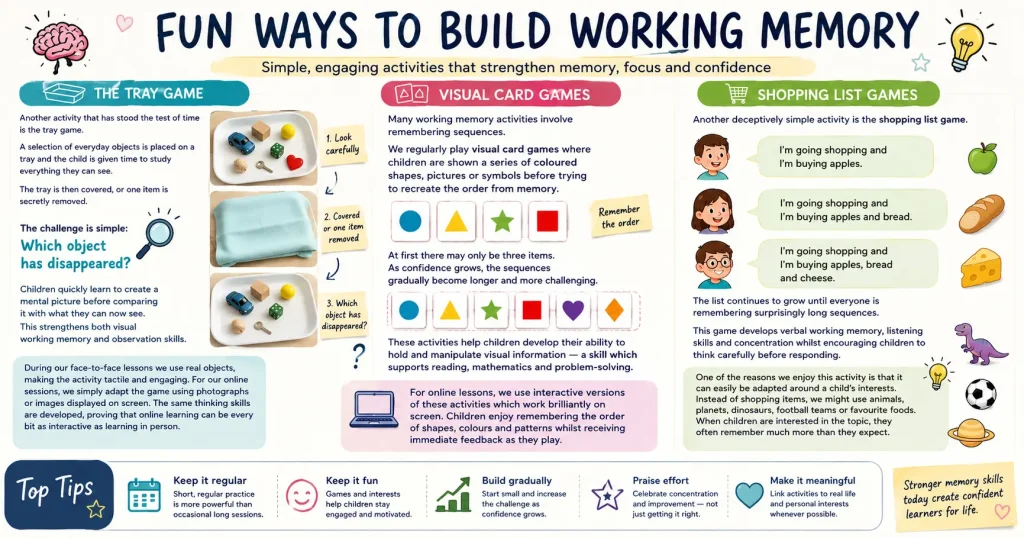
Working memory is often described as the brain’s “mental notepad”. It allows us to hold information in our minds whilst…
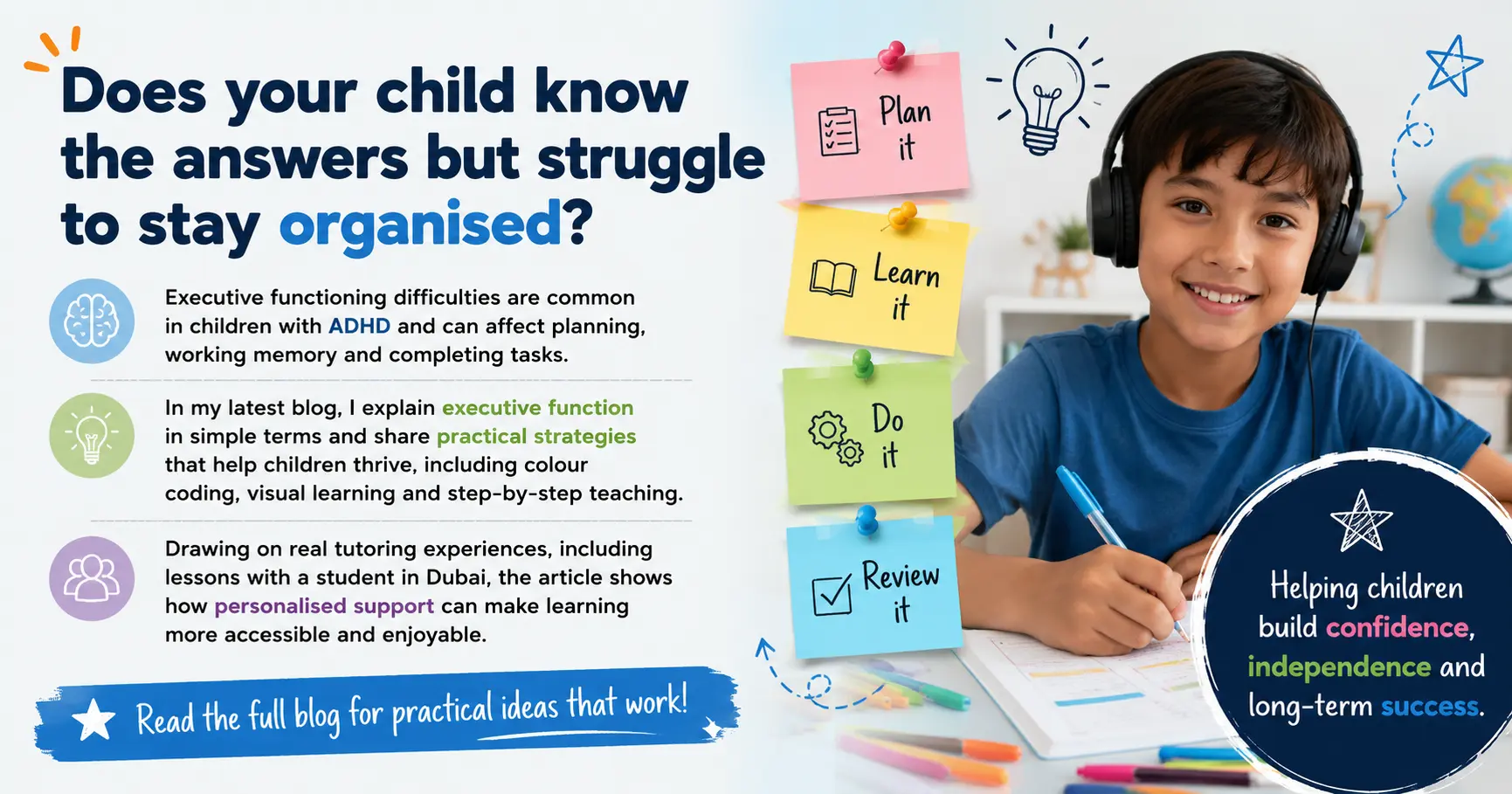
If your child has ADHD, you have probably experienced moments that leave you scratching your head.They can explain a maths…
Preparing for iGCSE English can feel like a daunting prospect for many families, but for children with ADHD, it can…
Moving to Dubai can be an exciting new chapter for families. The city is home to some of the world’s…
Recognise Strengths Alongside Support Needs
Conversations about additional needs can sometimes become heavily focused on difficulties.
It is important that support needs are understood and properly supported, but they should not become the whole story of a child.
Autistic children have their own interests, personalities, abilities and strengths. Some may develop an exceptionally detailed knowledge of subjects that fascinate them. Some may approach problems in creative or unexpected ways. Others may have strengths that are much quieter and only become apparent when they are given the right opportunity to demonstrate them.
There can also be significant challenges associated with being autistic, and those challenges deserve understanding, appropriate support and respect.
A strengths-based approach does not mean pretending that difficulties do not exist.
It means recognising the whole child.
A child’s support needs and their strengths can exist alongside one another.
Confidence Matters Alongside Curriculum Content
A child can understand something and still find it difficult to show that understanding in a particular setting.
This is something I see across many different learning profiles, including autism, ADHD, dyslexia, dyscalculia and other learning differences.
A learner may know the answer but struggle to organise their thoughts. They may understand a mathematical concept but find it difficult to explain their reasoning. They may have wonderful ideas for a piece of writing but struggle to transfer those ideas onto the page.
This is why I place such importance on creating a learning environment where children feel comfortable making mistakes.
Mistakes are part of learning.
Getting something wrong does not mean that a child has failed. It gives us information about what they understand already and what we might need to revisit.
Over time, small experiences of success can help children develop greater confidence in themselves as learners.
Learning Does Not Have to Look Exactly Like School
Personalised tuition gives us the opportunity to think carefully about how learning is presented.
For some children, movement may support concentration. For others, visual resources may be particularly useful. Some learners may benefit from shorter activities, while others may become deeply absorbed when a subject captures their interest.
Discussion, games, challenges, creative activities and practical examples can all have a place in learning.
These approaches are not exclusively for autistic children. They can benefit many different learners.
The important thing is to consider what helps the individual child engage, understand and demonstrate their learning.
Learning can be purposeful without feeling rigid.
It can be structured without being restrictive.
And it can remain academically ambitious while also being responsive to the needs of the learner.
Finding Their Own Route
Perhaps the most important thing I have learnt is that successful education is not about making every child learn in exactly the same way.
It is about helping each child develop their skills while giving them appropriate opportunities to access learning in ways that work for them.
For one autistic learner, that route might involve visual resources and clear routines.
For another, it might involve talking about a favourite subject before connecting that interest to English or maths.
For another, it might mean additional processing time, breaking tasks into smaller pieces or reducing unnecessary distractions.
And for another child, it might look completely different again.
That is the point.
There is no single autistic learning style.
There is no single teaching strategy that works for every autistic learner.
And there is certainly no expectation that an autistic child should be made to appear less autistic in order to succeed academically.
My ADHD does not make me an expert on autism, and I would never suggest that it does. What it has given me is personal experience of being neurodivergent, an understanding that people can experience learning differently, and a strong reminder to look for the individual rather than making assumptions based on a diagnosis.
Combined with my professional experience supporting children and my personal experience of having an autistic partner, this has shaped the way I approach personalised tuition.
The goal is not to change the child so that they fit the learning.
The goal is to make the learning more accessible to the child while maintaining meaningful and appropriate expectations.
When children feel understood, valued and capable, they can have greater opportunities to show what they know, develop their skills and enjoy learning.
And sometimes, one of the most rewarding parts of that process is discovering a strength that had previously been overlooked.
Supporting Autistic Learners as Individuals
At Bedford Tutor and our online division, Kite Tutoring, we have supported autistic children alongside learners with ADHD, dyslexia, dyscalculia and other learning differences for many years.
Our approach begins with the individual learner rather than assuming that a particular diagnosis tells us everything we need to know.
Personalised in-person, hybrid and online lessons can be adapted around the child’s needs, interests, communication preferences and learning goals, while continuing to work towards meaningful academic progress.
Whether your child is working towards school qualifications, following the British or American Curriculum abroad, being home educated or simply needs additional support with English or maths, we aim to create a learning environment where they can develop their skills and confidence.
Sometimes a child does not need someone to push them harder.
Sometimes they need someone to look carefully at the path in front of them and ask:
“What could make this more accessible?”
Because when we take the time to understand the individual learner, we give them more opportunities to show what they know, develop their skills and experience themselves as capable learners.
And sometimes, that is where the most meaningful progress begins.
Bel 😊
Related Posts
 Bedford, UK