Moving to a New Country With ADHD: The Challenges Nobody Talks About
Moving to a new country is often described as an exciting adventure. New opportunities. New friends. New experiences. Social media is full of smiling family photographs outside famous landmarks and stories about fresh starts.
But if you have ADHD, there is another side to relocation that rarely gets talked about.
The reality is that moving abroad can quietly turn everyday ADHD challenges up to maximum volume. Even positive life changes can place enormous demands on executive functioning, emotional regulation and working memory. As someone diagnosed with ADHD myself, I’ve come to realise that our brains don’t necessarily distinguish between good stress and bad stress—they simply recognise that everything has changed.
That doesn’t mean moving overseas can’t be wonderful. It absolutely can. But understanding the hidden challenges can make the transition much kinder on yourself and your family.
Every Routine Suddenly Disappears
Many people think ADHD means disliking routine.
Ironically, many of us actually depend on it far more than we realise.
Our brains often build invisible systems that keep life running. We know which supermarket sells our favourite foods. We know which road to take to work without thinking. We know where everything belongs in the house.
Then one day…
Everything changes.
Suddenly you’re learning a new transport system, different shopping habits, unfamiliar road signs and perhaps even a new language. Every simple task requires conscious thought instead of automatic memory.
By the end of the day, your brain can feel completely exhausted.
Decision Fatigue Becomes Constant
One thing people rarely mention is just how many decisions relocation involves.
Which school?
Which doctor?
Which phone provider?
Where do you buy familiar foods?
What paperwork needs completing next?
For someone with ADHD, decision fatigue can become overwhelming surprisingly quickly.
Many ADHDers already spend significant mental energy organising everyday life. Relocating adds hundreds of additional decisions every single week.
Sometimes it’s not the “big” decisions that become difficult—it’s choosing breakfast after spending the morning completing immigration paperwork.
Your Mask Can Become Harder to Maintain
Many adults with ADHD spend years learning how to appear organised, calm and in control. I often describe my own life as a mixture of genuine strengths alongside countless strategies that quietly compensate for ADHD. Those coping mechanisms become part of everyday life without us even noticing.
Moving abroad often removes those carefully-built supports overnight.
Without familiar routines, trusted people and predictable environments, ADHD traits may suddenly become far more noticeable.
You haven’t become “worse.”
You’re simply operating without the systems that previously helped you succeed.
Homesickness Isn’t Just Missing Home
For ADHD brains, homesickness can feel unusually intense.
It’s not only about missing family or favourite places.
It’s grieving predictability.
It’s missing knowing where everything is.
It’s missing the café where nobody needed directions.
It’s missing tiny routines that quietly reduced cognitive load every day.
These seemingly insignificant losses can accumulate until your brain feels permanently overloaded.
Children Often Show It Differently
Children with ADHD may not tell you they’re struggling.
Instead, you might notice:
Increased emotional outbursts
Difficulty sleeping
Greater distractibility
More frequent meltdowns
Reduced confidence
Reluctance to attend school
Increased forgetfulness
From the outside, it can look like “bad behaviour.”
More often, it’s a child whose brain is working incredibly hard simply to process change.
This is particularly true for children adjusting to international schools, different teaching styles and unfamiliar friendship groups.
Give Yourself Permission to Start Small
One lesson I’ve learnt from both my own ADHD journey and years supporting neurodivergent learners is that confidence rarely grows through pressure.
It grows through understanding.
When everything feels unfamiliar, simplify wherever possible.
Keep meals predictable.
Create one or two daily routines before trying to establish ten.
Celebrate finding the supermarket before worrying about making dozens of new friends.
Allow yourself to be a beginner.
None of this means you’ve failed—it simply means your ADHD brain is adapting to an enormous life transition.
The Hidden Strengths of ADHD Abroad
Despite the challenges, ADHD can also bring unexpected advantages.
Many ADHDers are naturally curious.
We notice details others overlook.
We often embrace new experiences with enthusiasm once initial anxiety settles.
Our creativity helps us solve unfamiliar problems.
Our willingness to explore can turn a foreign city into an endless adventure.
Some of the qualities that once felt like weaknesses can become remarkable strengths when living overseas.
The key is recognising that adjustment takes time.
Final Thoughts
Moving to another country changes far more than your address.
For someone with ADHD, it reshapes routines, identity, confidence and daily functioning in ways that many people never see.
If you’re finding the transition harder than expected, you’re certainly not alone. Sometimes the biggest challenge isn’t learning a new language or finding your way around a different city.
Sometimes it’s simply teaching your wonderfully unique ADHD brain that this new place can become home too.
Here at Bedford Tutor, I have supported many families relocating overseas, alongside home-educated learners across the UK and around the world. Whether a child is adjusting to an international school, following the British or American curriculum, or needs personalised support for ADHD, dyslexia, dyscalculia or autism, I create calm, flexible lessons that help learners rebuild confidence during times of change. If moving abroad has disrupted your child’s education, I’d love to help them settle into learning again.
To find out more, please click on the relevant link below:
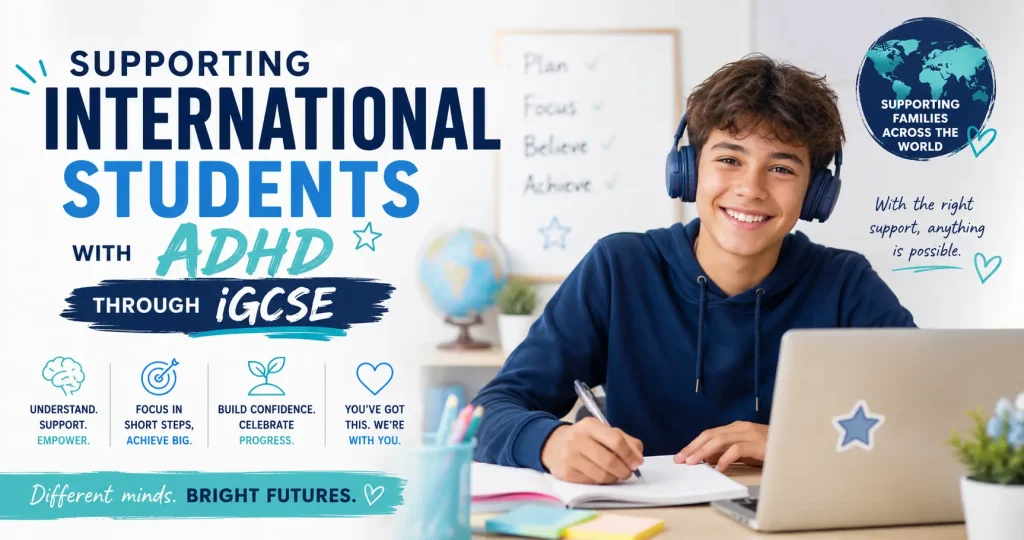
Preparing for iGCSE English can feel like a daunting prospect for many families, but for children with ADHD, it can sometimes feel even more overwhelming.
The good news is that ADHD does not prevent a child from succeeding in English. Over the years, I have worked with many learners who have ADHD, both in the UK and internationally, and one thing has become abundantly clear: when teaching is adapted to suit the individual child, remarkable progress is possible.
As someone who wasn’t diagnosed with ADHD until adulthood, I also understand first-hand that ADHD is incredibly varied. There is no such thing as a “typical” ADHD learner. Some children are constantly on the move, whilst others quietly disappear into their own thoughts. Some love reading but struggle to organise their ideas on paper. Others have brilliant imaginations but find it difficult to sustain attention during longer writing tasks. This diversity is something I have written about previously, and it remains one of the most important lessons I’ve learnt both personally and professionally.
When parents ask me how to prepare a child with ADHD for iGCSE English, my answer is always the same.
Start by understanding the child before worrying about the qualification.
Why iGCSE English Can Feel So Challenging
iGCSE English requires a wide range of skills.
Students need to read lengthy passages, identify subtle language techniques, infer meaning, organise their ideas logically and write extended responses under timed conditions.
For many children with ADHD, none of these tasks are impossible, but completing several of them at the same time can place a significant demand on working memory and executive functioning.
The challenge is rarely a lack of intelligence.
More often, it is managing attention, organising thoughts and maintaining concentration throughout longer tasks.
Fortunately, these are skills that can be developed with the right support.
Every ADHD Learner Is Different
One of the biggest misconceptions surrounding ADHD is that every child experiences it in the same way.
Nothing could be further from the truth.
Some learners appear highly energetic and impulsive. Others are thoughtful, quiet and easily distracted. Some can concentrate intensely on topics they enjoy yet struggle to begin tasks they find less engaging.
Looking back at my own education, I now recognise many of these differences in myself. Although I achieved well academically, my ADHD presented in ways that often went unnoticed because I loved learning and worked incredibly hard to mask many of my difficulties. That experience has shaped the way I teach today, reminding me that appearances rarely tell the whole story.
This understanding allows me to tailor lessons around the child sitting in front of me rather than relying on assumptions about ADHD.
A Student in the UAE: ADHD, Dyslexia and Growing Confidence
One student I supported in the UAE was studying iGCSE English whilst managing both ADHD and dyslexia.
Initially, English felt exhausting.
Long reading passages seemed overwhelming and organising ideas into extended written responses often caused frustration. Reading, processing information and planning an answer all at once placed considerable demands on working memory.
Rather than diving straight into full examination questions, we slowed everything down.
We broke texts into manageable sections, discussed ideas verbally before writing and used colour-coding to identify key language features and structural techniques. Together, we created simple plans before expanding them into paragraphs, allowing each stage of the writing process to feel achievable rather than overwhelming.
Gradually, confidence replaced anxiety.
Instead of worrying about completing an entire examination paper perfectly, each lesson became an opportunity to master one small skill at a time. Those small successes gradually built into something much bigger, and English became a subject that felt manageable rather than intimidating.
Learning Across the World: Supporting a Student in New Zealand
Another memorable learner lived in New Zealand.
Although separated by thousands of miles, many of the challenges were remarkably familiar.
This student had wonderful ideas and contributed brilliantly during discussions, yet turning those thoughts into structured written responses often felt much harder.
Like many learners with ADHD, attention fluctuated depending on the activity. When lessons became interactive, conversation-based and engaging, concentration improved dramatically.
We spent time discussing texts before writing, explored vocabulary through conversation and developed planning strategies that reduced the pressure of staring at a blank page.
Slowly, confidence grew.
It reinforced something I see repeatedly in my work with international learners: geography may change, but the importance of understanding how an ADHD brain learns remains exactly the same.
The Best Preparation Starts Long Before Year 10
One misconception I often hear is that preparation for iGCSE English begins shortly before the examinations.
In reality, many of the skills are developed years earlier.
I currently work with several children in late primary school who have ADHD and are already building the foundations that will eventually support GCSE success.
Reading regularly, discussing books, expanding vocabulary, developing inference skills and gradually increasing writing stamina all contribute to future success.
Perhaps most importantly, these younger learners are developing confidence.
Confidence is often overlooked in education, yet it has a profound impact on learning. Children who believe they can succeed are far more willing to attempt challenging tasks, ask questions and persevere when work becomes difficult.
By introducing these skills gradually throughout primary school, the transition into secondary education often feels far less daunting.
Practical Ways to Support Children with ADHD
Parents frequently ask what they can do at home.
In my experience, small changes often have the greatest impact.
Break longer tasks into smaller, manageable sections rather than expecting a child to complete everything at once.
Encourage discussion before writing so ideas become organised verbally before they reach the page.
Use visual planning methods such as mind maps or colour coding.
Allow regular movement breaks during study sessions.
Celebrate progress, effort and resilience just as much as examination results.
Most importantly, remember that learning is not a race.
Every child develops at their own pace.
Success Looks Different for Every Child
Over the years, I have worked with learners following the British Curriculum in countries including the UAE, Saudi Arabia and New Zealand, and one thing remains constant wherever children live.
Success begins with understanding.
Children with ADHD rarely need lower expectations.
Instead, they benefit from flexible teaching, patient encouragement and strategies that work alongside the way their brains naturally learn.
Whether a learner is taking their first steps towards analytical writing in late primary school or preparing for iGCSE English examinations overseas, the goal remains exactly the same: helping them become confident, capable and independent learners.
When children feel understood rather than judged, remarkable things can happen.
Here at Bedford Tutor, we have supported children with ADHD in the UK and around the world for many years, including learners preparing for iGCSE English and children developing the early literacy skills that form the foundations for future success. Alongside supporting students with dyslexia, dyscalculia and autism, we have developed a flexible, personalised approach that helps neurodivergent learners build confidence whilst developing the reading, writing and analytical skills they need to thrive.
To find out more, please click on the relevant link below:
Home education can be an incredibly rewarding way of learning.
It can give children the freedom to explore subjects in greater depth, learn at their own pace and spend more time developing the things they are genuinely interested in. For some families, it provides an opportunity to create an education that fits around the child rather than expecting the child to fit into a traditional school environment.
But I also know that home education can leave parents with plenty of questions.
Are we covering enough?
Is my child making the progress they should be?
How do I make sure they develop the English and maths skills they need?
And perhaps one of the biggest questions of all: how do I make learning work for my particular child?
Having supported home-educated children for many years, these are questions I understand very well. I have worked with learners studying a wide variety of subjects and following the British Curriculum, as well as children following other educational programmes around the world.
And one thing I have learnt repeatedly is that there is no single way to make home education work.
The child has to come first.
Home education doesn’t have to look like school
One of the things I love most about working with home-educated students is the freedom.
Learning doesn’t necessarily have to mean sitting at a desk completing worksheet after worksheet. In fact, some children become far more engaged when we take an idea from their own interests and use it as a starting point for learning.
A child who loves animals might explore descriptive writing through an imaginary wildlife documentary.
A student fascinated by football might develop mathematical skills through statistics, averages, percentages and graphs.
A child interested in history might discover that their passion provides a wonderful starting point for reading comprehension, vocabulary, research and extended writing.
Someone who loves gaming might develop problem-solving and logical thinking through mathematics, while also using their interests as inspiration for creative writing.
The curriculum still matters. Children need to develop important knowledge and skills. But the route we take to get there can be much more flexible.
Over the years, I have found that when children are genuinely interested in what they are learning, they often become far more willing to tackle the things they previously found difficult.
For more than fourteen years, I have supported children and young people with a wide range of educational needs, abilities and learning styles. My experience includes working with learners with ADHD, dyslexia, dyscalculia and autism, as well as children experiencing executive functioning difficulties, low confidence and anxiety around learning.
I am very proud to describe myself as a SEND-experienced tutor.
This isn’t simply because I have experience working with children who have additional needs. It is because understanding the individual learner is at the heart of the way I teach.
I am also neurodivergent myself.
I wasn’t diagnosed with ADHD until I was 31, and looking back at my own education, I can now see many things very differently. I loved learning and was academically capable, but there were aspects of education which were much harder for me than they appeared from the outside.
My own experience has made me particularly aware of how easily children can be misunderstood.
ADHD does not look the same in every person. Dyslexia does not affect every learner in exactly the same way. Autistic children are not all going to benefit from identical approaches. And a child with dyscalculia may have a completely different experience of mathematics from another child.
There is no single “SEND learner”.
My own ADHD journey taught me that very clearly. As I have written previously, my ADHD is not your ADHD and your ADHD is not mine. We all experience neurodivergence differently.
That philosophy is incredibly important in my tutoring.
I don’t want to see a diagnosis and immediately decide how a child should be taught.
I want to get to know the child.
A teenager I have supported for many years
One of the most rewarding parts of tutoring is seeing how a child develops over time.
I have been tutoring one particular teenager for a number of years, and it has been wonderful to watch her educational journey develop and change as she has grown.
I think this is a lovely example of why personalised tuition can be so valuable.
Education isn’t always about following a predetermined route simply because that is what everyone else is doing.
Sometimes we need to step back and ask:
What does this young person actually need now?
For this student, Functional Skills provides an important opportunity to develop practical English and maths skills which are relevant to her future. Because I have worked with her for so long, I understand her strengths, the areas she finds more difficult and the approaches which help her engage.
That relationship matters.
Good tuition isn’t simply about knowing the curriculum.
It is about knowing the learner.
Building the British Curriculum around the child
For families choosing home education, the British Curriculum can provide a useful framework.
It gives parents some reassurance about the knowledge and skills children are expected to develop, particularly in core subjects such as English and mathematics.
But a framework doesn’t have to become a cage.
One child may need additional time to develop reading comprehension. Another may need to revisit mathematical concepts several times before they become secure.
A dyslexic learner may benefit from multi-sensory approaches to reading, spelling and writing.
A child with dyscalculia may need practical and visual ways of understanding number.
An ADHD learner might benefit from shorter activities, movement, variety and clear structure.
An autistic learner may need predictable routines and carefully considered communication.
None of these things mean that a child is incapable of following the British Curriculum.
They simply mean that they may need a different route through it.
This is one of the greatest advantages of personalised home education.
English and maths are about much more than worksheets
English and maths are often the subjects parents feel most concerned about when they begin home educating.
With English, we might work on reading, comprehension, spelling, vocabulary, grammar, punctuation, creative writing or communication.
With maths, we might focus on number, calculation, reasoning, problem-solving, fractions, percentages or practical mathematics.
But underneath all of this is confidence.
I have seen children who are perfectly capable of learning begin to believe that they are “bad at English” or “just can’t do maths” because previous experiences have knocked their confidence.
This can be particularly painful for children with SEND.
A child who has spent years being told to concentrate harder, stop making careless mistakes or simply try harder can eventually start believing that they are the problem.
They aren’t.
Sometimes the teaching approach simply hasn’t matched the learner.
Learning through interests
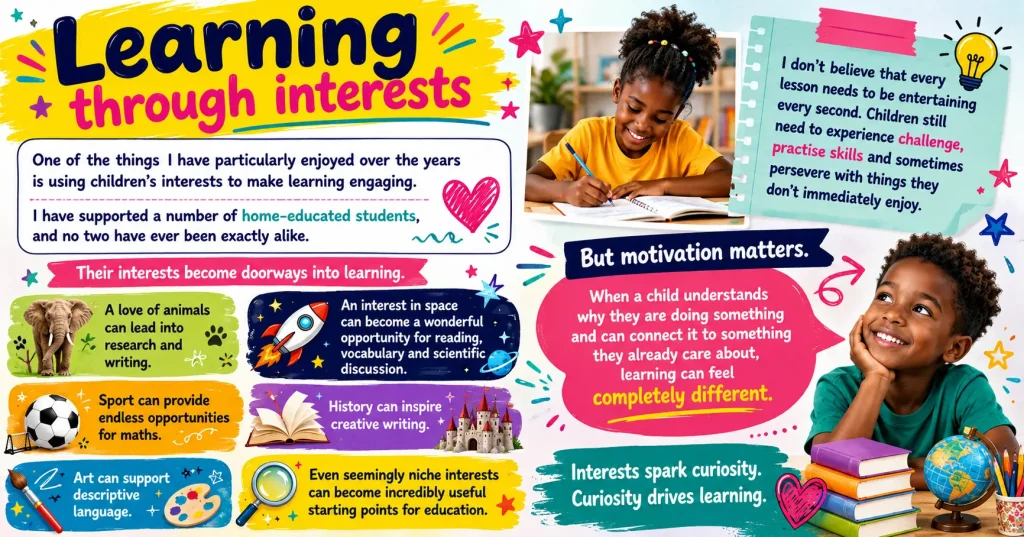
One of the things I have particularly enjoyed over the years is using children’s interests to make learning engaging.
I have supported a number of home-educated students, and no two have ever been exactly alike.
Their interests become doorways into learning.
A love of animals can lead into research and writing.
An interest in space can become a wonderful opportunity for reading, vocabulary and scientific discussion.
Sport can provide endless opportunities for maths.
History can inspire creative writing.
Art can support descriptive language.
Even seemingly niche interests can become incredibly useful starting points for education.
I don’t believe that every lesson needs to be entertaining every second. Children still need to experience challenge, practise skills and sometimes persevere with things they don’t immediately enjoy.
But motivation matters.
When a child understands why they are doing something and can connect it to something they already care about, learning can feel completely different.
Home education can be particularly valuable for SEND learners
For some families, home education provides something that traditional schooling simply hasn’t been able to offer: time.
Time to slow down.
Time to revisit something.
Time to ask another question.
Time to approach a concept differently.
Time to celebrate progress without constantly comparing a child with thirty other children in the same classroom.
This can be particularly valuable for neurodivergent learners.
Children with ADHD, dyslexia, dyscalculia and autism can sometimes spend an enormous amount of energy navigating environments that weren’t designed with their needs in mind.
Home education doesn’t automatically solve every difficulty, of course. Parents can still find themselves exhausted, uncertain or unsure about how best to support their child’s learning.
That is where specialist tuition can become a useful part of the wider home education picture.
The tutor doesn’t replace the parent.
Instead, they can provide subject expertise, structure, encouragement and a different perspective.
Looking towards September
As September approaches, I know many home-educating families will be thinking carefully about the year ahead.
For some children, that may mean continuing with the British Curriculum.
For others, it may mean strengthening English and maths, preparing for Functional Skills, developing confidence or creating a more consistent learning routine.
For children with SEND, finding the right support can be particularly important.
Perhaps your child has struggled with school and needs an education that feels calmer and more individual.
Perhaps they are academically capable but have lost confidence.
Perhaps they have ADHD and need learning to be more flexible and engaging.
Perhaps dyslexia has made reading and writing exhausting.
Perhaps maths has become a source of anxiety because of dyscalculia.
Or perhaps your child is simply wonderfully individual and you want their education to reflect that.
Whatever the reason, I believe home education should give children the opportunity to learn in a way that recognises who they are.
Not every child needs the same timetable.
Not every child needs the same resources.
And not every child will make progress in exactly the same way.
What they do need is someone who understands learning, understands SEND and is prepared to meet them where they are.
Personalised tuition that grows with the child
For me, that is what personalised tuition is really about.
It isn’t about taking a child and trying to squeeze them into a pre-existing programme.
It is about looking at the learner in front of me and asking:
Where are they now?
Where would they like to go?
And what will help them get there?
After many years of supporting home-educated learners, I have seen just how powerful this approach can be.
Sometimes progress is a qualification.
Sometimes it is finally understanding a mathematical concept that has caused difficulty for years.
Sometimes it is writing a paragraph independently.
Sometimes it is reading aloud without that familiar feeling of dread.
And sometimes it is simply a child finishing a lesson and saying:
From following the British Curriculum and developing core English and maths skills to working towards Functional Skills English and Maths, I adapt tuition around the individual learner. I also love using children’s interests as a starting point for learning, because I have seen time and time again how much more engaged children can become when education connects with something they genuinely care about.
Most importantly, I want children to finish their lessons feeling that they can learn.
If you are considering home education for September, or are already home educating and looking for specialist English, maths or SEND tuition, I would be very happy to have a conversation about your child’s individual needs.
As a tutor, one of the conversations I have most often with parents begins with the words:
“I knew something wasn’t quite right, but I never thought it might be dyslexia.”
Many families expect dyslexia to look exactly like the stereotypes we hear about—letters written backwards, an intense dislike of reading, or a child who simply cannot learn to spell. Whilst these signs can certainly occur, dyslexia is often far more subtle and varied than people realise.
Over the years, I have worked with many children whose dyslexia wasn’t identified until much later because the signs were quietly hiding in plain sight. Some were bright, articulate and imaginative children who had developed wonderful coping strategies. Others worked incredibly hard to keep up with their peers, leaving adults unaware of the effort involved.
Much like other forms of neurodiversity, every child’s experience is unique, and recognising the less obvious signs can make a tremendous difference to confidence and wellbeing.
“They’re So Clever—It Can’t Be Dyslexia”
One of the biggest misconceptions about dyslexia is that it reflects intelligence.
In reality, many dyslexic children are exceptionally creative, curious and thoughtful learners. They may excel in discussions, ask insightful questions and possess impressive general knowledge, yet still struggle to read, spell or write at the level people expect.
Because they appear academically capable in other areas, difficulties with literacy are sometimes dismissed as carelessness or a lack of effort.
I often tell parents that intelligence and dyslexia are not opposites. In fact, many dyslexic learners are remarkable problem-solvers who simply process language differently.
Difficulty Remembering Sequences
Parents frequently notice that their child struggles to remember everyday sequences long before reading difficulties become obvious.
You might notice problems with:
Remembering days of the week.
Learning multiplication tables.
Following multi-step instructions.
Recalling the alphabet in order.
Telling left from right.
I still meet children who can explain a complex scientific concept but become completely tangled when asked to remember three instructions in succession.
These difficulties are often linked to working memory and language processing rather than a lack of understanding.
Avoiding Reading Without Complaining About It
Not every child says, “I hate reading.”
Some simply avoid it in subtle ways.
They might suddenly need a drink, remember another task, become unusually tired or ask someone else to read aloud. Others choose books far below their age level because they provide comfort and success rather than frustration.
Parents sometimes assume their child simply isn’t interested in books, when in reality they are protecting themselves from feelings of failure.
Strong Verbal Skills but Weak Written Work
This is one of the most commonly overlooked signs.
A child may explain an idea beautifully in conversation but struggle to transfer those thoughts onto paper. Their vocabulary might be advanced, yet their writing appears much younger than expected.
I’ve taught many learners who can tell wonderfully imaginative stories aloud but freeze when faced with a blank page. The challenge isn’t creativity or intelligence—it’s bridging the gap between thinking and recording ideas.
Unusual Spelling Patterns
All children make spelling mistakes, but dyslexic learners often produce errors that seem inconsistent.
A word might be spelled correctly on one page and completely differently on the next. They may know the rule one day and forget it the following week.
This inconsistency can be confusing for parents.
The important thing to remember is that dyslexia isn’t about laziness or not paying attention. Many children are working twice as hard as their peers simply to achieve the same outcome.
Low Confidence Hidden Behind Humour
Some children become class clowns.
Others insist they “don’t care” about schoolwork.
Some avoid trying altogether because not trying feels safer than trying and failing.
What looks like a behavioural issue can sometimes be a child protecting their self-esteem.
One of the most heartbreaking things I hear is, “I’m stupid.”
Dyslexic children often know they are finding something harder than their friends, even when adults haven’t recognised the reason yet. Early support and reassurance can make an enormous difference to how they view themselves as learners.
Trust Your Instincts
Parents are usually the first people to notice when something feels different.
If your child is bright, imaginative and curious but seems to struggle disproportionately with reading, spelling, writing or remembering sequences, it may be worth exploring whether dyslexia could be a factor.
The earlier children receive understanding and appropriate support, the sooner they can develop strategies that play to their strengths.
Most importantly, dyslexia is not something to be feared.
Some of the most creative, innovative and successful people in the world are dyslexic. The goal is never to change who a child is, but to help them understand how their unique brain learns best. This strengths-based approach is central to the support we provide at Bedford Tutor and underpins everything from our multi-sensory literacy work to our confidence-building sessions with neurodivergent learners.
Finding the right online tutor for a child with ADHD is about far more than finding someone who knows their English or maths curriculum.
Of course, subject knowledge matters. Experience matters too. But, in my experience, the most important question is whether the tutor understands how that particular child learns.
ADHD does not look the same in every person. I know this personally. I was not diagnosed with ADHD until I was 31. Because I loved learning and generally did well academically at school, nobody really questioned whether ADHD might be part of the picture. Looking back, however, I can see that I could become intensely absorbed when something captured my imagination, whilst repetitive or uninteresting tasks were much harder to sustain. I also struggled with working memory and multi-step instructions.
That experience has shaped the way I teach.
There is no such thing as a standard ADHD learner. My own experience has taught me that my ADHD is not somebody else’s ADHD, and their ADHD is not mine. What works beautifully for one child may be completely wrong for another.
So, what should parents look for when choosing an online tutor for a child with ADHD?
A tutor who makes learning interesting
For me, this is one of the biggest things.
Many ADHD learners have what we might describe as an interest-driven nervous system. When something is genuinely fascinating, attention can suddenly become incredibly powerful. When something feels repetitive, disconnected from real life or simply boring, maintaining that attention can be much harder.
This is something I recognise from my own life. As a child, I could put enormous effort into something that had grabbed me, but sustaining effort on something that did not interest me was another matter entirely.
That is why I don’t believe an ADHD-friendly lesson should simply be a worksheet followed by another worksheet.
I want lessons to have energy.
We might play a game, tackle a challenge, discuss an unusual topic, use a visual resource, solve a practical problem or suddenly take the lesson in a completely different direction because the child has become fascinated by something.
Variation and novelty can make a huge difference.
This does not mean that learning lacks structure. Quite the opposite. A good tutor can provide a strong framework whilst changing what happens inside it.
A tutor who starts with the child, not the worksheet
One of the great advantages of one-to-one online tuition is that there is no need to teach every child in exactly the same way.
I can look at the child sitting in front of me and think: What is going to make this work for them?
For one learner, that might mean movement and interactive activities. For another, it could mean visual resources. For someone else, it might mean breaking a difficult task into smaller pieces or using a practical example.
My current approach is very much strengths-based. Rather than viewing ADHD simply through the difficulties it can create, I want to understand a child’s interests, strengths, personality and ambitions too. This is consistent with the wider approach I use across my SEND tuition, where lessons are adapted to the individual learner rather than expecting the learner to fit a fixed model.
And sometimes those interests can completely transform a lesson.
When maths meets motorsport
One of my current online students is absolutely passionate about motorsports.
He doesn’t just enjoy watching motorsport. He has a genuine ambition to establish a business connected with the industry.
So why would I teach him maths using completely unrelated examples if I don’t have to?
Instead, we have explored mathematics through the things he actually cares about.
We’ve looked at costings connected with motorsport, discussed business ideas and used real-world situations to make mathematical concepts more meaningful. We’ve also designed logos and talked about what a potential business website might need.
Suddenly, maths is no longer just maths.
It is part of his future.
This is precisely why I believe interests are so powerful for ADHD learners. We are not removing the educational objective. We are changing the route we take to get there.
A lesson about percentages might become a discussion about profit margins. A problem-solving activity might involve working out costs. English could involve writing website content or thinking about how a business should communicate with customers.
The curriculum is still there. We have simply given it a reason to matter.
A tutor who understands the importance of clear steps
Interest alone is not enough.
Children with ADHD can understand a concept perfectly well and still become overwhelmed when a task contains too many steps.
This is something I recognise from my own experiences. Multi-step instructions have historically been an area of difficulty for me, and it is one of the reasons I am very conscious about how I present information to children.
If a mathematical problem requires five stages, I don’t necessarily expect a child to hold all five stages in their working memory.
Instead, we might write them down.
Step 1: What information do we have?
Step 2: What do we need to find?
Step 3: Which operation do we need?
Step 4: Complete the calculation.
Step 5: Check the answer.
Colour-coding can be incredibly useful here too.
Perhaps the important numbers are highlighted in yellow, the operation is blue and the final answer is green. For a child who finds a page visually overwhelming, suddenly there is a pathway through it.
A large problem becomes a collection of smaller, manageable jobs.
This is very much in keeping with the ADHD-friendly strategies I use: visual structure, checklists, step-by-step instructions and breaking larger tasks into smaller chunks.
A tutor who has plenty of resources – but knows when to use them
In a classroom, one of the wonderful things we have is a wealth of resources.
We don’t have to teach every child with the same book, the same worksheet or the same activity.
If I know that a child loves dinosaurs, I can find dinosaur-related material. If they love sport, we can use sport. If they are fascinated by space, animals, cars or cooking, those interests can become bridges into learning.
This is particularly valuable with ADHD because interest can be the doorway into attention.
I have seen this with a girl I work with who absolutely loves nature. Rather than trying to make every reading comprehension about an arbitrary subject, we have used wildlife and nature-based comprehensions to develop her reading.
And it works beautifully because she already wants to know the answer.
She is not simply reading because an adult has told her to read. She is reading because she wants to discover something about an animal or the natural world.
That distinction matters.
A tutor who is patient and kind
Perhaps this sounds obvious, but I think it is one of the most important qualities of all.
Children with ADHD can spend an enormous amount of time being told to concentrate, stop fidgeting, listen properly, remember things and try harder.
Eventually, repeated correction can begin to affect confidence.
I remember how important it was when teachers recognised the things I did well. The teachers I remember most warmly were not necessarily those who were the strictest. They were the ones who noticed my enthusiasm, creativity and determination.
A good tutor needs patience.
They need to be able to say, Let’s try that another way.
They need to be comfortable repeating an explanation without making a child feel silly.
They need to celebrate the small victories.
And, perhaps most importantly, they need to help a child understand that finding something difficult does not mean they are incapable.
The best online tutor sees the whole child
Ultimately, I don’t think there is one perfect formula for tutoring a child with ADHD.
Some children love structure. Others need more flexibility. Some want to talk constantly. Others need quiet. Some thrive on games and movement, whilst others become completely absorbed by a particular subject.
The tutor’s job is to notice.
My own ADHD has taught me that neurodivergence is wonderfully varied. It has also taught me that children should not have to squeeze themselves into a particular model of what a learner is supposed to look like.
For me, the best online tuition combines kindness, structure, creativity, variation and genuine interest in the child.
It is about making learning entertaining without losing the educational purpose.
It is about taking a difficult multi-step problem and turning it into manageable steps.
It is about using colour, visuals and practical examples when they help.
It is about finding the subject that makes a child’s eyes light up and then asking, How can we use this to teach?
And sometimes, that means turning maths into motorsport.
Sometimes it means turning reading into wildlife exploration.
Sometimes it means designing a business logo, discussing a webpage or working out how much something would cost.
When we start with the child, rather than simply starting with the curriculum, learning can become something very different.
Whether that means developing reading through a child’s love of wildlife, making maths relevant through a passion for motorsport, or simply finding a clearer way through a multi-step problem, I believe children learn best when they feel understood.
If you have a child attending an international school, there is a good chance you have heard the term “GL Assessment” mentioned at some point.
Perhaps your child’s school uses GL tests to monitor progress. Maybe your child is preparing for entrance assessments at an international school. Or perhaps you’ve simply heard other parents talking about GL assessments and wondered what all the fuss is about.
Over the years, I have worked with many children attending international schools and, more recently, I have been supporting a number of students who are preparing for their GL assessments. One thing I have quickly discovered is that the words “assessment” and “test” often cause far more anxiety in parents than they do in children!
The reality is that GL assessments are simply designed to measure a child’s current attainment and identify areas of strength alongside areas that may require further development. What Exactly Are GL Assessments?
GL Assessment is an organisation which produces a range of standardised tests used by schools throughout the UK and across the world.
Many international schools use GL assessments because they provide useful information about a child’s progress in areas such as:
Reading
English
Mathematics
Verbal Reasoning
Non-Verbal Reasoning
Spelling, Grammar and Punctuation
Schools can then use this information to identify strengths, monitor progress and ensure students are receiving the support they need.
Although the assessments themselves vary depending on the school and age group, they are generally designed to assess skills children have developed over time rather than knowledge they have memorised the night before.
Should Parents Be Worried About GL Assessments?
In a word: no.
As someone who has worked with many children preparing for these assessments, I have found that confidence is often far more important than cramming.
Children tend to perform best when they feel relaxed, prepared and familiar with the types of questions they may encounter.
Unfortunately, some children hear the word “test” and immediately imagine something frightening. Before they have even opened the paper, they are already worrying about whether they will get questions wrong.
I completely understand this.
When I was at school, I often worried about assessments despite genuinely enjoying learning. Looking back, I realise that confidence can have a surprisingly large impact on performance.
How Can Parents Help?
One of the best ways parents can help is by keeping learning positive.
Children learn far more effectively when they are engaged and interested in what they are doing. This is particularly true for many neurodivergent learners, including children with ADHD, dyslexia and other learning differences.
Currently, I am tutoring several students who are studying for their GL assessments and one thing I always try to do is make the learning process enjoyable.
Rather than spending entire lessons completing practice papers, we often learn through games, challenges and interactive activities.
For example, grammar and punctuation can sometimes feel dry and repetitive when taught through worksheets alone. However, when these same skills are practised through games, quizzes and creative challenges, children often become far more motivated to learn.
Not only does this help them master new topics, but it also provides valuable opportunities to revisit and consolidate previously-learnt material.
Learning should never feel like a punishment.
In my experience, children make the greatest progress when they are having fun.
What Skills Are Assessed?
Although every assessment is slightly different, many GL tests focus on the core skills children use every day in school.
Reading assessments may explore comprehension, vocabulary and inference skills.
English assessments often include grammar, punctuation and spelling.
Mathematics assessments typically focus on reasoning, problem-solving and mathematical understanding.
Some schools also use verbal and non-verbal reasoning assessments, which look at how children identify patterns, solve problems and think logically.
The good news is that these are all skills which develop gradually over time.
Preparing Without Pressure
One of the biggest misconceptions about GL assessments is that preparation needs to be intense.
In reality, steady and consistent practice is often far more effective.
Reading regularly, discussing new vocabulary, developing mathematical fluency and building confidence with grammar and punctuation can all make a significant difference.
Most importantly, children need to understand that an assessment is simply a snapshot of where they are at a particular moment in time.
It does not define their intelligence, their potential or their future success.
Final Thoughts
Having worked with children from a variety of international schools, I have seen first-hand how common GL assessments have become across the international education sector.
Whilst the assessments themselves are important, I believe confidence, curiosity and a positive attitude towards learning remain far more valuable in the long term.
When children feel supported, engaged and motivated, they are much more likely to achieve their potential both inside and outside the assessment room.
After all, the goal is not simply to achieve a high score on a test.
The goal is to help children become confident, capable learners who enjoy the process of learning itself.
Here at Bedford Tutor, I have supported many children preparing for GL Assessments in international schools overseas. Through helping students develop their reading, grammar, punctuation, vocabulary and reasoning skills, I have created engaging lessons that build confidence whilst ensuring children feel fully prepared for the challenges these assessments can bring.
Why Some Children Flourish Outside a Traditional Classroom
For many years, school has been viewed as the only “normal” way for children to learn. Classrooms, timetables, uniforms and school bells have become so familiar that it’s easy to forget education doesn’t have to look the same for every child.
Over the years, I have worked with children from a wide range of educational backgrounds, including many who are home educated. One thing has become increasingly clear to me: whilst some children absolutely thrive in a busy classroom, others truly begin to flourish when learning takes place in a different environment.
That isn’t because they are less capable.
Often, it’s because they have finally found a way of learning that suits who they are.
Every Child Learns Differently
One of the biggest lessons I have learnt as both a tutor and someone with ADHD is that no two learners are the same. We often expect children to adapt to education, when perhaps education should spend a little more time adapting to children.
Some learners enjoy the structure and social interaction of school. Others become overwhelmed by the constant noise, transitions and demands of a busy classroom.
Children with ADHD, dyslexia, dyscalculia or autism may spend so much energy simply coping with the school environment that there is very little left for learning itself.
That doesn’t mean they can’t learn.
Sometimes it simply means they need a different environment to show what they are truly capable of.
Having been diagnosed with ADHD myself as an adult, I know first-hand how varied neurodivergent experiences can be. ADHD doesn’t look the same in everyone, and the same is true of every learning difference. We need to move away from expecting children to fit a single educational mould and instead recognise the incredible diversity in how young minds develop.
The Freedom to Learn at the Right Pace
One of the greatest advantages of home education is flexibility.
There is no pressure to keep up with thirty other children or rush through a topic before a lesson ends.
If a child finds fractions difficult, they can spend extra time building confidence before moving on. If they develop a sudden fascination with volcanoes, Ancient Egypt or space, those interests can become opportunities to strengthen reading, writing, mathematics and research skills.
Learning becomes something children actively participate in rather than something that simply happens to them.
I’ve seen children who once dreaded English begin writing imaginative stories because they were finally exploring topics they genuinely cared about. Equally, reluctant mathematicians often become enthusiastic problem-solvers when learning feels practical, engaging and relevant.
Confidence Often Comes Before Progress
Many children who move into home education have experienced setbacks in school.
Perhaps they’ve struggled with anxiety, bullying, unmet SEND needs or simply felt that they never quite fitted in.
Over time, repeated difficulties can begin to affect confidence far more than academic ability.
One of the first things I notice when working with home-educated learners is how quickly confidence can begin to return when pressure is reduced.
Without the fear of getting answers wrong in front of classmates, many children become more willing to ask questions, experiment and make mistakes.
Ironically, it is often when children stop worrying about learning that they begin learning most effectively.
Personalised Learning Makes a Difference
One-to-one tuition allows every lesson to be shaped around the individual child.
Some learners benefit from movement breaks every fifteen minutes. Others enjoy visual resources, games or discussion-based activities. Some prefer quiet routines, whilst others love creative projects that bring learning to life.
There isn’t one correct approach.
There is simply the approach that works best for that particular child.
Over the years, I’ve supported home-educated learners across the UK and internationally, including families in the UAE, Saudi Arabia, Singapore, Malaysia and Thailand. Although every family’s reasons for choosing home education are different, they often share one common goal: providing an education that genuinely meets their child’s needs.
Flourishing Looks Different for Every Child
Success isn’t always measured by test scores alone.
Sometimes success is the child who finally enjoys reading.
Sometimes it’s the anxious learner who volunteers an answer without fear.
Sometimes it’s the child who believes, perhaps for the first time in years, that they really are clever.
As tutors, teachers and parents, it can be tempting to compare children with one another.
In reality, each learner follows their own path.
Some children thrive in large classrooms. Others blossom in smaller, calmer environments where learning can move at their pace.
Neither path is better.
They’re simply different.
Final Thoughts
Traditional classrooms work brilliantly for many children, and for those learners they provide wonderful opportunities to grow academically and socially.
However, it’s equally important to recognise that there is no single definition of educational success.
For some children, particularly those who are neurodivergent, anxious or home educated, a personalised approach can unlock confidence and abilities that may have remained hidden in a more traditional setting.
When we stop asking children to fit education into one narrow shape and instead shape learning around the child, remarkable things can happen. After all, education isn’t about where a child learns.
It’s about helping them discover that they are capable of learning at all.
 Bedford, UK