One Thing Parents Should Look For In An Online Tutor

Collage of children learning online from home using laptops and tablets, illustrating engaging virtual lessons, personalised teaching and flexible online education.

When parents contact me looking for an online tutor, they often ask about qualifications, experience and academic results.

Those things are important, of course.

However, if I could recommend just one thing that parents should look for, it would be flexibility.

Not flexibility in the sense of cancelling lessons at the last minute or constantly changing plans. I mean the ability to adapt to a child’s individual circumstances, learning style and educational journey.

Over the years, I’ve worked with children from many different countries and educational backgrounds. Although every student has been unique, one thing has become very clear: children learn best when the adults supporting them are willing to adapt.

One of the greatest advantages of online tuition is that geography doesn’t really matter. From my little corner of Bedfordshire, I’ve been fortunate enough to work with children in Saudi Arabia, the UAE, Thailand and many other parts of the world. Whilst mathematics may still be mathematics and English may still be English, every child’s educational experience is slightly different.

One area where flexibility has been particularly important is school holidays.

When I first began working with international students, I quickly realised that not everyone follows the same academic calendar. Whilst children in the UK might be enjoying their summer holidays, some of my students overseas are preparing to return to school. Equally, there have been times when UK schools have been in full swing whilst students in Saudi Arabia or the UAE have been enjoying a well-earned break.

Rather than seeing this as a challenge, I’ve always viewed it as an opportunity.

The quieter periods often allow us to focus on confidence-building, revisit areas of learning that need strengthening or simply learn at a pace that isn’t always possible during a busy school term. Some of my most productive lessons have taken place when a child has been on holiday and finally had the mental space to breathe, reflect and enjoy learning again.

Flexibility is equally important when it comes to different curricula.

Not every child follows the British Curriculum. Over the years, I’ve supported students studying within British international schools, American curricula and a variety of international programmes. I’ve worked with children in Saudi Arabia preparing for assessments that look quite different from those taken by students in Bedford. I’ve taught learners in the UAE whose schools approach mathematics in a slightly different way. I’ve also worked with students in Thailand whose educational experiences have been shaped by an entirely different cultural and academic environment.

At first glance, these differences might seem significant.

In reality, good teaching is often about identifying the skills which sit beneath the curriculum. Whether a child is learning persuasive writing in Dubai, developing reading comprehension skills in Riyadh or strengthening mathematical reasoning in Bangkok, the core goal remains the same: helping them become confident, capable learners.

This is where flexibility becomes so valuable.

A tutor who rigidly follows one method or one curriculum may struggle when working with international learners. A flexible tutor, however, can adapt resources, explanations and teaching approaches to suit the child sitting in front of them.

As someone with ADHD, I think this is one of the reasons I value flexibility so highly. My own brain has never enjoyed being squeezed into neat little boxes. Looking back, the teachers who helped me most were rarely the ones who insisted there was only one way to do something. They were the people who recognised that different minds often need different routes to reach the same destination.

The same principle applies to tutoring.

Qualifications matter. Experience matters. Subject knowledge matters.

But if I were choosing an online tutor for a child, I would look for someone who is willing to adapt, willing to listen and willing to see the individual behind the curriculum.

Because when a tutor is flexible enough to meet a child where they are, learning often becomes far more successful than anyone imagined possible.

​​If you’re considering online tuition, our worldwide lessons offer one-to-one support for children aged 5 to 16 in an engaging, inspiring and encouraging learning environment. Each lesson is tailored to your child’s needs, helping them develop confidence, build key skills, and achieve their potential from the comfort of your home. 

​To find out more, please click on the link below:

Bel 😊



Related Posts

Related Blog Posts

  • Dyscalculia vs Maths Anxiety: Understanding the Difference

    Many parents contact me because their child is struggling with maths, but one of the first questions I often find myself asking is this:

    “Is this dyscalculia, maths anxiety, or perhaps a combination of both?”

    Whilst the two can sometimes look very similar on the surface, they are not the same thing. Understanding the difference can be incredibly important when it comes to providing the right support.

    When Maths Feels Frightening

    Over the years, I have worked with many children who experience significant maths anxiety.

    In some cases, the anxiety is so strong that it creates an immediate physical response. I have seen children freeze completely when presented with a mathematical problem. Some stare silently at the page. Others become visibly distressed. A few will immediately tell me they “can’t do maths” before they have even attempted the question.

    What’s particularly striking is that many of these children are perfectly capable mathematicians.

    The difficulty is not always the maths itself. Often, it is the fear associated with it.

    After experiencing repeated struggles, misunderstandings or feelings of failure, some children begin to view every maths question as a threat. Their brain switches into panic mode and accessing the skills they already possess becomes incredibly difficult.

    It is a little like asking somebody to perform a speech whilst standing in front of hundreds of people when they are terrified of public speaking. The knowledge may still be there, but anxiety makes it much harder to access.

    What Is Dyscalculia?

    Dyscalculia is a specific learning difficulty that affects a person’s ability to understand and work with numbers.

    Whilst every learner is different, children with dyscalculia may experience difficulties with:

    • Understanding number relationships
    • Remembering basic number facts
    • Estimating quantities
    • Learning times tables
    • Understanding place value
    • Sequencing mathematical processes
    • Telling the time
    • Understanding money

    Unlike maths anxiety, these difficulties are not simply caused by nervousness or low confidence.

    Even when a child feels calm and supported, the underlying challenges with numerical understanding may still be present.

    As someone who specialises in supporting learners with dyscalculia, I know that traditional teaching approaches are not always effective. Many children need concepts to be presented in very different ways before they truly begin to make sense.

    Why The Two Are Often Confused

    One of the reasons dyscalculia and maths anxiety are so frequently confused is because they often exist together.

    Imagine spending years finding maths harder than your peers.

    Perhaps you struggle to remember number facts. Maybe concepts seem to disappear as quickly as they are learnt. Over time, it is entirely understandable that confidence begins to suffer.

    Eventually, maths anxiety can develop alongside dyscalculia.

    Similarly, a child without dyscalculia may develop severe maths anxiety after negative educational experiences.

    This is why careful observation and personalised support are so important.

    Every child has their own unique learning profile. Just as no two children experience ADHD in exactly the same way, no two learners experience maths difficulties in exactly the same way either.

    The Importance of Visual and Tactile Learning

    One thing that has become very clear throughout my years of teaching is that abstract explanations rarely help struggling mathematicians.

    Whether I am supporting a child with diagnosed dyscalculia, maths anxiety, ADHD, autism or simply low confidence, I almost always begin with strong visual examples.

    Children need to see mathematics.

    They need opportunities to explore concepts using diagrams, visual models, number lines, counters, cubes, clocks, money, measuring equipment and other practical resources whenever available.

    When learning becomes visible and tangible, abstract ideas often become much easier to understand.

    A fraction suddenly makes sense when a child can physically divide something into equal parts.

    Place value becomes clearer when numbers can be built and manipulated.

    Time becomes less mysterious when learners can physically move the hands on a clock.

    At Bedford Tutor, many of the multi-sensory techniques we use with dyscalculic learners are beneficial for all maths students. In fact, some of the most significant breakthroughs I see occur when children move away from simply looking at numbers on a page and start interacting with mathematical concepts in a hands-on way. This personalised, engaging approach is central to how we support learners.

    Never Underestimate the Power of Fun

    If there is one thing I have learnt from teaching hundreds of children, it is that learning and enjoyment should never be viewed as opposites.

    In fact, they often work best together.

    Humour can completely transform a lesson.

    A child who arrives feeling anxious can often relax after a shared laugh. A game can make repetitive practice feel far less intimidating. A silly story can help a difficult concept stick in the memory far more effectively than a worksheet.

    Many children are genuinely surprised when they discover that maths lessons can be enjoyable.

    When confidence begins to grow, something remarkable often happens. Children stop focusing on what they might get wrong and start becoming curious about what they might learn.

    That shift in mindset can be incredibly powerful.

    Final Thoughts

    Whether a child has dyscalculia, maths anxiety or a combination of both, the most important thing is that they feel understood.

    Labels can be useful because they help us understand a learner’s needs, but effective support always begins with the individual child sitting in front of us.

    When we combine patience, visual learning, practical resources, humour and encouragement, mathematics often becomes far less frightening and far more accessible.

    Sometimes the biggest breakthrough isn’t learning a new mathematical concept.

    Sometimes it’s hearing a child say, for the very first time:

    “Actually… I think I can do this.”

    Here at Bedford Tutor, I have supported many children with dyscalculia, maths anxiety and confidence difficulties both in the UK and internationally. Through using visual teaching methods, multi-sensory resources and plenty of humour, I help learners develop a more positive relationship with mathematics whilst building the skills and confidence they need to succeed. Whether a child is home educated, attending school in Bedfordshire, or studying overseas in the UAE, Singapore, Malaysia or Thailand, my goal is always the same: helping them discover that maths can be accessible, enjoyable and achievable.

    To find out more, please click on the relevant link below:

    Bel 😊


    Related Posts

  • Morphology for Dyslexia: Powerful Ways to Improve Spelling

    When most people think about improving spelling, they imagine practising word lists over and over again.

    For many children, particularly those with dyslexia, that approach can quickly become repetitive, frustrating and, ultimately, ineffective.

    Over the years, I’ve found that one of the best ways to help children become more confident spellers is to help them understand why words are built the way they are. Rather than relying solely on memorisation, we explore the building blocks of language itself.

    This is where morphology becomes such a powerful learning tool.

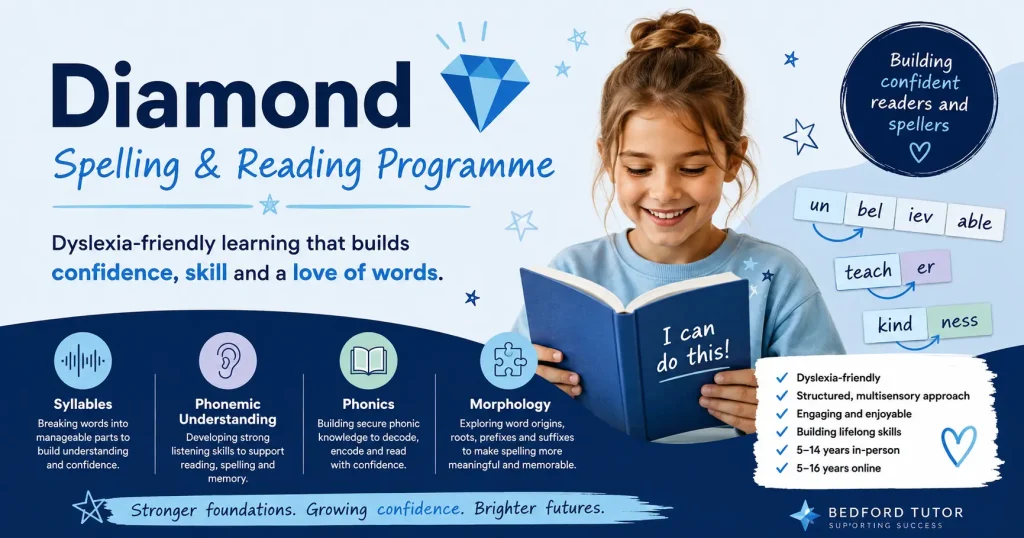
    Although we’ve been incorporating elements of morphology into our tuition for many years through our Diamond Spelling & Reading Programme, from September we’ll be expanding this aspect of our lessons even further, giving children even more opportunities to discover the fascinating stories hidden inside words.

    What Is Morphology?

    Morphology is simply the study of the parts that make up words.

    Many English words are built from prefixes, suffixes and root words. Once children begin to recognise these patterns, spelling starts to feel far less random.

    Instead of seeing a long, unfamiliar word as one enormous challenge, they begin to spot familiar pieces they already know.

    For example, understanding that helpful, careful and playful all share the suffix -ful helps children make connections between words rather than learning each one in isolation.

    Likewise, recognising prefixes such as un-, re- or dis- allows children to decode and spell new vocabulary with much greater confidence.

    Rather than memorising hundreds of individual spellings, they start recognising the patterns that link them together.

    Why Morphology Can Be Particularly Helpful for Dyslexic Learners

    Many children with dyslexia are excellent pattern spotters.

    Once they begin recognising how words fit together, spelling often becomes much more logical and far less overwhelming.

    Instead of asking, “How do I remember this word?”, they begin asking, “What parts can I already recognise?”

    That small shift in thinking can make a remarkable difference.

    Morphology also supports vocabulary development and reading comprehension. As children learn what different roots and affixes mean, they often find it much easier to work out the meanings of unfamiliar words when reading independently.

    It’s another example of one skill supporting several areas of literacy at once.

    Making Spelling Memorable Through Creativity

    One thing I’ve learnt over the years is that children rarely remember something simply because they’ve copied it twenty times.

    They remember experiences.

    That’s why creativity plays such an important role in my lessons.

    If we’re learning a new root word, we might draw it as a cartoon character. If we’re exploring a prefix, we may invent a silly story explaining where it came from. Sometimes we’ll create ridiculous sentences that make everyone laugh, because humour has a wonderful way of helping information stick in our memories.

    Drawing, storytelling and imaginative activities transform spelling from something children have to do into something they actually enjoy.

    Many neurodivergent learners are highly visual thinkers, and creating funny images or memorable stories often helps words stay in long-term memory far more effectively than repetition alone.

    The more senses involved in learning, the more opportunities the brain has to create lasting connections.

    Learning Should Be Fun

    This has always been one of my guiding principles.

    Children learn best when they are engaged.

    Over the years, we’ve used games, visual resources, discussion, word-building activities and creative challenges to help children understand how English works. Morphology has quietly been part of that process for a long time, even if we haven’t always labelled it as such.

    From September, however, we’ll be placing an even greater emphasis on exploring word families, roots, prefixes and suffixes in a structured but highly creative way.

    The aim isn’t simply to improve spelling accuracy.

    It’s to help children become curious about language.

    When children begin asking questions like, “Why does that word end like that?” or “Where did this word come from?”, they’re no longer just memorising spellings. They’re becoming language detectives.

    Looking Ahead to September

    One student I’m particularly excited to continue working with is a wonderful young learner I tutor online in Dubai, UAE.

    We’ve already made fantastic progress in developing confidence with reading and spelling, and from September we’ll be exploring morphology in much greater depth together. I can’t wait to see the connections they begin making as they discover how words are built and how those patterns can make spelling both easier and far more enjoyable.

    Watching those moments of understanding is one of the greatest pleasures of teaching.

    Suddenly, words that once seemed impossible begin to make sense.

    Confidence grows.

    And perhaps most importantly of all, children begin to realise that spelling isn’t simply about remembering random letters. It’s about understanding a wonderfully interconnected language that is full of patterns, history and fascinating discoveries waiting to be explored.

    Wondering How We Can Help?

    Whether you’re exploring tuition options, looking for specialist support or simply have a question, we’d love to hear from you. Tell us a little about your child and what you’re looking for, and we’ll be in touch as soon as possible.


    Current Availability

    Super Summer Learning (August): Good availability throughout the holiday

    Weekday daytime tuition (from September): Good availability for international students, home-educated learners and families with flexible schedules

    🗓️ After-school, Saturday & Sunday morning tuition (from September): Waiting list currently in operation


    Please include Area Code if Outside UK

    Related Posts

  • Choosing an Online Tutor for British Curriculum Children Abroad

    When families move overseas, one of the biggest priorities is ensuring their children continue to receive a high-quality education. Whether you’re living in the UAE, Saudi Arabia, Singapore, Malaysia, Thailand or elsewhere, international schools offer wonderful opportunities, but they can also present unique academic challenges.

    Over the years, I have worked with many children following the British Curriculum whilst living abroad, and one thing has become increasingly clear: choosing the right online tutor is about far more than finding someone who knows the curriculum.

    It’s about finding someone who understands your child.

    Why Families Living Abroad Often Seek Additional Support

    Moving overseas is exciting, but it also brings change.

    Children may be adapting to a new country, making new friends, learning alongside classmates from many different cultures and settling into an unfamiliar school environment. Even confident learners can take time to adjust.

    Some children need support because they’ve missed parts of the curriculum during an international move. Others simply benefit from having one consistent adult outside school who understands both the British education system and the realities of international life.

    I’ve often found that parents contact me not because their child is struggling, but because they want to build confidence before small gaps become larger ones.

    Experience with the British Curriculum Matters

    A tutor who understands the British Curriculum can provide reassurance for both parents and children.

    From Key Stage 1 through to Key Stage 4, English and maths develop in carefully planned stages. Understanding those expectations allows lessons to focus on exactly what a child needs, whether that’s strengthening phonics, improving reading comprehension, building mathematical reasoning or preparing for iGCSE English Language.

    Many international schools also use GL Assessments to monitor progress, meaning tutors who understand these assessments can provide targeted support without turning learning into endless test preparation.

    Every Child Learns Differently

    One lesson I’ve learnt after many years of tutoring is that no two children learn in quite the same way.

    Some thrive with structured explanations and routine.

    Others learn best through discussion, creativity and practical activities.

    Children with ADHD, dyslexia, dyscalculia or autism often need lessons adapted to suit the way their brains naturally process information rather than being expected to fit one teaching method.

    As someone diagnosed with ADHD myself, I understand how misleading educational stereotypes can be. ADHD looks different in every individual, and the same is true of every learner. The most effective tuition starts with understanding the child before the curriculum.

    Look Beyond Qualifications

    Qualifications certainly matter.

    Parents deserve to know their tutor has strong subject knowledge and appropriate experience.

    However, when I think back to my own education, the teachers who had the greatest impact weren’t necessarily those with the longest list of qualifications.

    They were the ones who listened.

    They noticed when confidence was slipping.

    They explained things differently when the first explanation didn’t quite make sense.

    Those qualities are just as important in online tuition.

    A tutor who builds trust will often achieve far more than one who simply delivers information.

    Flexibility Makes a Huge Difference

    One of the greatest strengths of online tuition is flexibility.

    Families living abroad often follow different school calendars from the UK. Whilst British schools may be enjoying their summer holidays, many international schools are preparing for a new academic year.

    Having a tutor who can adapt lessons around these schedules makes learning far less stressful.

    Flexibility also extends to teaching methods.

    Some children benefit from visual resources.

    Others enjoy games and interactive challenges.

    Some need additional time to process new concepts before moving on.

    The best tutors recognise that adapting to the learner is often the key to long-term success.

    Communication with Parents is Essential

    One aspect of tutoring that parents often overlook is communication.

    When families are living overseas, parents may not always have daily contact with teachers in the same way they would in the UK.

    Regular updates from a tutor can therefore become incredibly valuable.

    Knowing which areas are improving, where confidence is growing and what to continue practising at home helps everyone work together towards the same goals.

    Confidence Comes Before Progress

    One of my favourite moments as a tutor isn’t when a child achieves a high score.

    It’s when they say, “I think I can do this.”

    Confidence changes everything.

    Children begin asking more questions.

    They become willing to tackle more challenging work.

    Mistakes stop feeling frightening and become part of learning instead.

    I’ve seen this happen countless times with students across the UK and around the world. Often, academic progress follows naturally once confidence has been rebuilt.

    Questions to Ask Before Choosing an Online Tutor

    Before making your decision, consider asking:

    • Do they have experience teaching the British Curriculum?
    • Have they worked with international school students?
    • Can they support children with different learning styles or SEND?
    • How do they personalise lessons?
    • Do they communicate regularly with parents?
    • Do they focus on confidence as well as academic achievement?

    The answers will often tell you far more than a long list of qualifications.

    Final Thoughts

    Choosing an online tutor for your child whilst living abroad is an important decision.

    The right tutor should provide more than curriculum knowledge. They should understand children as individuals, adapt their teaching to suit different learning styles and help learners feel confident, supported and motivated.

    Whether your family is based in Dubai, Abu Dhabi, Riyadh, Jeddah, Kuala Lumpur, Singapore, Bangkok or elsewhere, personalised online tuition can provide valuable continuity alongside an excellent international education.

    After all, children don’t simply need someone to teach them English or maths.

    They need someone who helps them believe they can succeed.


    Related Posts


  • Primary Maths Confidence: Powerful Ways to Help Children

    Confidence and maths don’t always seem to go hand in hand.

    Over the years, I’ve met countless children who happily tackle a tricky reading comprehension but freeze the moment they see a page of calculations. Some will quietly whisper, “I’m just not good at maths,” whilst others become anxious before we’ve even looked at the first question.

    The interesting thing is that very few of these children actually lack mathematical ability.

    More often than not, what they’re lacking is confidence.

    Once children begin believing they “can’t do maths”, that belief can quickly become the biggest obstacle to their progress. Fortunately, confidence isn’t something children either have or don’t have. Like mathematical skills themselves, it can be developed with the right support, encouragement and experiences.

    Why Maths Confidence Matters

    Primary school is where children build the foundations for future mathematical learning.

    Whether they’re learning number bonds, multiplication tables, fractions or problem-solving, every new concept builds on previous knowledge. When confidence is low, children often avoid taking risks, rush through questions or give up before they’ve really started.

    I’ve found that many children who struggle in maths aren’t afraid of numbers themselves. They’re afraid of making mistakes.

    That fear can become surprisingly powerful.

    A child who worries about getting an answer wrong may stop volunteering answers in class, avoid challenging questions or rely heavily on adults for reassurance. Over time, this can create the impression that maths is simply “not their subject”, when in reality they’re capable of much more than they realise.

    Celebrate Effort, Not Just Correct Answers

    One of the most effective ways to build confidence is to praise effort rather than perfection.

    Imagine two children tackling the same problem. One gets the correct answer immediately. The other makes several mistakes but perseveres until they finally understand the method.

    Which child has learnt more?

    Quite often, it’s the second.

    Learning maths involves making mistakes. Every incorrect answer provides information about what a child understands and what still needs developing.

    When children realise mistakes are a normal part of learning rather than something to fear, they become much more willing to have a go.

    Simple comments such as:

    • “I really like how you kept trying.”
    • “You chose a good strategy.”
    • “Let’s work out together where it went wrong.”

    can have a far greater impact than simply saying, “Well done.”

    Make Maths Practical

    Young children naturally learn through doing.

    Abstract numbers on a worksheet can sometimes feel confusing, but place the same mathematical concept into a real-life situation and everything suddenly becomes much clearer.

    Cooking together provides wonderful opportunities to explore measurement, fractions and weighing.

    Shopping encourages children to estimate costs, compare prices and calculate change.

    Building with bricks develops understanding of shape, patterns and spatial reasoning.

    Even setting the table can become an opportunity to practise counting, multiplication and sharing equally.

    When maths becomes part of everyday life, children begin to see that it has purpose beyond the classroom.

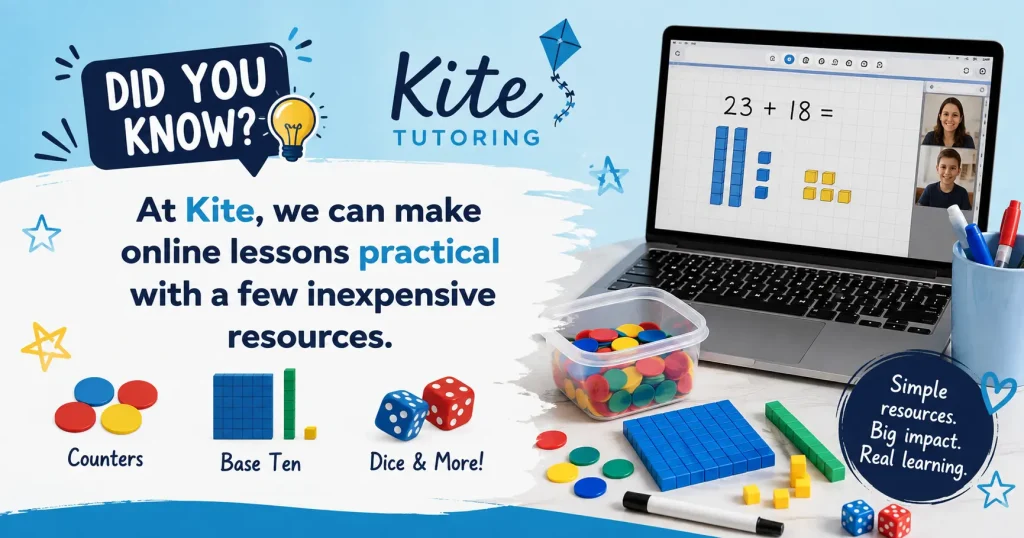
    Did You Know? promotional graphic for Kite Tutoring showing that online lessons can be practical with a few inexpensive resources. A laptop displays a maths lesson using virtual base ten blocks while physical counters, base ten equipment, dice and whiteboard pens are arranged on the desk, illustrating how simple hands-on resources support engaging online learning.

    Build Confidence Through Small Successes

    One of the biggest mistakes adults sometimes make is moving on too quickly.

    Children need opportunities to experience success.

    If every activity feels just beyond their current ability, confidence gradually begins to fade.

    Instead, try to create a series of achievable challenges.

    Perhaps today your child confidently adds two-digit numbers.

    Tomorrow they might tackle three-digit numbers with support.

    Next week they may begin solving simple word problems using the same skills.

    These small successes gradually build into genuine mathematical confidence.

    I’ve often seen children who initially describe themselves as “bad at maths” completely change their attitude after a few weeks of carefully structured learning. Nothing magical has happened. They’ve simply experienced enough success to start believing in themselves.

    Keep Learning Enjoyable

    One of my favourite ways to teach primary maths is through games.

    Children often don’t realise how much mathematical thinking they’re doing when they’re enjoying themselves.

    Card games encourage number recognition and quick mental calculations.

    Board games develop counting, strategy and logical thinking.

    Dice games build fluency with addition, subtraction and multiplication.

    Even simple treasure hunts can involve measuring distances, following coordinates or solving mathematical clues.

    When learning feels fun, children become much more willing to tackle new challenges.

    This is particularly true for many neurodivergent learners, including children with ADHD, dyscalculia and autism, who often respond brilliantly to interactive, engaging activities rather than repetitive worksheets. Creating enjoyable learning experiences has always been central to my approach because motivation and confidence often grow together.

    Encourage Mathematical Talk

    Sometimes children know far more than they realise.

    Instead of immediately asking for the answer, ask questions such as:

    • “How did you work that out?”
    • “Can you explain your thinking?”
    • “Is there another way to solve it?”
    • “How do you know your answer makes sense?”

    Talking through mathematical thinking helps children organise their ideas whilst giving adults valuable insight into any misconceptions.

    It also reinforces an important message:

    Maths isn’t just about getting the right answer.

    It’s about understanding.

    Every Child Learns Differently

    As someone who has worked with many children with ADHD, dyscalculia, dyslexia and autism, I’ve learnt that no two learners approach maths in exactly the same way.

    Some children benefit from visual models.

    Others need practical resources they can physically move.

    Some need learning broken into smaller chunks, whilst others thrive when mathematical concepts are linked to their favourite interests.

    The key is flexibility.

    Rather than expecting every child to learn through one method, we should adapt our teaching to suit the learner sitting in front of us. This personalised, strengths-based approach is something I’ve found particularly valuable when supporting children with additional learning needs.

    Confidence Lasts Longer Than Correct Answers

    One thing I often remind parents is that confidence isn’t built in a single lesson.

    It develops gradually through hundreds of positive learning experiences.

    Each encouraging conversation.

    Each problem solved.

    Each moment when a child says, “I did it!”

    Those moments matter far more than many people realise.

    After all, children who believe they can succeed are far more likely to persevere when learning becomes challenging.

    And that resilience will support them long after they’ve forgotten how to calculate fractions or complete long multiplication.


    Wondering How We Can Help?

    Whether you’re exploring tuition options, looking for specialist support or simply have a question, we’d love to hear from you. Tell us a little about your child and what you’re looking for, and we’ll be in touch as soon as possible.


    Current Availability

    Super Summer Learning (August): Good availability throughout the holiday

    Weekday daytime tuition (from September): Good availability for international students, home-educated learners and families with flexible schedules

    🗓️ After-school, Saturday & Sunday morning tuition (from September): Waiting list currently in operation


    Please include Area Code if Outside UK

    Related Posts

  • Supporting Students with ADHD Through iGCSE English

    Preparing for iGCSE English can feel like a daunting prospect for many families, but for children with ADHD, it can sometimes feel even more overwhelming.

    The good news is that ADHD does not prevent a child from succeeding in English. Over the years, I have worked with many learners who have ADHD, both in the UK and internationally, and one thing has become abundantly clear: when teaching is adapted to suit the individual child, remarkable progress is possible.

    As someone who wasn’t diagnosed with ADHD until adulthood, I also understand first-hand that ADHD is incredibly varied. There is no such thing as a “typical” ADHD learner. Some children are constantly on the move, whilst others quietly disappear into their own thoughts. Some love reading but struggle to organise their ideas on paper. Others have brilliant imaginations but find it difficult to sustain attention during longer writing tasks. This diversity is something I have written about previously, and it remains one of the most important lessons I’ve learnt both personally and professionally.

    When parents ask me how to prepare a child with ADHD for iGCSE English, my answer is always the same.

    Start by understanding the child before worrying about the qualification.

    Why iGCSE English Can Feel So Challenging

    iGCSE English requires a wide range of skills.

    Students need to read lengthy passages, identify subtle language techniques, infer meaning, organise their ideas logically and write extended responses under timed conditions.

    For many children with ADHD, none of these tasks are impossible, but completing several of them at the same time can place a significant demand on working memory and executive functioning.

    The challenge is rarely a lack of intelligence.

    More often, it is managing attention, organising thoughts and maintaining concentration throughout longer tasks.

    Fortunately, these are skills that can be developed with the right support.

    Every ADHD Learner Is Different

    One of the biggest misconceptions surrounding ADHD is that every child experiences it in the same way.

    Nothing could be further from the truth.

    Some learners appear highly energetic and impulsive. Others are thoughtful, quiet and easily distracted. Some can concentrate intensely on topics they enjoy yet struggle to begin tasks they find less engaging.

    Looking back at my own education, I now recognise many of these differences in myself. Although I achieved well academically, my ADHD presented in ways that often went unnoticed because I loved learning and worked incredibly hard to mask many of my difficulties. That experience has shaped the way I teach today, reminding me that appearances rarely tell the whole story.

    This understanding allows me to tailor lessons around the child sitting in front of me rather than relying on assumptions about ADHD.

    A Student in the UAE: ADHD, Dyslexia and Growing Confidence

    One student I supported in the UAE was studying iGCSE English whilst managing both ADHD and dyslexia.

    Initially, English felt exhausting.

    Long reading passages seemed overwhelming and organising ideas into extended written responses often caused frustration. Reading, processing information and planning an answer all at once placed considerable demands on working memory.

    Rather than diving straight into full examination questions, we slowed everything down.

    We broke texts into manageable sections, discussed ideas verbally before writing and used colour-coding to identify key language features and structural techniques. Together, we created simple plans before expanding them into paragraphs, allowing each stage of the writing process to feel achievable rather than overwhelming.

    Gradually, confidence replaced anxiety.

    Instead of worrying about completing an entire examination paper perfectly, each lesson became an opportunity to master one small skill at a time. Those small successes gradually built into something much bigger, and English became a subject that felt manageable rather than intimidating.

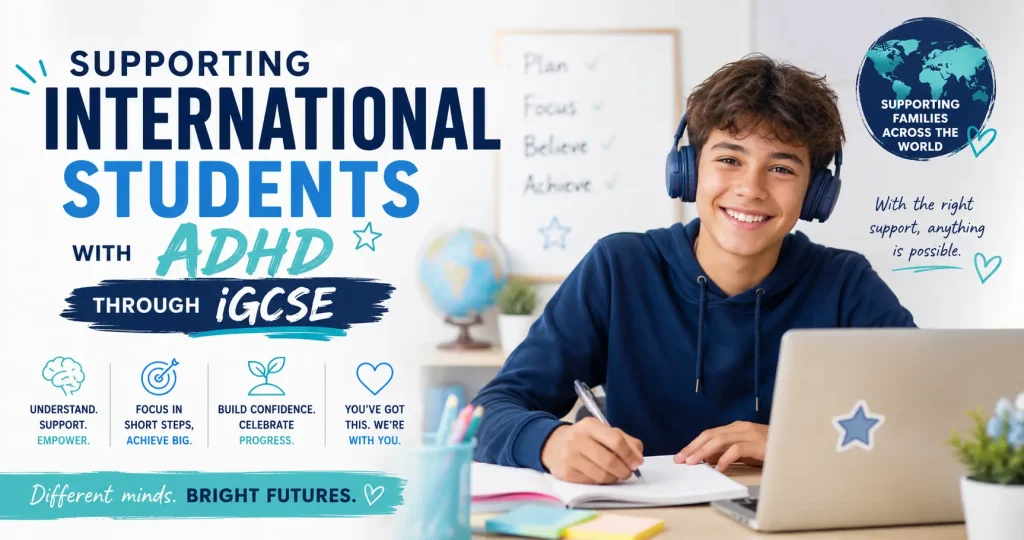
    Smiling international student with ADHD studying confidently for iGCSE exams during an online lesson, highlighting supportive, structured learning that builds confidence, focus and academic success.

    Learning Across the World: Supporting a Student in New Zealand

    Another memorable learner lived in New Zealand.

    Although separated by thousands of miles, many of the challenges were remarkably familiar.

    This student had wonderful ideas and contributed brilliantly during discussions, yet turning those thoughts into structured written responses often felt much harder.

    Like many learners with ADHD, attention fluctuated depending on the activity. When lessons became interactive, conversation-based and engaging, concentration improved dramatically.

    We spent time discussing texts before writing, explored vocabulary through conversation and developed planning strategies that reduced the pressure of staring at a blank page.

    Slowly, confidence grew.

    It reinforced something I see repeatedly in my work with international learners: geography may change, but the importance of understanding how an ADHD brain learns remains exactly the same.

    The Best Preparation Starts Long Before Year 10

    One misconception I often hear is that preparation for iGCSE English begins shortly before the examinations.

    In reality, many of the skills are developed years earlier.

    I currently work with several children in late primary school who have ADHD and are already building the foundations that will eventually support GCSE success.

    Reading regularly, discussing books, expanding vocabulary, developing inference skills and gradually increasing writing stamina all contribute to future success.

    Perhaps most importantly, these younger learners are developing confidence.

    Confidence is often overlooked in education, yet it has a profound impact on learning. Children who believe they can succeed are far more willing to attempt challenging tasks, ask questions and persevere when work becomes difficult.

    By introducing these skills gradually throughout primary school, the transition into secondary education often feels far less daunting.

    Practical Ways to Support Children with ADHD

    Parents frequently ask what they can do at home.

    In my experience, small changes often have the greatest impact.

    Break longer tasks into smaller, manageable sections rather than expecting a child to complete everything at once.

    Encourage discussion before writing so ideas become organised verbally before they reach the page.

    Use visual planning methods such as mind maps or colour coding.

    Allow regular movement breaks during study sessions.

    Celebrate progress, effort and resilience just as much as examination results.

    Most importantly, remember that learning is not a race.

    Every child develops at their own pace.

    Success Looks Different for Every Child

    Over the years, I have worked with learners following the British Curriculum in countries including the UAE, Saudi Arabia and New Zealand, and one thing remains constant wherever children live.

    Success begins with understanding.

    Children with ADHD rarely need lower expectations.

    Instead, they benefit from flexible teaching, patient encouragement and strategies that work alongside the way their brains naturally learn.

    Whether a learner is taking their first steps towards analytical writing in late primary school or preparing for iGCSE English examinations overseas, the goal remains exactly the same: helping them become confident, capable and independent learners.

    When children feel understood rather than judged, remarkable things can happen.


    Wondering How We Can Help?

    Whether you’re exploring tuition options, looking for specialist support or simply have a question, we’d love to hear from you. Tell us a little about your child and what you’re looking for, and we’ll be in touch as soon as possible.


    Current Availability

    Super Summer Learning (August): Good availability throughout the holiday

    Weekday daytime tuition (from September): Good availability for international students, home-educated learners and families with flexible schedules

    🗓️ After-school, Saturday & Sunday morning tuition (from September): Waiting list currently in operation


    Please include Area Code if Outside UK

    Related Posts

  • Reading Fluency for Dyslexic Children: Helpful Tips

    For some children with dyslexia, reading can feel like hard work.

    A page of words which looks perfectly ordinary to an adult can feel like a maze to a child who is still working out sounds, recognising familiar words and remembering what they have just read. When reading requires so much concentration, it is understandable that some children begin to avoid it altogether.

    This is why I believe building reading fluency should be about much more than simply asking a child to read more books.

    It is about helping them become familiar with words, developing confidence, creating opportunities for successful literacy and, perhaps most importantly, helping them discover that books and stories can actually be enjoyable.

    Over the years, I have supported many children with dyslexia and have found that small, everyday opportunities to practise literacy can make a surprisingly big difference.

    What is reading fluency?

    Reading fluency is the ability to read words accurately, smoothly and with increasing confidence.

    For a child with dyslexia, this can take time. They may need to work much harder than their peers to recognise words automatically, decode unfamiliar vocabulary or remember common spelling patterns.

    This does not mean they lack intelligence or understanding.

    In fact, many dyslexic learners are bright, creative and incredibly capable. The difficulty is often that the mechanics of reading can require so much mental energy that there is less capacity left for enjoying the story or thinking about what the words mean.

    This is why developing fluency gradually can be so valuable.

    Reading does not only happen with a book

    One of the things I encourage parents to remember is that literacy practice does not have to mean sitting at a table with a reading book every evening.

    There are opportunities to read everywhere.

    Think about a car journey.

    There are road signs, shop names, directions, number plates and signs on buildings. A child might spot a word they recognise and read it aloud. Perhaps they can read “STOP” on a road sign, “Tesco” outside the supermarket or a place name they have seen before.

    These little moments count.

    They allow children to practise recognising words in a natural environment without the pressure of completing a formal literacy exercise.

    Sometimes I will deliberately point out a sign and ask, “Can you read that one?” Other times, I might let the child notice it themselves.

    It is amazing how much more enjoyable literacy can become when it has a purpose.

    Short reading activities can be incredibly effective

    When a child finds reading difficult, long sessions can quickly become exhausting.

    This is particularly important to remember with dyslexic learners.

    Rather than expecting a child to read for a long period of time, I often prefer short, manageable activities. A few minutes of focused practice can be much more productive than pushing a child until they are tired and frustrated.

    Flash cards can be useful here.

    We might practise a small number of familiar words, revisit words we have encountered before or look at particular spelling patterns. The aim is not to overwhelm the child with a huge pile of cards.

    Instead, we want them to experience success.

    Perhaps they read eight words correctly today.

    Tomorrow, we might revisit those same words before introducing one or two new ones.

    Over time, words which once required considerable thought can become familiar. That growing automaticity can make literacy feel less tiring.

    Choose books because the child loves them

    One of the most important things we can do is choose books that children actually want to read.

    If a child loves dinosaurs, let them read about dinosaurs.

    If they are fascinated by football, find a football book.

    If they adore funny stories, look for something that makes them laugh.

    If they love animals, choose animal stories or fact books.

    The subject matter matters because motivation matters.

    However, there is another important consideration: the book needs to be suitable for the child’s age and reading ability.

    A child may be ten years old but have a reading age which means that some ten-year-old novels are currently too difficult. There is absolutely nothing wrong with finding a book which is easier to read while still being interesting and age-appropriate.

    We want children to feel successful, not embarrassed by the level of the book they are using.

    A book being easier does not make the experience less valuable.

    Let children read the words they can

    When I am reading with a child, I don’t want to take every word away from them.

    If they can read a word, I let them read it.

    That sounds obvious, but it is an important part of building independence.

    If a child sees a familiar word and recognises it, that is a success. We want them to notice those moments and realise, “I know this word!”

    If they come across a word they cannot read, however, they do not need to sit staring at it indefinitely.

    This is where adult support becomes incredibly valuable.

    Guided reading: supporting without taking over

    Guided reading is one of the approaches I particularly like because it gives children the opportunity to work through text independently whilst knowing that an adult is there to help.

    The child reads the words they can.

    When they reach a word they cannot decode, the adult provides an appropriate prompt or helps them work through it.

    Sometimes we might look at the sounds within the word. Sometimes we might break a longer word into syllables. Sometimes the adult simply supplies the word so that the child can continue with the sentence and maintain the meaning of the story.

    The important thing is that the child is not left struggling for so long that reading becomes miserable.

    Nor do we want an adult reading the entire book for them.

    It is a partnership.

    The child reads what they can. The adult supports what they cannot.

    That creates a lovely balance between independence and reassurance.

    Don’t forget to talk about the story

    Reading fluency is not simply about saying words quickly.

    Reading is about understanding, imagining, questioning and connecting with what is on the page.

    After a short section, we might stop and ask:

    “What do you think is going to happen?”

    “Why do you think the character did that?”

    “Which bit was your favourite?”

    “Can you find the word that tells us…?”

    These conversations allow children to engage with the meaning of the text even when decoding is still developing.

    They also remind children that reading is about much more than getting every word right.

    Confidence is part of the process

    Perhaps the most important thing I have learnt from working with dyslexic learners is that confidence can change everything.

    When a child has experienced repeated difficulty with reading, they can begin to see themselves as someone who “can’t read”.

    We need to challenge that belief gently.

    One word.

    One sentence.

    One page.

    One successful book.

    These little victories matter.

    As I have written previously, I cannot overstate the importance of helping a child recognise their own progress. Sometimes confidence grows through tiny successes which gradually begin to fill a much larger bucket.

    This is also why we try to make literacy learning active and engaging. Our dyslexia support work incorporates structured approaches alongside creativity, visual learning and hands-on activities, rather than relying solely on repetitive worksheets.

    Reading fluency is a journey, not a race

    Every child develops at a different pace.

    For a child with dyslexia, reading may take longer to become automatic, and there may be periods when progress feels frustratingly slow. That does not mean progress is not happening.

    • Keep reading visible in everyday life.
    • Read signs during car journeys.
    • Use short flash-card activities.
    • Choose books around your child’s interests.
    • Make sure the reading level is appropriate.
    • Let them read the words they know.
    • Guide them through the words they don’t.
    • Talk about the story.
    • And, above all, protect their confidence.

    We are not trying to create a child who can simply get to the end of a page as quickly as possible.

    We are trying to help create a child who looks at a page and thinks, “I can do this.”

    That is where reading fluency becomes so much more than a literacy skill. It becomes another little piece of independence, confidence and enjoyment.

    Wondering How We Can Help?

    Whether you’re exploring tuition options, looking for specialist support or simply have a question, we’d love to hear from you. Tell us a little about your child and what you’re looking for, and we’ll be in touch as soon as possible.


    Current Availability

    Super Summer Learning (August): Good availability throughout the holiday

    Weekday daytime tuition (from September): Good availability for international students, home-educated learners and families with flexible schedules

    🗓️ After-school, Saturday & Sunday morning tuition (from September): Waiting list currently in operation


    Please include Area Code if Outside UK

    Related Posts