Bedford, UK


British Curriculum vs American Curriculum: What Parents Living Abroad Should Know
One of the questions I am frequently asked by parents living overseas is whether there is a significant difference between the British and American curricula.
The short answer is yes… and no!
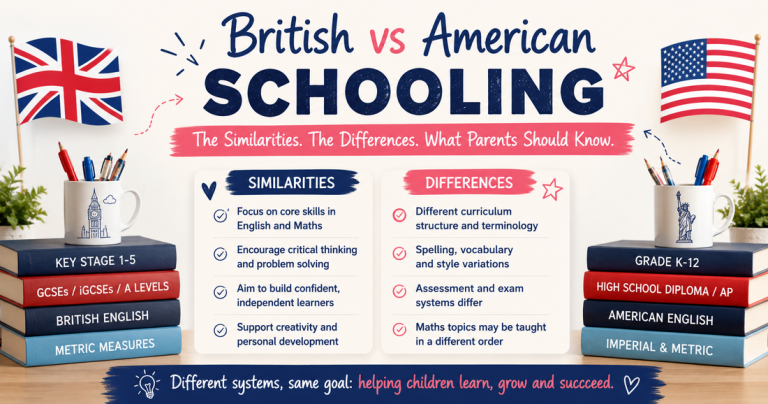
Having taught children following both educational systems for many years in countries such as the UAE and Thailand, I am often surprised by how similar they really are. Whilst there are certainly some differences in terminology, assessment and curriculum content, both ultimately aim to help children develop the same core skills: confidence in reading, competence in writing and a secure understanding of mathematics. That being said, there are some important distinctions which can occasionally catch families by surprise, particularly when children move between schools or educational systems.
One of the most obvious differences appears in English.
Although British English and American English are essentially the same language, there are some spelling variations which can occasionally cause confusion. For example, a child attending a British school may write colour, favourite and centre, whilst a child following the American curriculum will be expected to write color, favorite and center.
I often teach both British and American English and one of the first things I reassure children about is that neither version is “wrong”. The important thing is consistency. If a child is studying within an American school, they should use American spellings. If they are following the British curriculum, British spellings are usually expected.
Fortunately, children tend to adapt remarkably quickly once they understand the differences.
Over the years, I have also gained extensive experience preparing students for the GL Assessments used by many international schools. These assessments often form an important part of school entry procedures and provide valuable information about a child’s strengths and areas for development. Supporting children through these assessments has given me a strong understanding of the skills many international schools expect students to demonstrate.
Alongside this, I regularly support students studying iGCSE English Language. I particularly enjoy helping learners develop their reading, writing and analytical skills whilst building the confidence needed to tackle longer pieces of writing and examination questions.
My experience is not limited to the British curriculum, however.
I have also worked with students in countries such as Saudi Arabia who follow Common Core English and Mathematics programmes, and regularly support children studying both the British and American curricula. Over the years, working across different educational systems has taught me that successful teaching is rarely about the curriculum itself. More often, it is about understanding the child sitting in front of you and adapting your approach to suit the way they learn best.
Mathematics is perhaps where some of the most noticeable differences occur.
When I first began supporting a student studying the American mathematics curriculum over a longer period of time, I quickly realised that certain concepts were approached differently. The methods were not necessarily better or worse, but they were sometimes presented in a different order or explained using different terminology.
One area which particularly expanded my own knowledge was the use of imperial measurements.
Whilst British children are often familiar with miles and occasionally encounter other imperial units, the American curriculum tends to make much greater use of feet, inches, yards, pounds and gallons. Supporting students with these concepts helped me become far more confident teaching measurement systems which are not always covered in depth within the British curriculum.
Experiences like these have been invaluable because they have allowed me to become more adaptable as a tutor.
Perhaps the biggest lesson I have learnt is that children are often far more flexible than adults give them credit for. Whether they are learning colour or color, converting centimetres or inches, preparing for GL Assessments or studying iGCSE English Language, the underlying goal remains exactly the same: helping them become confident, capable learners.
Curricula may vary from country to country, but curiosity, confidence and a love of learning are universal.
As someone who works with children from a wide range of countries and educational backgrounds, I genuinely enjoy helping students navigate these differences and discover that, regardless of which curriculum they follow, they are capable of achieving great things.
Here at Bedford Tutor, I have supported children following both the British and American curricula for many years. From GL Assessments and iGCSE English Language to Common Core English and Mathematics, working with learners from different educational systems has helped me develop a flexible approach that allows every child to build confidence whilst developing the skills they need to succeed.
To find out more, please click on the link below:
Bel 😊