Bedford, UK



Working memory is often described as the brain’s “mental notepad”. It allows us to hold information in our minds whilst using it. Whether a child is remembering a set of instructions, solving a maths problem, following a sentence whilst reading or recalling how to spell a word, working memory is constantly at work.
For many children, particularly those with ADHD, dyslexia, dyscalculia or other special educational needs, working memory can become overloaded very quickly. This doesn’t mean they aren’t intelligent. In fact, many highly capable children have weaker working memory and simply need the right strategies to help them succeed.
One of the questions parents often ask me is whether working memory can be improved.
The answer is encouraging: whilst every child is different, working memory skills can often be strengthened through regular practice. Better still, many of the most effective activities feel like games rather than formal learning.
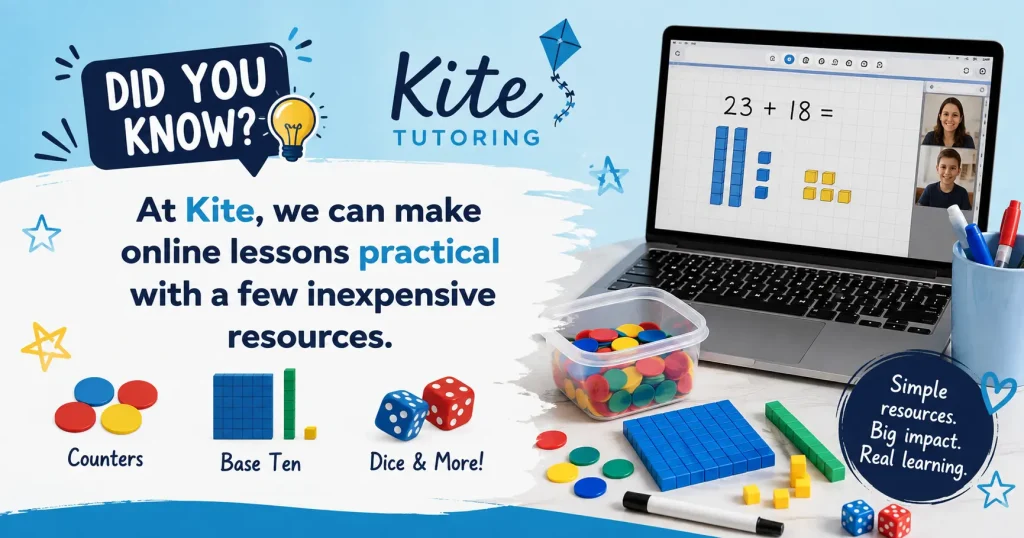
At Bedford Tutor and our online division, Kite Tutoring, we naturally build working memory activities into our lessons because children are far more likely to make progress when they’re engaged and enjoying themselves. Rather than endless worksheets, we use practical, visual and interactive activities that develop memory alongside confidence.
Why Working Memory Matters
Working memory plays a role in almost every aspect of learning.
Children use it when:
- Following multi-step instructions.
- Remembering what they’ve just read.
- Solving mathematical calculations.
- Learning spellings.
- Writing sentences whilst remembering punctuation and grammar.
- Holding information in mind whilst answering questions.
When working memory is under pressure, children may forget what they were doing halfway through a task, lose track of instructions or become frustrated because they know the answer but can’t quite hold onto it.
Fortunately, there are lots of enjoyable ways to strengthen these skills.
Matching Pairs
One of our favourite working memory activities is the classic matching pairs game.
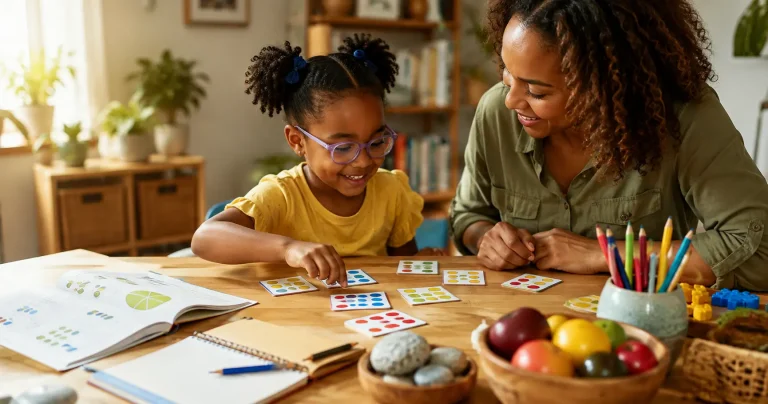
Although it seems simple, matching pairs encourages children to store visual information before retrieving it moments later. Every time they turn over two cards, they’re practising concentration, visual memory and recall.
During our face-to-face lessons, we use physical matching cards which can easily be adapted to suit different ages and interests. Sometimes the cards contain pictures, whilst other times they focus on letters, words, numbers or curriculum topics.
Our online learners certainly don’t miss out. We regularly use interactive Wordwall matching activities which recreate exactly the same challenge on screen. Children often become so engaged in trying to beat their previous score that they forget they’re developing an important learning skill at the same time.
The Tray Game
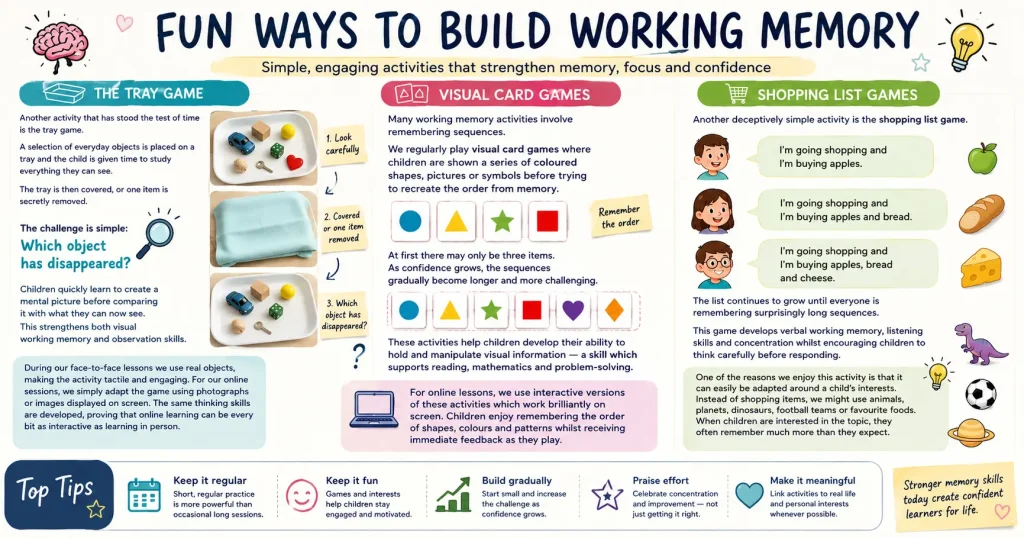
Another activity that has stood the test of time is the tray game.
A selection of everyday objects is placed on a tray and the child is given time to study everything they can see.
The tray is then covered, or one item is secretly removed.
The challenge is simple:
Which object has disappeared?
Children quickly learn to create a mental picture before comparing it with what they can now see. This strengthens both visual working memory and observation skills.
It’s a game that children of all ages enjoy because it naturally becomes more challenging as they improve.
During our face-to-face lessons we use real objects, making the activity tactile and engaging. For our online sessions, we simply adapt the game using photographs or images displayed on screen. The same thinking skills are developed, proving that online learning can be every bit as interactive as learning in person.
Visual Card Games
Many working memory activities involve remembering sequences.
We regularly play visual card games where children are shown a series of coloured shapes, pictures or symbols before trying to recreate the order from memory.
At first there may only be three items.
As confidence grows, the sequences gradually become longer and more challenging.
These activities help children develop their ability to hold and manipulate visual information — a skill which supports reading, mathematics and problem-solving.
For online lessons, we use interactive versions of these activities which work brilliantly on screen. Children enjoy remembering the order of shapes, colours and patterns whilst receiving immediate feedback as they play.
Shopping List Games
Another deceptively simple activity is the shopping list game.
It begins with one item.
“I’m going shopping and I’m buying apples.”
The next person repeats the first item before adding another.
“I’m going shopping and I’m buying apples and bread.”
The list continues to grow until everyone is remembering surprisingly long sequences.
This game develops verbal working memory, listening skills and concentration whilst encouraging children to think carefully before responding.
One of the reasons I enjoy this activity is that it can easily be adapted around a child’s interests. Instead of shopping items, we might use animals, planets, dinosaurs, football teams or favourite foods. When children are interested in the topic, they often remember much more than they expect.
Why Games Work So Well
Children rarely develop stronger working memory by completing endless worksheets.
Instead, they improve through repeated opportunities to remember, retrieve and manipulate information in enjoyable ways.
Games naturally encourage repetition without boredom.
Children are willing to have another go because they’re focused on winning the challenge rather than practising a cognitive skill.
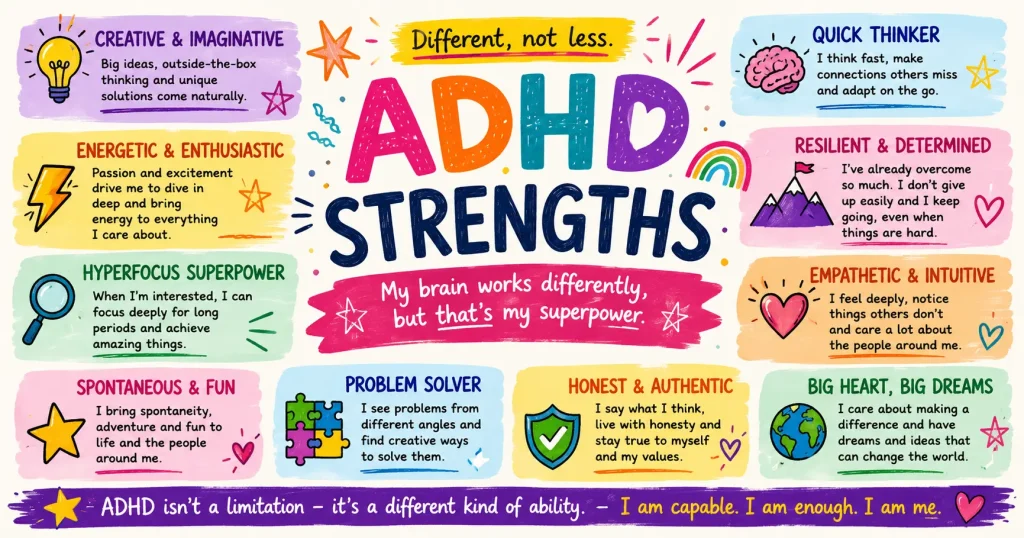
This is particularly important for many neurodivergent learners. Children with ADHD, dyslexia, dyscalculia or autism often benefit from highly interactive learning which keeps them actively involved rather than passively completing written exercises.
Over the years, I’ve found that confidence often grows alongside working memory. As children experience success, they become more willing to tackle increasingly challenging activities, creating a positive cycle of progress.
Final Thoughts
Working memory is an essential foundation for successful learning, but it doesn’t have to be developed through formal exercises alone.
Simple activities such as matching pairs, the tray game, visual sequencing games and shopping list challenges all strengthen important cognitive skills whilst making learning enjoyable.
Whether we’re working together face-to-face or online using interactive Wordwall activities and other digital resources, our aim is always the same: to help children develop stronger working memory in an environment where they feel relaxed, engaged and confident.
After all, when children enjoy learning, they’re far more likely to remember it.
Here Bedford Tutor and Kite Tutoring, we regularly incorporate working memory activities into our personalised English and maths lessons. From interactive Wordwall games and visual memory challenges to practical activities that can be adapted for both in-person and online learning, we help children with ADHD, dyslexia, dyscalculia and other learning differences develop confidence whilst strengthening the skills that make learning easier.
To find out more, please see below:
Bel 😊