• British Curriculum Online Tuition: Powerful Benefits Abroad

    Why British Curriculum Online Tuition Works So Well for Families Living Abroad

    Moving abroad is an exciting adventure for families. Whether you’ve relocated to Dubai, Abu Dhabi, Riyadh, Jeddah, Singapore, Kuala Lumpur, Bangkok or elsewhere, international life offers children wonderful opportunities to experience new cultures, make lifelong friendships and develop a global outlook.

    However, alongside the excitement often comes a familiar concern for parents:

    “How do we make sure our child keeps up with the British Curriculum?”

    Over the years, I have worked with many families living overseas, supporting children attending British international schools, home educating, or preparing to return to the UK. One thing has become increasingly clear to me: online tuition isn’t simply a convenient alternative to face-to-face lessons—it is often the ideal solution.

    For many internationally based families, British Curriculum online tuition provides consistency, flexibility and personalised support that can be difficult to find locally.

    Learning With a Tutor Who Understands the British Curriculum

    One of the biggest advantages of working with a specialist British tutor is continuity.

    Whilst many international schools provide an excellent education, children sometimes need additional support with particular topics, exam preparation or confidence building. Parents often tell me they simply want someone who understands exactly what their child is learning.

    Whether a student is studying Key Stage 1 Maths, Key Stage 2 English, Key Stage 3 Creative Writing, GCSE, iGCSE or preparing for GL Assessments, lessons can be tailored to complement what is happening in school rather than working against it.

    This consistency becomes particularly valuable for families who relocate regularly. A child may move between schools in different countries whilst continuing to follow the British Curriculum, and having the same tutor throughout those changes provides welcome stability.

    Flexibility That Fits Around International Life

    Life overseas rarely follows exactly the same pattern as life in the UK.

    School terms differ between countries. Public holidays vary enormously. Some families travel frequently for work, whilst others return to Britain during school holidays.

    Online tuition adapts to those changing schedules.

    Rather than travelling across a city after school or trying to find a local tutor with suitable experience, lessons take place from home. Children can learn in familiar surroundings whilst maintaining a regular routine regardless of where they happen to be living.

    Over the years, I’ve supported families studying the British Curriculum across the UAE, Saudi Arabia, Singapore, Malaysia and Thailand, and one thing I’ve learnt is that flexibility matters. Every family’s timetable is slightly different, particularly when balancing school commitments, extracurricular activities and different time zones.

    Personalised Learning Makes a Huge Difference

    One-to-one tuition allows every lesson to focus entirely on the individual child.

    Unlike a busy classroom, there is time to revisit difficult concepts, answer questions immediately and adjust the pace of learning without worrying about keeping up with thirty other pupils.

    Some children need additional practice with fractions.

    Others want to improve their creative writing.

    Some simply need reassurance that they’re capable.

    Every child is different, and personalised tuition recognises that.

    As someone who has supported children for many years, I have found that confidence often grows surprisingly quickly once learning is tailored to the child rather than expecting the child to adapt to the lesson.

    Supporting Neurodivergent Learners Overseas

    Many of the families I work with have children who have ADHD, dyslexia, dyscalculia or autism.

    Living abroad can sometimes make accessing specialist educational support more difficult, particularly if English-language SEND services are limited or waiting lists are long.

    Online tuition can bridge that gap.

    Rather than expecting every learner to fit one teaching style, lessons can be adapted to suit how each child learns best.

    Some learners benefit from visual resources.

    Others enjoy discussion-based learning.

    Some need movement breaks or learning broken into smaller chunks.

    Having ADHD myself has reinforced something I’ve always believed: neurodivergent learners don’t all look the same. Every child has their own strengths, challenges and ways of learning. Understanding the individual child is always more important than relying on stereotypes.

    Confidence Travels Better Than Knowledge Alone

    When families move between countries, children sometimes worry about fitting into a new school.

    They may wonder whether they’ll make friends, understand different teaching styles or keep up academically.

    Academic support certainly helps, but confidence is often the biggest factor.

    One of the most rewarding parts of tutoring the British Curriculum internationally is watching children gradually become more willing to ask questions, tackle unfamiliar challenges and believe in themselves.

    When children feel safe making mistakes, learning accelerates naturally.

    This is particularly important for children preparing for transitions into new schools or returning to the UK after living overseas.

    Parents Stay Closely Involved

    Another benefit of online tuition is communication.

    Parents living abroad often appreciate regular updates about their child’s progress with the British Curriculum, particularly if work commitments mean they cannot always speak with teachers during the school day.

    A strong partnership between tutor, parent and child creates consistency.

    Small concerns can be identified early, achievements celebrated together and future learning planned collaboratively.

    Children thrive when the adults around them work as a team.

    Technology Has Made Online Learning Better Than Ever

    When online learning first became widespread, many people viewed it as a temporary solution.

    Today, the experience is completely different.

    Interactive whiteboards, shared documents, educational games, visual resources and instant feedback make lessons engaging and highly effective.

    Many children actually prefer learning online.

    Without the distractions of a busy classroom, they often feel more comfortable asking questions and participating fully. During the growth of online learning, I found many students became more engaged and confident in one-to-one virtual lessons than they had been in traditional classroom settings.

    A Long-Term Investment in Your Child’s Education

    Families living abroad often move several times during a child’s education.

    Schools may change.

    Countries may change.

    Curricula may occasionally vary.

    However, having a trusted tutor provides one constant throughout those transitions.

    Whether your child is preparing for GL Assessments, studying iGCSE English Language, strengthening maths skills or building confidence in reading and writing as part of the British Curriculum, consistent support can make those challenges feel far less overwhelming.

    Ultimately, successful online tuition isn’t just about improving grades.

    It’s about helping children become resilient, confident learners who know they can succeed wherever life takes them.


    Wondering How We Can Help?

    Whether you’re exploring tuition options, looking for specialist support or simply have a question, we’d love to hear from you. Tell us a little about your child and what you’re looking for, and we’ll be in touch as soon as possible.


    Current Availability

    Super Summer Learning (August): Good availability throughout the holiday

    Weekday daytime tuition (from September): Good availability for international students, home-educated learners and families with flexible schedules

    🗓️ After-school, Saturday & Sunday morning tuition (from September): Waiting list currently in operation


    Please include Area Code if Outside UK

    Related Posts

  • Supporting Students with ADHD Through iGCSE English

    Preparing for iGCSE English can feel like a daunting prospect for many families, but for children with ADHD, it can sometimes feel even more overwhelming.

    The good news is that ADHD does not prevent a child from succeeding in English. Over the years, I have worked with many learners who have ADHD, both in the UK and internationally, and one thing has become abundantly clear: when teaching is adapted to suit the individual child, remarkable progress is possible.

    As someone who wasn’t diagnosed with ADHD until adulthood, I also understand first-hand that ADHD is incredibly varied. There is no such thing as a “typical” ADHD learner. Some children are constantly on the move, whilst others quietly disappear into their own thoughts. Some love reading but struggle to organise their ideas on paper. Others have brilliant imaginations but find it difficult to sustain attention during longer writing tasks. This diversity is something I have written about previously, and it remains one of the most important lessons I’ve learnt both personally and professionally.

    When parents ask me how to prepare a child with ADHD for iGCSE English, my answer is always the same.

    Start by understanding the child before worrying about the qualification.

    Why iGCSE English Can Feel So Challenging

    iGCSE English requires a wide range of skills.

    Students need to read lengthy passages, identify subtle language techniques, infer meaning, organise their ideas logically and write extended responses under timed conditions.

    For many children with ADHD, none of these tasks are impossible, but completing several of them at the same time can place a significant demand on working memory and executive functioning.

    The challenge is rarely a lack of intelligence.

    More often, it is managing attention, organising thoughts and maintaining concentration throughout longer tasks.

    Fortunately, these are skills that can be developed with the right support.

    Every ADHD Learner Is Different

    One of the biggest misconceptions surrounding ADHD is that every child experiences it in the same way.

    Nothing could be further from the truth.

    Some learners appear highly energetic and impulsive. Others are thoughtful, quiet and easily distracted. Some can concentrate intensely on topics they enjoy yet struggle to begin tasks they find less engaging.

    Looking back at my own education, I now recognise many of these differences in myself. Although I achieved well academically, my ADHD presented in ways that often went unnoticed because I loved learning and worked incredibly hard to mask many of my difficulties. That experience has shaped the way I teach today, reminding me that appearances rarely tell the whole story.

    This understanding allows me to tailor lessons around the child sitting in front of me rather than relying on assumptions about ADHD.

    A Student in the UAE: ADHD, Dyslexia and Growing Confidence

    One student I supported in the UAE was studying iGCSE English whilst managing both ADHD and dyslexia.

    Initially, English felt exhausting.

    Long reading passages seemed overwhelming and organising ideas into extended written responses often caused frustration. Reading, processing information and planning an answer all at once placed considerable demands on working memory.

    Rather than diving straight into full examination questions, we slowed everything down.

    We broke texts into manageable sections, discussed ideas verbally before writing and used colour-coding to identify key language features and structural techniques. Together, we created simple plans before expanding them into paragraphs, allowing each stage of the writing process to feel achievable rather than overwhelming.

    Gradually, confidence replaced anxiety.

    Instead of worrying about completing an entire examination paper perfectly, each lesson became an opportunity to master one small skill at a time. Those small successes gradually built into something much bigger, and English became a subject that felt manageable rather than intimidating.

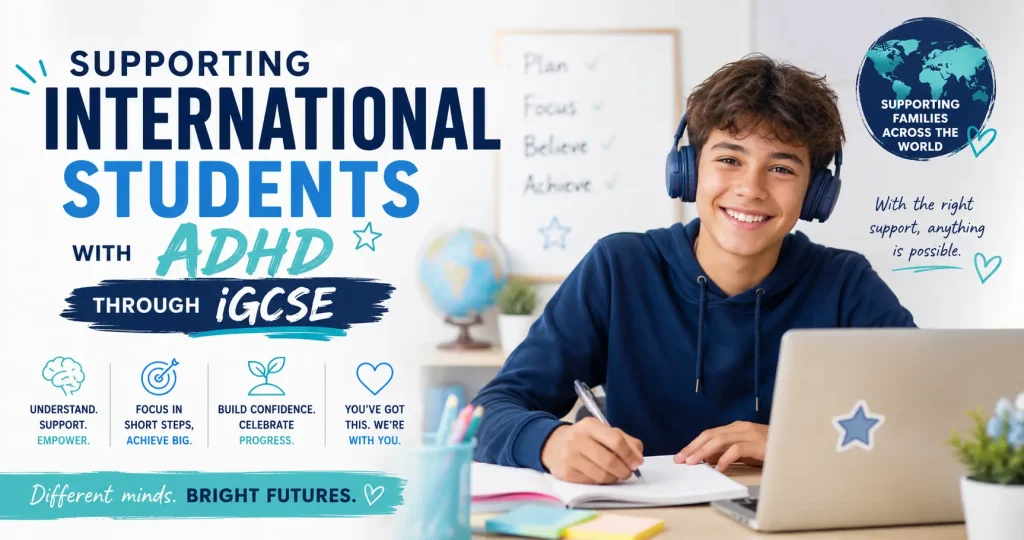
    Smiling international student with ADHD studying confidently for iGCSE exams during an online lesson, highlighting supportive, structured learning that builds confidence, focus and academic success.

    Learning Across the World: Supporting a Student in New Zealand

    Another memorable learner lived in New Zealand.

    Although separated by thousands of miles, many of the challenges were remarkably familiar.

    This student had wonderful ideas and contributed brilliantly during discussions, yet turning those thoughts into structured written responses often felt much harder.

    Like many learners with ADHD, attention fluctuated depending on the activity. When lessons became interactive, conversation-based and engaging, concentration improved dramatically.

    We spent time discussing texts before writing, explored vocabulary through conversation and developed planning strategies that reduced the pressure of staring at a blank page.

    Slowly, confidence grew.

    It reinforced something I see repeatedly in my work with international learners: geography may change, but the importance of understanding how an ADHD brain learns remains exactly the same.

    The Best Preparation Starts Long Before Year 10

    One misconception I often hear is that preparation for iGCSE English begins shortly before the examinations.

    In reality, many of the skills are developed years earlier.

    I currently work with several children in late primary school who have ADHD and are already building the foundations that will eventually support GCSE success.

    Reading regularly, discussing books, expanding vocabulary, developing inference skills and gradually increasing writing stamina all contribute to future success.

    Perhaps most importantly, these younger learners are developing confidence.

    Confidence is often overlooked in education, yet it has a profound impact on learning. Children who believe they can succeed are far more willing to attempt challenging tasks, ask questions and persevere when work becomes difficult.

    By introducing these skills gradually throughout primary school, the transition into secondary education often feels far less daunting.

    Practical Ways to Support Children with ADHD

    Parents frequently ask what they can do at home.

    In my experience, small changes often have the greatest impact.

    Break longer tasks into smaller, manageable sections rather than expecting a child to complete everything at once.

    Encourage discussion before writing so ideas become organised verbally before they reach the page.

    Use visual planning methods such as mind maps or colour coding.

    Allow regular movement breaks during study sessions.

    Celebrate progress, effort and resilience just as much as examination results.

    Most importantly, remember that learning is not a race.

    Every child develops at their own pace.

    Success Looks Different for Every Child

    Over the years, I have worked with learners following the British Curriculum in countries including the UAE, Saudi Arabia and New Zealand, and one thing remains constant wherever children live.

    Success begins with understanding.

    Children with ADHD rarely need lower expectations.

    Instead, they benefit from flexible teaching, patient encouragement and strategies that work alongside the way their brains naturally learn.

    Whether a learner is taking their first steps towards analytical writing in late primary school or preparing for iGCSE English examinations overseas, the goal remains exactly the same: helping them become confident, capable and independent learners.

    When children feel understood rather than judged, remarkable things can happen.


    Wondering How We Can Help?

    Whether you’re exploring tuition options, looking for specialist support or simply have a question, we’d love to hear from you. Tell us a little about your child and what you’re looking for, and we’ll be in touch as soon as possible.


    Current Availability

    Super Summer Learning (August): Good availability throughout the holiday

    Weekday daytime tuition (from September): Good availability for international students, home-educated learners and families with flexible schedules

    🗓️ After-school, Saturday & Sunday morning tuition (from September): Waiting list currently in operation


    Please include Area Code if Outside UK

    Related Posts

  • The Best British Curriculum Resources for Families Living Overseas

    Moving abroad is an exciting adventure, but when children begin following the British Curriculum outside the UK, many parents quickly discover that finding high-quality learning resources isn’t always straightforward.

    Whether you’re living in Dubai, Abu Dhabi, Riyadh, Jeddah, Singapore, Kuala Lumpur, Bangkok or elsewhere, you’ll probably find yourself asking similar questions.

    • Which websites actually follow the British Curriculum?
    • Are free resources good enough?
    • How can I support my child without buying dozens of expensive workbooks?

    Having worked with children following the British Curriculum in countries across the Middle East and Asia for many years, I’ve seen first-hand which resources genuinely help children develop confidence and which simply create more stress.

    The good news is that there are some excellent options available.

    Start with Your Child’s School

    Before purchasing anything, it’s always worth asking your child’s school which resources they already recommend.

    Many British international schools subscribe to online learning platforms that families can access from home. Teachers often use the same terminology, teaching methods and curriculum sequence within these platforms, making them ideal for reinforcing classroom learning.

    Using resources that match your child’s school can prevent confusion, particularly in mathematics where different methods may be taught.

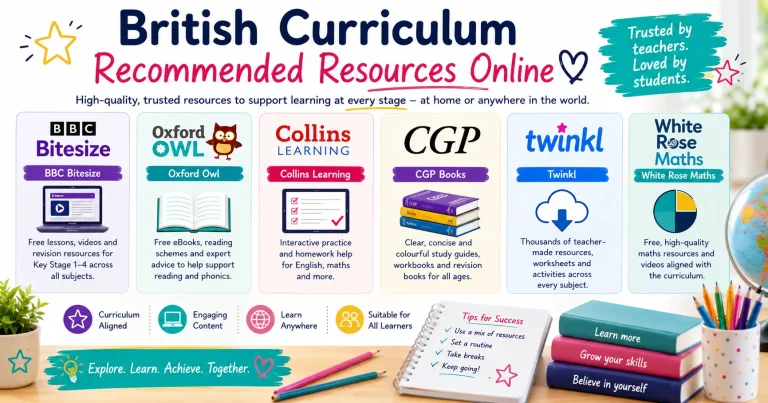
    BBC Bitesize

    BBC Bitesize remains one of the best free educational resources available.

    Although originally designed for UK pupils, it works equally well for British Curriculum learners living overseas.

    I used BBC Bitesize extensively throughout my GCSEs and A Levels, and it played a significant role in my own academic success. Whenever I needed a clear explanation of a difficult topic or a quick way to revise before an exam, it was one of the first places I turned. Even now, I still recommend it to students and regularly use it when planning lessons because the explanations are concise, engaging and easy to understand.

    Children can revise:

    • English
    • Maths
    • Science
    • History
    • Geography

    The explanations are clear, age-appropriate and broken into manageable sections, making them particularly useful for independent learners.

    For older students preparing for GCSEs or iGCSEs, Bitesize is also excellent for revision.

    Oxford Owl

    If your child is developing reading confidence, Oxford Owl is a wonderful resource.

    I’ve used Oxford Owl many times when planning lessons, particularly when looking for engaging reading activities and age-appropriate eBooks. It also brings back happy memories for me because I learnt to read with the Oxford Reading Tree books as a child. Biff, Chip and Kipper were a huge part of my own reading journey, and I still have a real fondness for them today. It’s lovely to be able to recommend a resource that not only supports so many of my students but also helped me discover a love of reading myself.

    Alongside its extensive collection of books, Oxford Owl also offers phonics, grammar and maths activities, making it a fantastic all-round resource for families following the British Curriculum.

    It includes:

    • Free eBooks
    • Reading activities
    • Phonics support
    • Grammar resources
    • Maths activities

    Parents often tell me they struggle to know what books are suitable for their child’s age. Oxford Owl helps remove much of the guesswork.

    Collins Learning

    Collins produces many of the workbooks used in UK schools.

    Their books provide structured practice for:

    • English
    • Maths
    • Grammar
    • Spelling
    • Reasoning
    • SATs preparation

    I particularly like Collins because the progression is logical and the activities are usually short enough to avoid overwhelming children.

    CGP Books

    If you’ve ever visited a UK bookshop, you’ve almost certainly seen CGP books.

    They’re popular for good reason.

    I actually used CGP books myself when I was at school and found them incredibly helpful when revising for GCSEs and A Levels. Their clear explanations, straightforward layout and little touches of humour made even the more challenging topics feel far less intimidating. Years later, I still regularly use CGP books when planning lessons and recommending additional practice to students. They’re a fantastic resource that I return to time and time again.

    Older learners studying Key Stage 2, Key Stage 3 or GCSE material often enjoy their straightforward style, and the explanations are clear enough to help build confidence without feeling overwhelming.

    Twinkl

    Twinkl has become one of the largest educational resource websites available, and it is definitely one of my favourite places to go for inspiration, lesson ideas and ready-made teaching resources. Whether I’m looking for creative activities, engaging games or adaptable lesson templates, I often find something that can be tailored to suit the individual needs of my students.

    Parents can download:

    • Worksheets
    • Games
    • Display materials
    • Reading activities
    • Writing prompts
    • Maths investigations

    One advantage of Twinkl is the sheer variety.

    Whether your child needs additional support with fractions, handwriting or creative writing, you’ll usually find something suitable.

    White Rose Maths

    White Rose Maths has transformed mathematics teaching across many UK schools.

    Its resources focus on developing understanding rather than memorising procedures.

    Many British international schools now follow White Rose or use similar approaches, making it particularly helpful for families wanting to reinforce classroom learning at home.

    Reading Is Still the Most Powerful Resource

    One thing surprises many parents.

    The most valuable educational resource usually isn’t an app.

    It’s books.

    Children who read regularly tend to develop:

    • Vocabulary
    • Comprehension
    • Writing skills
    • General knowledge
    • Confidence

    Reading together, discussing stories and encouraging curiosity often has a greater long-term impact than completing another worksheet.

    For children living overseas, reading also helps maintain familiarity with British vocabulary, expressions and cultural references that appear throughout the curriculum.

    Don’t Feel You Need Every Resource

    One of the biggest mistakes I see is parents purchasing everything.

    A shelf full of workbooks rarely leads to better learning.

    Children usually benefit far more from using a small number of resources consistently than constantly switching between different programmes.

    Consistency builds confidence.

    When Additional Support Can Help

    Even with excellent resources, some children benefit from personalised guidance.

    This is especially true if they are:

    Resources provide practice.

    A tutor can identify misconceptions, adapt explanations and tailor learning to the individual child.

    That’s something no worksheet can fully replace.

    Final Thoughts

    Living overseas doesn’t mean compromising on educational quality.

    Today, families have access to an incredible range of British Curriculum resources from almost anywhere in the world.

    The key isn’t finding the most expensive programme.

    It’s finding resources that suit your child’s personality, confidence level and learning style.

    Sometimes one engaging lesson, one enjoyable book or one encouraging conversation achieves far more than hours spent working through endless exercises.

    After all, education isn’t simply about completing work.

    It’s about helping children become curious, confident learners who enjoy discovering new things.


    Wondering How We Can Help?

    Whether you’re exploring tuition options, looking for specialist support or simply have a question, we’d love to hear from you. Tell us a little about your child and what you’re looking for, and we’ll be in touch as soon as possible.


    Current Availability

    Super Summer Learning (August): Good availability throughout the holiday

    Weekday daytime tuition (from September): Good availability for international students, home-educated learners and families with flexible schedules

    🗓️ After-school, Saturday & Sunday morning tuition (from September): Waiting list currently in operation


    Please include Area Code if Outside UK

    Related Posts

  • British Curriculum Tuition for Families in Thailand

    Moving to Thailand can be an exciting adventure for families. Whether you are relocating for work, joining an international school community or already settled in Bangkok, Phuket, Chiang Mai or elsewhere in the country, one thing many parents have in common is wanting their children to continue making good progress with the British Curriculum.

    Over the years, I have had the pleasure of supporting students living in Thailand through personalised online English and maths tuition. Every family’s situation is different, but the questions I receive are often remarkably similar.

    Will my child keep up with the UK curriculum?

    How can we prepare for iGCSEs whilst living overseas?

    What happens if my child needs extra support or has ADHD, dyslexia or another additional learning need?

    The good news is that with the right support, children can thrive wherever they are in the world.

    Why Families in Thailand Choose British Curriculum Tuition

    Thailand has a large number of excellent international schools, many of which follow the English National Curriculum or offer qualifications such as iGCSEs and A Levels.

    Even within these schools, however, children sometimes benefit from additional one-to-one support.

    Some need help filling small gaps in their understanding before those gaps become larger. Others want to build confidence in English or mathematics, prepare for GL Assessments or strengthen their reading and writing skills.

    Many parents simply value having an experienced tutor who understands the British education system and can provide consistent support throughout the academic year.

    Personalised Learning Makes a Difference

    One of the greatest advantages of one-to-one tuition is that every lesson can be tailored to the individual learner.

    No two children learn in exactly the same way.

    Some children enjoy discussion-based lessons, whilst others prefer visual resources, games or practical activities. Some thrive with structure and routine, whilst others benefit from a more flexible approach that follows their interests whilst still meeting curriculum objectives.

    Having worked with children from a variety of international schools, I have found that adapting to each learner is often far more important than following a rigid teaching plan.

    When children feel comfortable asking questions and making mistakes, confidence begins to grow naturally.

    Supporting Neurodivergent Learners

    Many of the students I support have ADHD, dyslexia, dyscalculia, autism or other learning differences.

    As someone who was diagnosed with ADHD as an adult, I understand both personally and professionally that neurodivergent learners are incredibly diverse. There is no single “ADHD learner” or “dyslexic learner”. Every child has their own strengths, challenges and preferred ways of learning. This understanding has shaped my tutoring approach, focusing on flexibility, encouragement and building confidence alongside academic skills.
    Rather than expecting children to fit a particular method of teaching, I adapt lessons to suit the child sitting in front of me.

    This might involve:

    • Breaking tasks into manageable steps.
    • Using multi-sensory activities.
    • Building working memory strategies.
    • Encouraging movement and interaction where appropriate.
    • Celebrating progress, however small.

    When children feel understood rather than judged, they often make remarkable progress.

    English and Maths Tuition for the British Curriculum

    I currently support learners across a wide age range, helping them develop confidence in both English and mathematics.

    English lessons may include:

    • Reading comprehension
    • Creative writing
    • Grammar and punctuation
    • Vocabulary development
    • Spelling
    • Functional Skills English
    • iGCSE English Language preparation

    Mathematics tuition can cover:

    • Number and calculation
    • Fractions, decimals and percentages
    • Problem solving
    • Reasoning
    • Algebra
    • Geometry
    • Functional Skills Maths
    • iGCSE Maths support

    Every lesson is adapted to the student’s current level and long-term goals.

    Preparing for GL Assessments and iGCSEs

    Many British international schools in Thailand use GL Assessments to monitor progress.

    Preparation is rarely about memorising endless facts. Instead, it focuses on developing secure reading, mathematical reasoning, grammar, vocabulary and problem-solving skills.

    Likewise, students preparing for iGCSE examinations benefit from steady, confidence-building practice rather than last-minute cramming.

    Having supported many learners through these assessments, I have found that children perform best when they understand the concepts, feel prepared and enjoy the learning process rather than fearing it. This approach reflects the way I work with international school students across the world.

    Learning Across Time Zones

    One of the advantages of online tuition is flexibility.

    Thailand is several hours ahead of the UK, depending on the time of year, but lessons can be arranged to fit around school, extracurricular activities and family life.

    Many families appreciate being able to access specialist British Curriculum tuition without needing to find local support that may not fully align with their child’s educational programme.

    Whether your child attends an international school, is home educated or is preparing to relocate to another country, regular online tuition provides continuity and reassurance.

    Building Confidence for the Future

    Academic progress is important, but confidence is equally valuable.

    Many children begin tuition believing they “aren’t good at English” or “just can’t do maths”. Over time, those beliefs often begin to change.

    As understanding grows, confidence follows.

    Children become more willing to ask questions, attempt challenging tasks and celebrate their own achievements.

    Those moments are often the most rewarding part of tutoring.

    Final Thoughts

    Living overseas should never limit a child’s educational opportunities.

    With personalised British Curriculum tuition, children in Thailand can continue developing strong English and mathematics skills whilst enjoying all the opportunities that international life has to offer.

    Whether your child needs ongoing academic support, preparation for GL Assessments or iGCSEs, or specialist tuition for ADHD, dyslexia, dyscalculia or autism, the right one-to-one support can make a lasting difference.


    Wondering How We Can Help?

    Whether you’re exploring tuition options, looking for specialist support or simply have a question, we’d love to hear from you. Tell us a little about your child and what you’re looking for, and we’ll be in touch as soon as possible.


    Current Availability

    Super Summer Learning (August): Good availability throughout the holiday

    Weekday daytime tuition (from September): Good availability for international students, home-educated learners and families with flexible schedules

    🗓️ After-school, Saturday & Sunday morning tuition (from September): Waiting list currently in operation


    Please include Area Code if Outside UK

    Related Posts

  • ADHD in Dubai Schools: Ways Students Can Thrive

    Moving to Dubai can be an exciting new chapter for families. The city is home to some of the world’s leading international schools, offering British, American, IB and other internationally recognised curricula. For many children, the transition brings new friendships, opportunities and experiences.

    However, for students with ADHD, starting or attending an international school can present some additional challenges. New routines, unfamiliar expectations and the fast pace of school life can all place extra demands on executive functioning skills.

    The good news is that children with ADHD can absolutely thrive in international schools when they receive the right understanding and support. As someone who was diagnosed with ADHD as an adult and who has spent many years supporting neurodivergent learners both in the UK and overseas, I’ve seen first-hand just how transformative the right environment can be.

    ADHD Looks Different in Every Child

    One of the biggest misconceptions surrounding ADHD is that every child experiences it in the same way.

    Some children are highly energetic and impulsive, whilst others appear quiet, thoughtful and easily distracted. Some excel academically but struggle with organisation, whilst others find traditional classroom learning difficult from an early age.

    My own experience taught me this lesson. I loved learning, achieved well at school and was often described as organised, yet I also experienced distractibility, impulsivity and difficulties with attention that weren’t recognised until adulthood. ADHD is incredibly diverse, and understanding that diversity is often the first step towards effective support.

    Rather than asking, “Does this child look like someone with ADHD?” it is far more helpful to ask, “How does this particular child’s brain work best?”

    Why International Schools Can Be Both Wonderful and Challenging

    Dubai’s international schools are incredibly diverse. Children often learn alongside classmates from dozens of different nationalities, creating rich cultural experiences that many ADHD learners genuinely enjoy.

    At the same time, international education often involves:

    • High academic expectations.
    • Frequent assessments.
    • Busy timetables.
    • Large social environments.
    • Transitions between different curricula.

    Executive functioning skills such as organisation, working memory, planning and time management are essential for navigating these demands. These are precisely the areas where many ADHD learners need additional support.

    When schools recognise these differences and adapt accordingly, children often flourish.

    Creating Predictable Routines

    Children with ADHD generally cope far better when they know what to expect.

    Predictable classroom routines reduce uncertainty and free up mental energy for learning. Visual timetables, written instructions and clear expectations can make an enormous difference.

    Many international schools in Dubai already make excellent use of technology. Homework platforms, digital calendars and online learning systems can all become valuable organisational tools when used consistently.

    Consistency between school and home also helps children feel secure.

    Supporting Executive Function Skills

    Executive functioning is often described as the brain’s management system.

    Students with ADHD may know exactly what they need to do but struggle to begin, remember instructions or organise materials efficiently.

    Practical strategies include:

    • Breaking larger tasks into manageable sections.
    • Providing checklists.
    • Using colour coding for subjects.
    • Allowing extra planning time.
    • Teaching organisation explicitly rather than assuming children naturally acquire these skills.

    These strategies benefit many learners, not just those with ADHD.

    Movement Helps Learning

    One of the greatest myths surrounding education is that good learning always happens whilst sitting perfectly still.

    Many ADHD learners actually concentrate better when movement is incorporated into their day.

    Simple adjustments might include:

    • Standing while completing part of a task.
    • Short movement breaks.
    • Stretching between activities.
    • Using discreet fidget tools where appropriate.
    • Interactive learning activities.

    Looking back, many of my happiest learning experiences involved active participation rather than simply listening. For many children, movement supports attention rather than distracting from it.

    Confidence Is Just as Important as Academic Support

    Perhaps the greatest danger facing many ADHD learners isn’t the ADHD itself.

    It’s losing confidence.

    Children who regularly forget homework, misplace equipment or struggle to complete tasks may begin believing they’re lazy or incapable.

    Nothing could be further from the truth.

    Many ADHD learners are incredibly creative, curious and imaginative. They often ask insightful questions, think laterally and approach problems from fresh perspectives.

    The role of parents and teachers is to ensure these strengths are recognised alongside the challenges.

    A child who believes in themselves is far more likely to persevere through difficult moments.

    Working Together Makes the Difference

    The strongest outcomes happen when parents, teachers and tutors communicate openly.

    This is particularly valuable in international schools where families may also be adapting to life in a new country.

    Regular conversations about:

    • What is working well.
    • Current challenges.
    • Helpful classroom strategies.
    • Emotional wellbeing.
    • Academic progress.

    allow everyone to support the child consistently.

    When children receive the same messages of encouragement both at home and at school, their confidence often grows remarkably quickly.

    Online Tuition Can Complement International School Learning

    Many families in Dubai choose online tuition to reinforce learning without adding unnecessary pressure.

    One-to-one lessons provide opportunities to revisit concepts, strengthen executive functioning skills and build confidence in a calm environment.

    Because lessons are personalised, they can adapt to the individual learner rather than expecting the learner to adapt to a rigid teaching style.

    This flexibility is particularly valuable for ADHD learners, who often benefit from engaging, interactive lessons that match their interests and learning preferences.

    Final Thoughts

    Children with ADHD don’t need to become different learners.

    They need learning environments that recognise how their brains naturally work.

    International schools in Dubai already offer exceptional educational opportunities. When these are combined with understanding, flexible teaching and strong communication between home and school, ADHD learners can achieve remarkable things.

    Most importantly, children need to know that ADHD is not a limitation on their potential. Every learner’s strengths and challenges are unique, and with the right support they can develop the confidence, resilience and skills to flourish both academically and personally.


    Wondering How We Can Help?

    Whether you’re exploring tuition options, looking for specialist support or simply have a question, we’d love to hear from you. Tell us a little about your child and what you’re looking for, and we’ll be in touch as soon as possible.


    Current Availability

    Super Summer Learning (August): Good availability throughout the holiday

    Weekday daytime tuition (from September): Good availability for international students, home-educated learners and families with flexible schedules

    🗓️ After-school, Saturday & Sunday morning tuition (from September): Waiting list currently in operation


    Please include Area Code if Outside UK

    Related Posts

  • Choosing an Online Tutor for British Curriculum Children Abroad

    When families move overseas, one of the biggest priorities is ensuring their children continue to receive a high-quality education. Whether you’re living in the UAE, Saudi Arabia, Singapore, Malaysia, Thailand or elsewhere, international schools offer wonderful opportunities, but they can also present unique academic challenges.

    Over the years, I have worked with many children following the British Curriculum whilst living abroad, and one thing has become increasingly clear: choosing the right online tutor is about far more than finding someone who knows the curriculum.

    It’s about finding someone who understands your child.

    Why Families Living Abroad Often Seek Additional Support

    Moving overseas is exciting, but it also brings change.

    Children may be adapting to a new country, making new friends, learning alongside classmates from many different cultures and settling into an unfamiliar school environment. Even confident learners can take time to adjust.

    Some children need support because they’ve missed parts of the curriculum during an international move. Others simply benefit from having one consistent adult outside school who understands both the British education system and the realities of international life.

    I’ve often found that parents contact me not because their child is struggling, but because they want to build confidence before small gaps become larger ones.

    Experience with the British Curriculum Matters

    A tutor who understands the British Curriculum can provide reassurance for both parents and children.

    From Key Stage 1 through to Key Stage 4, English and maths develop in carefully planned stages. Understanding those expectations allows lessons to focus on exactly what a child needs, whether that’s strengthening phonics, improving reading comprehension, building mathematical reasoning or preparing for iGCSE English Language.

    Many international schools also use GL Assessments to monitor progress, meaning tutors who understand these assessments can provide targeted support without turning learning into endless test preparation.

    Every Child Learns Differently

    One lesson I’ve learnt after many years of tutoring is that no two children learn in quite the same way.

    Some thrive with structured explanations and routine.

    Others learn best through discussion, creativity and practical activities.

    Children with ADHD, dyslexia, dyscalculia or autism often need lessons adapted to suit the way their brains naturally process information rather than being expected to fit one teaching method.

    As someone diagnosed with ADHD myself, I understand how misleading educational stereotypes can be. ADHD looks different in every individual, and the same is true of every learner. The most effective tuition starts with understanding the child before the curriculum.

    Look Beyond Qualifications

    Qualifications certainly matter.

    Parents deserve to know their tutor has strong subject knowledge and appropriate experience.

    However, when I think back to my own education, the teachers who had the greatest impact weren’t necessarily those with the longest list of qualifications.

    They were the ones who listened.

    They noticed when confidence was slipping.

    They explained things differently when the first explanation didn’t quite make sense.

    Those qualities are just as important in online tuition.

    A tutor who builds trust will often achieve far more than one who simply delivers information.

    Flexibility Makes a Huge Difference

    One of the greatest strengths of online tuition is flexibility.

    Families living abroad often follow different school calendars from the UK. Whilst British schools may be enjoying their summer holidays, many international schools are preparing for a new academic year.

    Having a tutor who can adapt lessons around these schedules makes learning far less stressful.

    Flexibility also extends to teaching methods.

    Some children benefit from visual resources.

    Others enjoy games and interactive challenges.

    Some need additional time to process new concepts before moving on.

    The best tutors recognise that adapting to the learner is often the key to long-term success.

    Communication with Parents is Essential

    One aspect of tutoring that parents often overlook is communication.

    When families are living overseas, parents may not always have daily contact with teachers in the same way they would in the UK.

    Regular updates from a tutor can therefore become incredibly valuable.

    Knowing which areas are improving, where confidence is growing and what to continue practising at home helps everyone work together towards the same goals.

    Confidence Comes Before Progress

    One of my favourite moments as a tutor isn’t when a child achieves a high score.

    It’s when they say, “I think I can do this.”

    Confidence changes everything.

    Children begin asking more questions.

    They become willing to tackle more challenging work.

    Mistakes stop feeling frightening and become part of learning instead.

    I’ve seen this happen countless times with students across the UK and around the world. Often, academic progress follows naturally once confidence has been rebuilt.

    Questions to Ask Before Choosing an Online Tutor

    Before making your decision, consider asking:

    • Do they have experience teaching the British Curriculum?
    • Have they worked with international school students?
    • Can they support children with different learning styles or SEND?
    • How do they personalise lessons?
    • Do they communicate regularly with parents?
    • Do they focus on confidence as well as academic achievement?

    The answers will often tell you far more than a long list of qualifications.

    Final Thoughts

    Choosing an online tutor for your child whilst living abroad is an important decision.

    The right tutor should provide more than curriculum knowledge. They should understand children as individuals, adapt their teaching to suit different learning styles and help learners feel confident, supported and motivated.

    Whether your family is based in Dubai, Abu Dhabi, Riyadh, Jeddah, Kuala Lumpur, Singapore, Bangkok or elsewhere, personalised online tuition can provide valuable continuity alongside an excellent international education.

    After all, children don’t simply need someone to teach them English or maths.

    They need someone who helps them believe they can succeed.


    Related Posts


  • What is iGCSE English? A Parent’s Guide

    If your child is studying the British Curriculum, particularly at an international school, you’ve probably come across the term iGCSE English. Like many parents, you may be wondering exactly what it involves and how it differs from the GCSE English qualifications taken by students in the UK.

    Over the years, I’ve supported many students studying IGCSE English Language, from learners here in the UK to students attending British international schools in the UAE, Saudi Arabia, Thailand, and other countries. Teaching students from a range of educational and cultural backgrounds has given me valuable insight into the needs of international learners while maintaining a strong focus on the Cambridge and Edexcel IGCSE English specifications. Although every school is slightly different, one thing remains the same: parents often worry far more about the examination than they need to.

    The good news is that success in iGCSE English isn’t simply about memorising mark schemes or completing endless past papers. At its heart, it’s about developing strong reading, writing and communication skills that will benefit a child long after they have left school.

    What is iGCSE English?

    The International General Certificate of Secondary Education (iGCSE) is an internationally recognised qualification, typically studied by students aged 14 to 16.

    Many British international schools choose iGCSE qualifications because they provide a rigorous academic programme that is recognised by schools, colleges and universities around the world.

    Although there are several examination boards offering iGCSE English Language, they all assess similar core skills. Students are expected to read a variety of texts, think critically about what they have read, communicate their ideas clearly and produce writing for different purposes and audiences.

    Because the qualification is recognised internationally, it is widely taught in British international schools across the world. Many of the students I work with are following exactly the same iGCSE English courses as their peers in the UK, despite being thousands of miles away.

    These are skills that develop gradually over time rather than something that can be learnt overnight.

    What Does iGCSE English Assess?

    Whilst every specification is slightly different, students are generally expected to demonstrate:

    • Reading comprehension
    • Vocabulary development
    • Language analysis
    • Writing for different audiences and purposes
    • Creative writing
    • Transactional writing
    • Organising ideas clearly
    • Accurate spelling, punctuation and grammar

    Many parents are surprised to discover that iGCSE English isn’t simply about knowing the “right answers.” Students are often rewarded for their ability to interpret texts, explain their thinking and communicate effectively.

    That means confidence, vocabulary and reading experience are just as important as exam knowledge.

    My Approach to iGCSE English

    One of the questions I’m occasionally asked is whether I spend lessons working through lots of past papers.

    The honest answer is… not really.

    Of course, there is value in becoming familiar with the style of an examination, but my focus has always been on helping students develop the underlying English skills that lead to long-term success.

    Rather than teaching children to memorise mark schemes or perfect examination techniques, I help them become stronger readers, more thoughtful writers and more confident communicators.

    We spend time exploring vocabulary, discussing high-quality texts, developing analytical thinking and practising different styles of writing. We look at how authors create meaning, how language influences readers and how ideas can be communicated clearly and effectively.

    In my experience, when those foundations become secure, students naturally become much better equipped to tackle assessments.

    More importantly, they develop skills that will continue to benefit them throughout their education, university and later life.

    Supporting Students with SEND

    This approach is particularly valuable for many of the children I work with who have ADHD, dyslexia, autism or other special educational needs.

    Every learner is different.

    Some children become overwhelmed by the pressure of repeated exam practice. Others lose confidence because they begin to associate English with getting questions wrong instead of enjoying reading and writing.

    As someone with ADHD myself, I understand how important it is to adapt learning to the individual child rather than expecting every learner to fit the same mould. My lessons are personalised, engaging and designed to build confidence alongside academic skills.

    For some students, this means breaking larger tasks into manageable steps. For others, it involves using discussion, visual resources, creative activities or simply allowing extra time to process ideas.

    When children feel understood, they are far more likely to enjoy learning—and children who enjoy learning often make the greatest progress.

    iGCSE English for ESL and EFL Learners

    Many of the students I support attend British international schools where English is the language of learning, even though it isn’t always the language spoken at home.

    Whether they’re living in Dubai, Singapore, Kuala Lumpur or Hong Kong, it’s common for children to move confidently between two or more languages every day. Whilst this is an incredible skill, iGCSE English often requires a much deeper understanding of vocabulary, inference, figurative language and written expression.

    This is one of the reasons I enjoy supporting students learning English as a second or foreign language (ESL/EFL). Rather than relying on memorised responses, we focus on expanding vocabulary naturally, exploring increasingly challenging texts and building confidence through meaningful discussion and purposeful writing.

    These skills not only support success in iGCSE English but also help students across every other subject they study in English.

    Confidence Matters More Than Parents Often Realise

    Looking back at my own education, the teachers who inspired me most weren’t the ones who taught me how to pass an examination.

    They were the ones who made me curious.

    They encouraged me to ask questions, think independently and enjoy the process of learning.

    That philosophy has stayed with me throughout my career.

    Examinations are important, but they are only one small part of a child’s educational journey. The ability to communicate clearly, think critically and express ideas confidently will continue to open doors long after the examination papers have been packed away.

    Final Thoughts

    iGCSE English is about far more than preparing for an examination.

    It is an opportunity for young people to become confident readers, capable writers and thoughtful communicators.

    Whilst there is certainly a place for becoming familiar with exam formats, I believe the greatest progress comes from developing the core skills that underpin success. Strong reading comprehension, rich vocabulary, analytical thinking and confident writing don’t just help students achieve better results—they equip them with skills for life.


    Related Posts

  • British Curriculum vs American Curriculum: What Parents Living Abroad Should Know


    One of the questions I am frequently asked by parents living overseas is whether there is a significant difference between the British and American curricula.

    The short answer is yes… and no!

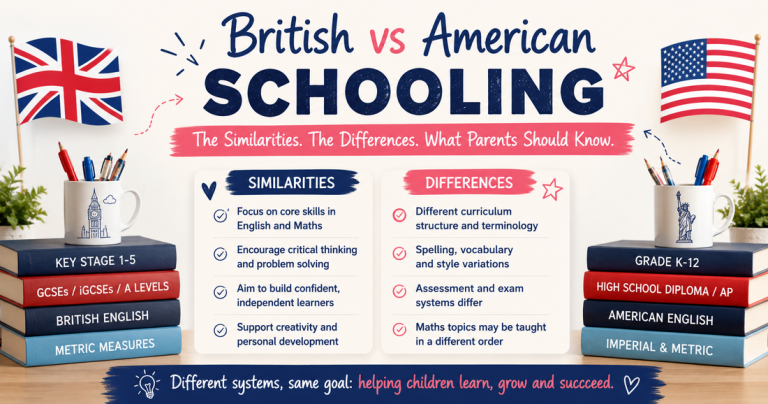
    Having taught children following both educational systems for many years in countries such as the UAE and Thailand, I am often surprised by how similar they really are. Whilst there are certainly some differences in terminology, assessment and curriculum content, both ultimately aim to help children develop the same core skills: confidence in reading, competence in writing and a secure understanding of mathematics. That being said, there are some important distinctions which can occasionally catch families by surprise, particularly when children move between schools or educational systems.​

    One of the most obvious differences appears in English.

    Although British English and American English are essentially the same language, there are some spelling variations which can occasionally cause confusion. For example, a child attending a British school may write colour, favourite and centre, whilst a child following the American curriculum will be expected to write color, favorite and center.

    I often teach both British and American English and one of the first things I reassure children about is that neither version is “wrong”. The important thing is consistency. If a child is studying within an American school, they should use American spellings. If they are following the British curriculum, British spellings are usually expected.

    Fortunately, children tend to adapt remarkably quickly once they understand the differences.

    Over the years, I have also gained extensive experience preparing students for the GL Assessments used by many international schools. These assessments often form an important part of school entry procedures and provide valuable information about a child’s strengths and areas for development. Supporting children through these assessments has given me a strong understanding of the skills many international schools expect students to demonstrate.

    Alongside this, I regularly support students studying iGCSE English Language. I particularly enjoy helping learners develop their reading, writing and analytical skills whilst building the confidence needed to tackle longer pieces of writing and examination questions.

    My experience is not limited to the British curriculum, however.

    I have also worked with students in countries such as Saudi Arabia who follow Common Core English and Mathematics programmes, and regularly support children studying both the British and American curricula. Over the years, working across different educational systems has taught me that successful teaching is rarely about the curriculum itself. More often, it is about understanding the child sitting in front of you and adapting your approach to suit the way they learn best.​

    Mathematics is perhaps where some of the most noticeable differences occur.

    When I first began supporting a student studying the American mathematics curriculum over a longer period of time, I quickly realised that certain concepts were approached differently. The methods were not necessarily better or worse, but they were sometimes presented in a different order or explained using different terminology.

    One area which particularly expanded my own knowledge was the use of imperial measurements.

    Whilst British children are often familiar with miles and occasionally encounter other imperial units, the American curriculum tends to make much greater use of feet, inches, yards, pounds and gallons. Supporting students with these concepts helped me become far more confident teaching measurement systems which are not always covered in depth within the British curriculum.

    Experiences like these have been invaluable because they have allowed me to become more adaptable as a tutor.

    Perhaps the biggest lesson I have learnt is that children are often far more flexible than adults give them credit for. Whether they are learning colour or color, converting centimetres or inches, preparing for GL Assessments or studying iGCSE English Language, the underlying goal remains exactly the same: helping them become confident, capable learners.

    Curricula may vary from country to country, but curiosity, confidence and a love of learning are universal.

    As someone who works with children from a wide range of countries and educational backgrounds, I genuinely enjoy helping students navigate these differences and discover that, regardless of which curriculum they follow, they are capable of achieving great things.

    Here at Bedford Tutor, I have supported children following both the British and American curricula for many years. From GL Assessments and iGCSE English Language to Common Core English and Mathematics, working with learners from different educational systems has helped me develop a flexible approach that allows every child to build confidence whilst developing the skills they need to succeed.

    To find out more, please click on the link below:

    Bel 😊


    Related Posts