Bedford, UK



For some children with dyslexia, reading can feel like hard work.
A page of words which looks perfectly ordinary to an adult can feel like a maze to a child who is still working out sounds, recognising familiar words and remembering what they have just read. When reading requires so much concentration, it is understandable that some children begin to avoid it altogether.
This is why I believe building reading fluency should be about much more than simply asking a child to read more books.
It is about helping them become familiar with words, developing confidence, creating opportunities for successful literacy and, perhaps most importantly, helping them discover that books and stories can actually be enjoyable.
Over the years, I have supported many children with dyslexia and have found that small, everyday opportunities to practise literacy can make a surprisingly big difference.
What is reading fluency?
Reading fluency is the ability to read words accurately, smoothly and with increasing confidence.
For a child with dyslexia, this can take time. They may need to work much harder than their peers to recognise words automatically, decode unfamiliar vocabulary or remember common spelling patterns.
This does not mean they lack intelligence or understanding.
In fact, many dyslexic learners are bright, creative and incredibly capable. The difficulty is often that the mechanics of reading can require so much mental energy that there is less capacity left for enjoying the story or thinking about what the words mean.
This is why developing fluency gradually can be so valuable.
Reading does not only happen with a book
One of the things I encourage parents to remember is that literacy practice does not have to mean sitting at a table with a reading book every evening.
There are opportunities to read everywhere.
Think about a car journey.
There are road signs, shop names, directions, number plates and signs on buildings. A child might spot a word they recognise and read it aloud. Perhaps they can read “STOP” on a road sign, “Tesco” outside the supermarket or a place name they have seen before.
These little moments count.
They allow children to practise recognising words in a natural environment without the pressure of completing a formal literacy exercise.
Sometimes I will deliberately point out a sign and ask, “Can you read that one?” Other times, I might let the child notice it themselves.
It is amazing how much more enjoyable literacy can become when it has a purpose.
Short reading activities can be incredibly effective
When a child finds reading difficult, long sessions can quickly become exhausting.
This is particularly important to remember with dyslexic learners.
Rather than expecting a child to read for a long period of time, I often prefer short, manageable activities. A few minutes of focused practice can be much more productive than pushing a child until they are tired and frustrated.
Flash cards can be useful here.
We might practise a small number of familiar words, revisit words we have encountered before or look at particular spelling patterns. The aim is not to overwhelm the child with a huge pile of cards.
Instead, we want them to experience success.
Perhaps they read eight words correctly today.
Tomorrow, we might revisit those same words before introducing one or two new ones.
Over time, words which once required considerable thought can become familiar. That growing automaticity can make literacy feel less tiring.
Choose books because the child loves them
One of the most important things we can do is choose books that children actually want to read.
If a child loves dinosaurs, let them read about dinosaurs.
If they are fascinated by football, find a football book.
If they adore funny stories, look for something that makes them laugh.
If they love animals, choose animal stories or fact books.
The subject matter matters because motivation matters.
However, there is another important consideration: the book needs to be suitable for the child’s age and reading ability.
A child may be ten years old but have a reading age which means that some ten-year-old novels are currently too difficult. There is absolutely nothing wrong with finding a book which is easier to read while still being interesting and age-appropriate.
We want children to feel successful, not embarrassed by the level of the book they are using.
A book being easier does not make the experience less valuable.
Let children read the words they can
When I am reading with a child, I don’t want to take every word away from them.
If they can read a word, I let them read it.
That sounds obvious, but it is an important part of building independence.
If a child sees a familiar word and recognises it, that is a success. We want them to notice those moments and realise, “I know this word!”
If they come across a word they cannot read, however, they do not need to sit staring at it indefinitely.
This is where adult support becomes incredibly valuable.
Guided reading: supporting without taking over
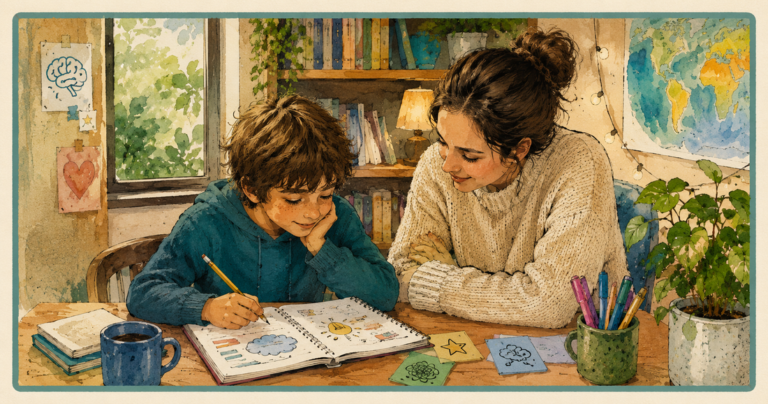
Guided reading is one of the approaches I particularly like because it gives children the opportunity to work through text independently whilst knowing that an adult is there to help.
The child reads the words they can.
When they reach a word they cannot decode, the adult provides an appropriate prompt or helps them work through it.
Sometimes we might look at the sounds within the word. Sometimes we might break a longer word into syllables. Sometimes the adult simply supplies the word so that the child can continue with the sentence and maintain the meaning of the story.
The important thing is that the child is not left struggling for so long that reading becomes miserable.
Nor do we want an adult reading the entire book for them.
It is a partnership.
The child reads what they can. The adult supports what they cannot.
That creates a lovely balance between independence and reassurance.
Don’t forget to talk about the story
Reading fluency is not simply about saying words quickly.
Reading is about understanding, imagining, questioning and connecting with what is on the page.
After a short section, we might stop and ask:
“What do you think is going to happen?”
“Why do you think the character did that?”
“Which bit was your favourite?”
“Can you find the word that tells us…?”
These conversations allow children to engage with the meaning of the text even when decoding is still developing.
They also remind children that reading is about much more than getting every word right.
Confidence is part of the process
Perhaps the most important thing I have learnt from working with dyslexic learners is that confidence can change everything.
When a child has experienced repeated difficulty with reading, they can begin to see themselves as someone who “can’t read”.
We need to challenge that belief gently.
One word.
One sentence.
One page.
One successful book.
These little victories matter.
As I have written previously, I cannot overstate the importance of helping a child recognise their own progress. Sometimes confidence grows through tiny successes which gradually begin to fill a much larger bucket.
This is also why we try to make literacy learning active and engaging. Our dyslexia support work incorporates structured approaches alongside creativity, visual learning and hands-on activities, rather than relying solely on repetitive worksheets.
Reading fluency is a journey, not a race
Every child develops at a different pace.
For a child with dyslexia, reading may take longer to become automatic, and there may be periods when progress feels frustratingly slow. That does not mean progress is not happening.
- Keep reading visible in everyday life.
- Read signs during car journeys.
- Use short flash-card activities.
- Choose books around your child’s interests.
- Make sure the reading level is appropriate.
- Let them read the words they know.
- Guide them through the words they don’t.
- Talk about the story.
- And, above all, protect their confidence.
We are not trying to create a child who can simply get to the end of a page as quickly as possible.
We are trying to help create a child who looks at a page and thinks, “I can do this.”
That is where reading fluency becomes so much more than a literacy skill. It becomes another little piece of independence, confidence and enjoyment.
Supporting Dyslexic Readers at Bedford Tutor
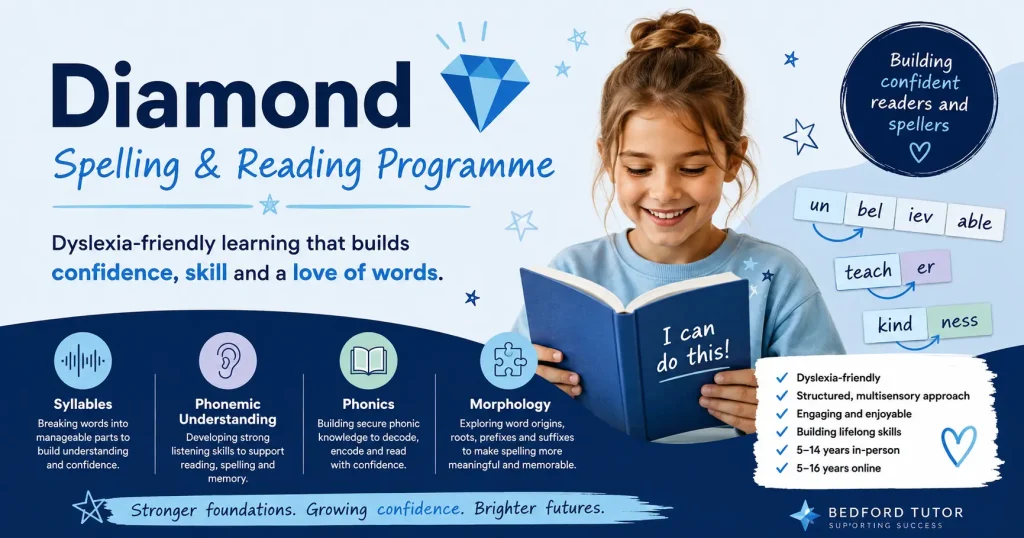
Here at Bedford Tutor and Kite Online Tutoring, we have supported many children with dyslexia through personalised English tuition and our Diamond Spelling & Reading Programme. Our approach combines structured literacy teaching with engaging, practical and creative activities, helping children develop reading and spelling skills whilst building confidence along the way. We understand that every learner is different, so lessons are adapted to the child’s individual age, ability, strengths and needs.
If reading has become a source of frustration for your child, sometimes the answer is not simply to ask them to read more.
Sometimes we need to find a different way into reading.
And sometimes, the most important first step is helping a child discover that they really can become a reader.
To find out more, please see below:
Bel 😊