Bedford, UK


Why Some Children Flourish Outside a Traditional Classroom
For many years, school has been viewed as the only “normal” way for children to learn. Classrooms, timetables, uniforms and school bells have become so familiar that it’s easy to forget education doesn’t have to look the same for every child.
Over the years, I have worked with children from a wide range of educational backgrounds, including many who are home educated. One thing has become increasingly clear to me: whilst some children absolutely thrive in a busy classroom, others truly begin to flourish when learning takes place in a different environment.
That isn’t because they are less capable.
Often, it’s because they have finally found a way of learning that suits who they are.
Every Child Learns Differently
One of the biggest lessons I have learnt as both a tutor and someone with ADHD is that no two learners are the same. We often expect children to adapt to education, when perhaps education should spend a little more time adapting to children.
Some learners enjoy the structure and social interaction of school. Others become overwhelmed by the constant noise, transitions and demands of a busy classroom.
Children with ADHD, dyslexia, dyscalculia or autism may spend so much energy simply coping with the school environment that there is very little left for learning itself.
That doesn’t mean they can’t learn.
Sometimes it simply means they need a different environment to show what they are truly capable of.
Having been diagnosed with ADHD myself as an adult, I know first-hand how varied neurodivergent experiences can be. ADHD doesn’t look the same in everyone, and the same is true of every learning difference. We need to move away from expecting children to fit a single educational mould and instead recognise the incredible diversity in how young minds develop.
The Freedom to Learn at the Right Pace
One of the greatest advantages of home education is flexibility.
There is no pressure to keep up with thirty other children or rush through a topic before a lesson ends.
If a child finds fractions difficult, they can spend extra time building confidence before moving on. If they develop a sudden fascination with volcanoes, Ancient Egypt or space, those interests can become opportunities to strengthen reading, writing, mathematics and research skills.
Learning becomes something children actively participate in rather than something that simply happens to them.
I’ve seen children who once dreaded English begin writing imaginative stories because they were finally exploring topics they genuinely cared about. Equally, reluctant mathematicians often become enthusiastic problem-solvers when learning feels practical, engaging and relevant.
Confidence Often Comes Before Progress
Many children who move into home education have experienced setbacks in school.
Perhaps they’ve struggled with anxiety, bullying, unmet SEND needs or simply felt that they never quite fitted in.
Over time, repeated difficulties can begin to affect confidence far more than academic ability.
One of the first things I notice when working with home-educated learners is how quickly confidence can begin to return when pressure is reduced.
Without the fear of getting answers wrong in front of classmates, many children become more willing to ask questions, experiment and make mistakes.
Ironically, it is often when children stop worrying about learning that they begin learning most effectively.
Personalised Learning Makes a Difference
One-to-one tuition allows every lesson to be shaped around the individual child.
Some learners benefit from movement breaks every fifteen minutes. Others enjoy visual resources, games or discussion-based activities. Some prefer quiet routines, whilst others love creative projects that bring learning to life.
There isn’t one correct approach.
There is simply the approach that works best for that particular child.
Over the years, I’ve supported home-educated learners across the UK and internationally, including families in the UAE, Saudi Arabia, Singapore, Malaysia and Thailand. Although every family’s reasons for choosing home education are different, they often share one common goal: providing an education that genuinely meets their child’s needs.
Flourishing Looks Different for Every Child
Success isn’t always measured by test scores alone.
Sometimes success is the child who finally enjoys reading.
Sometimes it’s the anxious learner who volunteers an answer without fear.
Sometimes it’s the child who believes, perhaps for the first time in years, that they really are clever.
As tutors, teachers and parents, it can be tempting to compare children with one another.
In reality, each learner follows their own path.
Some children thrive in large classrooms. Others blossom in smaller, calmer environments where learning can move at their pace.
Neither path is better.
They’re simply different.
Final Thoughts
Traditional classrooms work brilliantly for many children, and for those learners they provide wonderful opportunities to grow academically and socially.
However, it’s equally important to recognise that there is no single definition of educational success.
For some children, particularly those who are neurodivergent, anxious or home educated, a personalised approach can unlock confidence and abilities that may have remained hidden in a more traditional setting.
When we stop asking children to fit education into one narrow shape and instead shape learning around the child, remarkable things can happen.
After all, education isn’t about where a child learns.
It’s about helping them discover that they are capable of learning at all.
Here at Bedford Tutor, I have supported home-educated learners across the UK and around the world for many years. Whether a family has chosen home education from the outset or is looking for an alternative after school has become challenging, I provide personalised English and maths tuition that helps children with ADHD, dyslexia, dyscalculia, autism and other learning differences build confidence whilst developing the essential skills they need to thrive.
To find out more, please click on the relevant link below:
Bel 😊

Related Blog Posts
Helping Autistic Children Find Their Own Route into Learning
There is no single way to learn.
This sounds like a simple statement, but it is something I have become increasingly aware of throughout my years of working with children. Every learner arrives with their own personality, interests, strengths, experiences, preferences and individual ways of approaching learning. For autistic children, as with all children, finding approaches that feel accessible and meaningful to the individual can make a real difference.
I have also gained a personal perspective on autism through my own life. My partner is autistic, and alongside my professional experience of working with autistic children, this has given me an even greater appreciation of how varied individual experiences of autism can be.
Although I am not autistic myself, I was diagnosed with ADHD as an adult. ADHD and autism are distinct neurodevelopmental conditions, although there can be some areas of overlap in how they may relate to learning, executive functioning, attention, sensory experiences and emotional regulation. My own experience of being neurodivergent has helped me recognise that people can experience learning and their surroundings in very different ways.
At the same time, I am very conscious that my experience of ADHD is my own. It does not tell me what it is like to be autistic, and I would never want to suggest that it does. Autistic people are the experts in their own experiences.
What it has encouraged me to do is remain curious, listen carefully and avoid making assumptions about what a child can or cannot do based simply on a diagnosis.
Every Autistic Child Is an Individual
One phrase I return to regularly is:
“When you have met one autistic person, you have met one autistic person.”
For me, this captures something important.
Autistic people are individuals, with their own personalities, preferences, interests, strengths, communication styles, sensory experiences and ways of interacting with the world. Autism can be experienced very differently from one person to another.
One autistic child may communicate very confidently through speech but find certain sensory environments difficult. Another may communicate in a different way. One child may enjoy a predictable routine, while another may be comfortable with considerable flexibility.
There is no single autistic experience and no single approach to learning that will suit every autistic learner.
This is why I believe it is so important to get to know the child rather than making assumptions based on a label.
Understanding the Child Behind the Learning
One of the most important things I have learnt from working with children is that what works brilliantly for one learner may not work at all for another.
Some autistic learners may find certain aspects of school particularly demanding, such as changes in routine, sensory distractions, communication demands, processing information or managing several instructions at once. Other children may find completely different aspects of learning challenging.
These differences do not tell us what a child is capable of.
A child can have the ability to complete a task and still find it difficult to demonstrate that ability in a particular situation. This can happen for many different reasons, including processing demands, working memory, executive functioning, attention, anxiety, communication differences or simply being asked to demonstrate knowledge in a way that does not suit the individual learner.
This is not unique to autism. Similar experiences can occur across many different neurodevelopmental and learning differences.
For me, the important question is therefore not simply:
“What does this child find difficult?”
It is also:
“What helps this child show what they know?”
Start with Strengths and Interests
Interests can be a wonderful starting point for learning.
A child who is fascinated by animals might be more motivated to practise descriptive writing by creating a fact file about a favourite species. A learner interested in space might explore reading comprehension through a passage about planets, or develop mathematical skills through problems involving distances and measurements.
The academic objective has not disappeared.
We have simply connected it to something meaningful to the learner.
I have seen this repeatedly in my work with children. When a learner is genuinely interested in a subject, engagement can change enormously. Questions may come more naturally, conversation can develop and a child who previously seemed reluctant to write may become much more willing to put ideas onto paper.
Interests do not have to be used in every lesson, and not every child wants their favourite interest incorporated into academic work. The important thing is to find out what genuinely motivates the individual child rather than assuming.
Sometimes the route into learning only becomes clear once we take the time to discover what makes a child curious.
Provide Structure Where It Helps
Predictability can be helpful for some autistic learners, although again, individual preferences vary.
Knowing what is going to happen next can make a lesson feel more manageable for a child who finds uncertainty difficult. A familiar structure might therefore include:
Warm-up → main activity → short break → challenge → review
But the exact format should be shaped around the individual learner.
Some children may benefit from visual explanations or knowing how much work remains. Others may find it easier when instructions are broken into smaller steps rather than being given a long list of information at once.
This is not about reducing expectations.
It is about making expectations accessible.
For a child who finds a large task difficult to approach, dividing it into smaller stages can make the same learning objective feel much more manageable.
Instead of:
“Write a story.”
we might begin with:
“Let’s choose our character.”
Then:
“Where are they?”
Then:
“What happens first?”
The task remains the same. We have simply provided a clearer route towards it.
Make Room for Different Ways of Communicating
Learning does not always have to begin with writing.
Some children may find it easier to explain an idea verbally before putting it onto paper. Others may prefer drawing, sorting, matching, discussing, using visual resources or working with physical materials.
There is no single correct way for a child to demonstrate understanding.
This is one reason I enjoy personalised tuition so much. There is time to notice what happens when we change the way something is presented.
If one explanation does not work, we can try another.
If a written activity feels difficult to access, perhaps we can talk about it first.
If a concept remains abstract, perhaps we can make it visual.
If a child communicates their understanding more effectively in another way, we can take that into account while still working towards the underlying learning objective.
My own ADHD has taught me to value this flexibility enormously. I know from personal experience that there can be a difference between understanding something and being able to access it through a particular method.
But I do not assume that an autistic child experiences the world in the same way I do.
Quite the opposite.
My own neurodivergence reminds me to stay curious rather than make assumptions.
The aim is not to find one “autism-friendly” teaching technique that works for everyone.
It is to remain flexible enough to keep looking for what works for the individual learner.
What Makes an Online Tutor a Good Fit for a
Finding the right online tutor for a child with ADHD is about far more than finding someone who knows their…

ADHD and Primary English: Helping Children Share Their Ideas with
One of the things I love most about teaching English is discovering what is going on inside a child’s imagination.Sometimes…
Working Memory Strategies: Fun Ways to Boost Learning
Working memory is often described as the brain’s “mental notepad”. It allows us to hold information in our minds whilst…
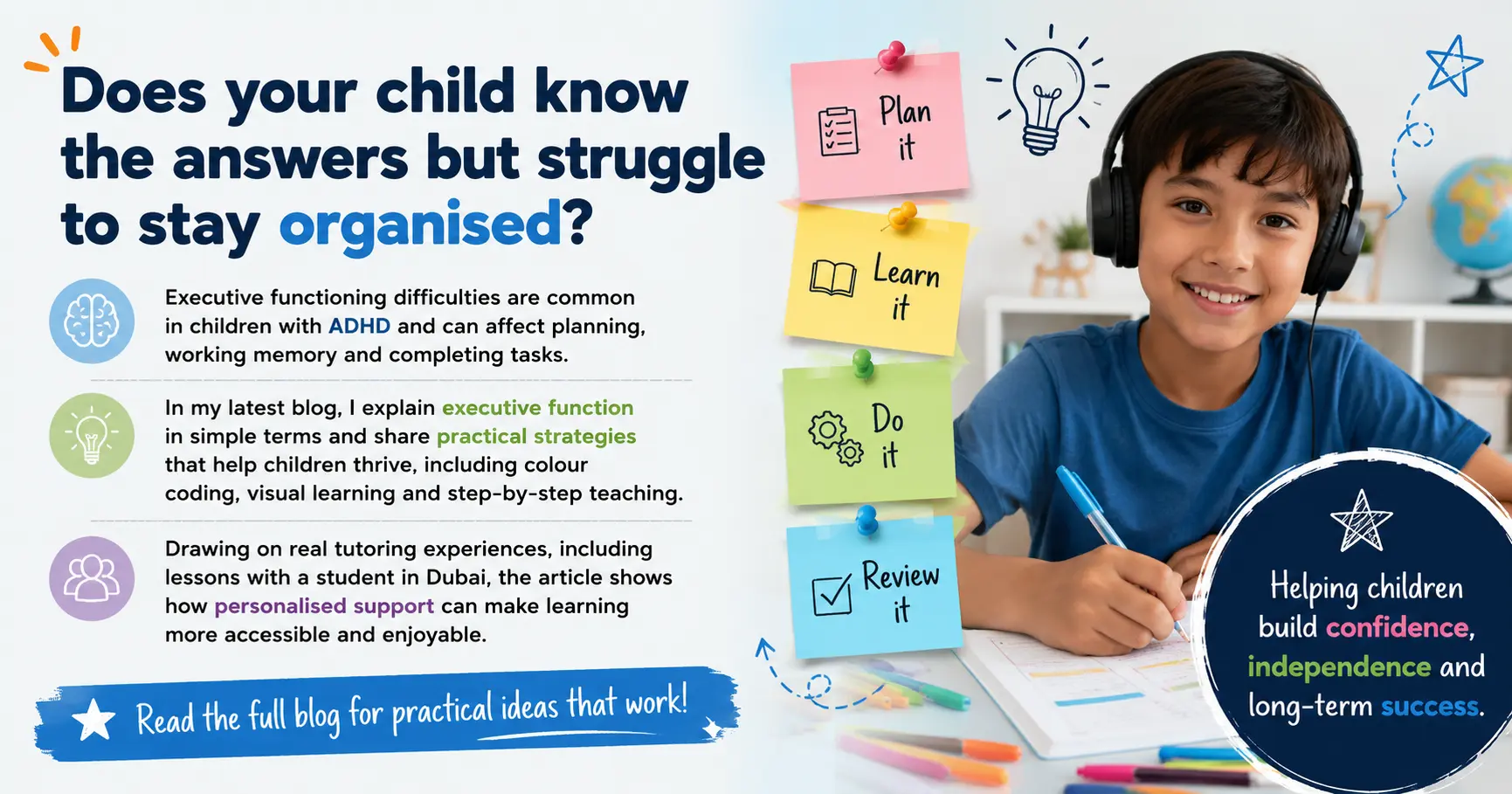
ADHD and Executive Function: Simple Strategies That Help Children Thrive
If your child has ADHD, you have probably experienced moments that leave you scratching your head.They can explain a maths…
Supporting Students with ADHD Through iGCSE English
Preparing for iGCSE English can feel like a daunting prospect for many families, but for children with ADHD, it can…
ADHD in Dubai Schools: Ways Students Can Thrive
Moving to Dubai can be an exciting new chapter for families. The city is home to some of the world’s…
Recognise Strengths Alongside Support Needs
Conversations about additional needs can sometimes become heavily focused on difficulties.
It is important that support needs are understood and properly supported, but they should not become the whole story of a child.
Autistic children have their own interests, personalities, abilities and strengths. Some may develop an exceptionally detailed knowledge of subjects that fascinate them. Some may approach problems in creative or unexpected ways. Others may have strengths that are much quieter and only become apparent when they are given the right opportunity to demonstrate them.
There can also be significant challenges associated with being autistic, and those challenges deserve understanding, appropriate support and respect.
A strengths-based approach does not mean pretending that difficulties do not exist.
It means recognising the whole child.
A child’s support needs and their strengths can exist alongside one another.
Confidence Matters Alongside Curriculum Content
A child can understand something and still find it difficult to show that understanding in a particular setting.
This is something I see across many different learning profiles, including autism, ADHD, dyslexia, dyscalculia and other learning differences.
A learner may know the answer but struggle to organise their thoughts. They may understand a mathematical concept but find it difficult to explain their reasoning. They may have wonderful ideas for a piece of writing but struggle to transfer those ideas onto the page.
This is why I place such importance on creating a learning environment where children feel comfortable making mistakes.
Mistakes are part of learning.
Getting something wrong does not mean that a child has failed. It gives us information about what they understand already and what we might need to revisit.
Over time, small experiences of success can help children develop greater confidence in themselves as learners.
Learning Does Not Have to Look Exactly Like School
Personalised tuition gives us the opportunity to think carefully about how learning is presented.
For some children, movement may support concentration. For others, visual resources may be particularly useful. Some learners may benefit from shorter activities, while others may become deeply absorbed when a subject captures their interest.
Discussion, games, challenges, creative activities and practical examples can all have a place in learning.
These approaches are not exclusively for autistic children. They can benefit many different learners.
The important thing is to consider what helps the individual child engage, understand and demonstrate their learning.
Learning can be purposeful without feeling rigid.
It can be structured without being restrictive.
And it can remain academically ambitious while also being responsive to the needs of the learner.
Finding Their Own Route
Perhaps the most important thing I have learnt is that successful education is not about making every child learn in exactly the same way.
It is about helping each child develop their skills while giving them appropriate opportunities to access learning in ways that work for them.
For one autistic learner, that route might involve visual resources and clear routines.
For another, it might involve talking about a favourite subject before connecting that interest to English or maths.
For another, it might mean additional processing time, breaking tasks into smaller pieces or reducing unnecessary distractions.
And for another child, it might look completely different again.
That is the point.
There is no single autistic learning style.
There is no single teaching strategy that works for every autistic learner.
And there is certainly no expectation that an autistic child should be made to appear less autistic in order to succeed academically.
My ADHD does not make me an expert on autism, and I would never suggest that it does. What it has given me is personal experience of being neurodivergent, an understanding that people can experience learning differently, and a strong reminder to look for the individual rather than making assumptions based on a diagnosis.
Combined with my professional experience supporting children and my personal experience of having an autistic partner, this has shaped the way I approach personalised tuition.
The goal is not to change the child so that they fit the learning.
The goal is to make the learning more accessible to the child while maintaining meaningful and appropriate expectations.
When children feel understood, valued and capable, they can have greater opportunities to show what they know, develop their skills and enjoy learning.
And sometimes, one of the most rewarding parts of that process is discovering a strength that had previously been overlooked.
Supporting Autistic Learners as Individuals
At Bedford Tutor and our online division, Kite Tutoring, we have supported autistic children alongside learners with ADHD, dyslexia, dyscalculia and other learning differences for many years.
Our approach begins with the individual learner rather than assuming that a particular diagnosis tells us everything we need to know.
Personalised in-person, hybrid and online lessons can be adapted around the child’s needs, interests, communication preferences and learning goals, while continuing to work towards meaningful academic progress.
Whether your child is working towards school qualifications, following the British or American Curriculum abroad, being home educated or simply needs additional support with English or maths, we aim to create a learning environment where they can develop their skills and confidence.
Sometimes a child does not need someone to push them harder.
Sometimes they need someone to look carefully at the path in front of them and ask:
“What could make this more accessible?”
Because when we take the time to understand the individual learner, we give them more opportunities to show what they know, develop their skills and experience themselves as capable learners.
And sometimes, that is where the most meaningful progress begins.
Bel 😊
Related Posts
What Makes an Online Tutor a Good Fit for a Child with ADHD?
Finding the right online tutor for a child with ADHD is about far more than finding someone who knows their English or maths curriculum.
Of course, subject knowledge matters. Experience matters too. But, in my experience, the most important question is whether the tutor understands how that particular child learns.
ADHD does not look the same in every person. I know this personally. I was not diagnosed with ADHD until I was 31. Because I loved learning and generally did well academically at school, nobody really questioned whether ADHD might be part of the picture. Looking back, however, I can see that I could become intensely absorbed when something captured my imagination, whilst repetitive or uninteresting tasks were much harder to sustain. I also struggled with working memory and multi-step instructions.
That experience has shaped the way I teach.
There is no such thing as a standard ADHD learner. My own experience has taught me that my ADHD is not somebody else’s ADHD, and their ADHD is not mine. What works beautifully for one child may be completely wrong for another.
So, what should parents look for when choosing an online tutor for a child with ADHD?
A tutor who makes learning interesting
For me, this is one of the biggest things.
Many ADHD learners have what we might describe as an interest-driven nervous system. When something is genuinely fascinating, attention can suddenly become incredibly powerful. When something feels repetitive, disconnected from real life or simply boring, maintaining that attention can be much harder.
This is something I recognise from my own life. As a child, I could put enormous effort into something that had grabbed me, but sustaining effort on something that did not interest me was another matter entirely.
That is why I don’t believe an ADHD-friendly lesson should simply be a worksheet followed by another worksheet.
I want lessons to have energy.
We might play a game, tackle a challenge, discuss an unusual topic, use a visual resource, solve a practical problem or suddenly take the lesson in a completely different direction because the child has become fascinated by something.
Variation and novelty can make a huge difference.
This does not mean that learning lacks structure. Quite the opposite. A good tutor can provide a strong framework whilst changing what happens inside it.
A tutor who starts with the child, not the worksheet
One of the great advantages of one-to-one online tuition is that there is no need to teach every child in exactly the same way.
I can look at the child sitting in front of me and think: What is going to make this work for them?
For one learner, that might mean movement and interactive activities. For another, it could mean visual resources. For someone else, it might mean breaking a difficult task into smaller pieces or using a practical example.
My current approach is very much strengths-based. Rather than viewing ADHD simply through the difficulties it can create, I want to understand a child’s interests, strengths, personality and ambitions too. This is consistent with the wider approach I use across my SEND tuition, where lessons are adapted to the individual learner rather than expecting the learner to fit a fixed model.
And sometimes those interests can completely transform a lesson.
When maths meets motorsport
One of my current online students is absolutely passionate about motorsports.
He doesn’t just enjoy watching motorsport. He has a genuine ambition to establish a business connected with the industry.
So why would I teach him maths using completely unrelated examples if I don’t have to?
Instead, we have explored mathematics through the things he actually cares about.
We’ve looked at costings connected with motorsport, discussed business ideas and used real-world situations to make mathematical concepts more meaningful. We’ve also designed logos and talked about what a potential business website might need.
Suddenly, maths is no longer just maths.
It is part of his future.
This is precisely why I believe interests are so powerful for ADHD learners. We are not removing the educational objective. We are changing the route we take to get there.
A lesson about percentages might become a discussion about profit margins. A problem-solving activity might involve working out costs. English could involve writing website content or thinking about how a business should communicate with customers.
The curriculum is still there. We have simply given it a reason to matter.
A tutor who understands the importance of clear steps
Interest alone is not enough.
Children with ADHD can understand a concept perfectly well and still become overwhelmed when a task contains too many steps.
This is something I recognise from my own experiences. Multi-step instructions have historically been an area of difficulty for me, and it is one of the reasons I am very conscious about how I present information to children.
If a mathematical problem requires five stages, I don’t necessarily expect a child to hold all five stages in their working memory.
Instead, we might write them down.
Step 1: What information do we have?
Step 2: What do we need to find?
Step 3: Which operation do we need?
Step 4: Complete the calculation.
Step 5: Check the answer.
Colour-coding can be incredibly useful here too.
Perhaps the important numbers are highlighted in yellow, the operation is blue and the final answer is green. For a child who finds a page visually overwhelming, suddenly there is a pathway through it.
A large problem becomes a collection of smaller, manageable jobs.
This is very much in keeping with the ADHD-friendly strategies I use: visual structure, checklists, step-by-step instructions and breaking larger tasks into smaller chunks.
Client gallery powered by Picflow
A tutor who has plenty of resources – but knows when to use them
In a classroom, one of the wonderful things we have is a wealth of resources.
We don’t have to teach every child with the same book, the same worksheet or the same activity.
If I know that a child loves dinosaurs, I can find dinosaur-related material. If they love sport, we can use sport. If they are fascinated by space, animals, cars or cooking, those interests can become bridges into learning.
This is particularly valuable with ADHD because interest can be the doorway into attention.
I have seen this with a girl I work with who absolutely loves nature. Rather than trying to make every reading comprehension about an arbitrary subject, we have used wildlife and nature-based comprehensions to develop her reading.
And it works beautifully because she already wants to know the answer.
She is not simply reading because an adult has told her to read. She is reading because she wants to discover something about an animal or the natural world.
That distinction matters.
A tutor who is patient and kind
Perhaps this sounds obvious, but I think it is one of the most important qualities of all.
Children with ADHD can spend an enormous amount of time being told to concentrate, stop fidgeting, listen properly, remember things and try harder.
Eventually, repeated correction can begin to affect confidence.
I remember how important it was when teachers recognised the things I did well. The teachers I remember most warmly were not necessarily those who were the strictest. They were the ones who noticed my enthusiasm, creativity and determination.
A good tutor needs patience.
They need to be able to say, Let’s try that another way.
They need to be comfortable repeating an explanation without making a child feel silly.
They need to celebrate the small victories.
And, perhaps most importantly, they need to help a child understand that finding something difficult does not mean they are incapable.
The best online tutor sees the whole child
Ultimately, I don’t think there is one perfect formula for tutoring a child with ADHD.
Some children love structure. Others need more flexibility. Some want to talk constantly. Others need quiet. Some thrive on games and movement, whilst others become completely absorbed by a particular subject.
The tutor’s job is to notice.
My own ADHD has taught me that neurodivergence is wonderfully varied. It has also taught me that children should not have to squeeze themselves into a particular model of what a learner is supposed to look like.
For me, the best online tuition combines kindness, structure, creativity, variation and genuine interest in the child.
It is about making learning entertaining without losing the educational purpose.
It is about taking a difficult multi-step problem and turning it into manageable steps.
It is about using colour, visuals and practical examples when they help.
It is about finding the subject that makes a child’s eyes light up and then asking, How can we use this to teach?
And sometimes, that means turning maths into motorsport.
Sometimes it means turning reading into wildlife exploration.
Sometimes it means designing a business logo, discussing a webpage or working out how much something would cost.
When we start with the child, rather than simply starting with the curriculum, learning can become something very different.
It can become something they actually want to do.
A personalised approach to ADHD tuition
Here at Kite Tutoring, the online division of Bedford Tutor, I have supported learners across the UK and around the world for many years. My own experience of ADHD, combined with more than fourteen years of educational experience, has shaped a flexible, strengths-based approach to tuition. I work with children who have ADHD, dyslexia, dyscalculia, autism and other learning differences, adapting lessons around their individual needs, interests and goals.
Whether that means developing reading through a child’s love of wildlife, making maths relevant through a passion for motorsport, or simply finding a clearer way through a multi-step problem, I believe children learn best when they feel understood.
To find out more, please see below:
Bel 😊
Related Posts
Morphology for Dyslexia: Powerful Ways to Improve Spelling
When most people think about improving spelling, they imagine practising word lists over and over again.
For many children, particularly those with dyslexia, that approach can quickly become repetitive, frustrating and, ultimately, ineffective.
Over the years, I’ve found that one of the best ways to help children become more confident spellers is to help them understand why words are built the way they are. Rather than relying solely on memorisation, we explore the building blocks of language itself.
This is where morphology becomes such a powerful learning tool.
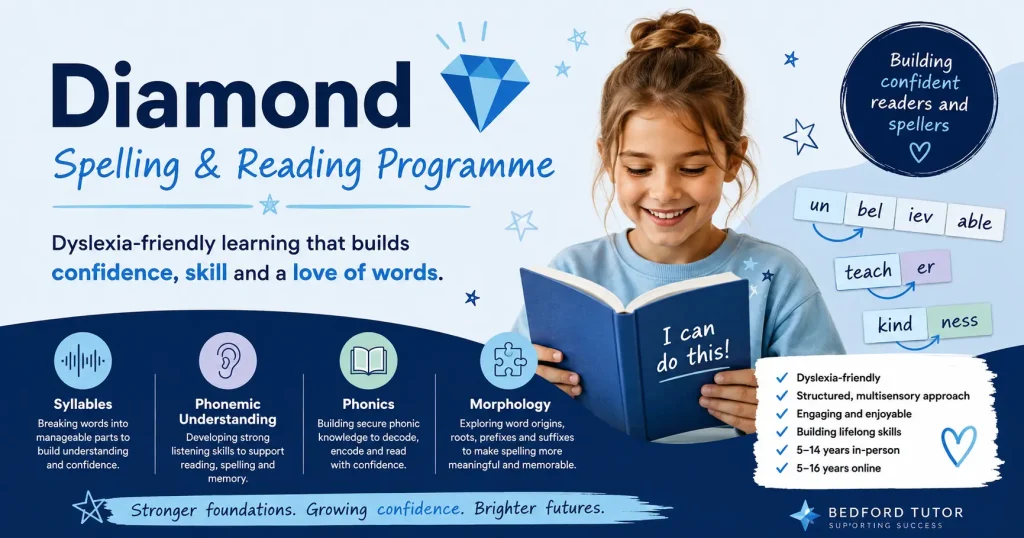
Although we’ve been incorporating elements of morphology into our tuition for many years through our Diamond Spelling & Reading Programme, from September we’ll be expanding this aspect of our lessons even further, giving children even more opportunities to discover the fascinating stories hidden inside words.
What Is Morphology?
Morphology is simply the study of the parts that make up words.
Many English words are built from prefixes, suffixes and root words. Once children begin to recognise these patterns, spelling starts to feel far less random.
Instead of seeing a long, unfamiliar word as one enormous challenge, they begin to spot familiar pieces they already know.
For example, understanding that helpful, careful and playful all share the suffix -ful helps children make connections between words rather than learning each one in isolation.
Likewise, recognising prefixes such as un-, re- or dis- allows children to decode and spell new vocabulary with much greater confidence.
Rather than memorising hundreds of individual spellings, they start recognising the patterns that link them together.
Why Morphology Can Be Particularly Helpful for Dyslexic Learners
Many children with dyslexia are excellent pattern spotters.
Once they begin recognising how words fit together, spelling often becomes much more logical and far less overwhelming.
Instead of asking, “How do I remember this word?”, they begin asking, “What parts can I already recognise?”
That small shift in thinking can make a remarkable difference.
Morphology also supports vocabulary development and reading comprehension. As children learn what different roots and affixes mean, they often find it much easier to work out the meanings of unfamiliar words when reading independently.
It’s another example of one skill supporting several areas of literacy at once.
Making Spelling Memorable Through Creativity
One thing I’ve learnt over the years is that children rarely remember something simply because they’ve copied it twenty times.
They remember experiences.
That’s why creativity plays such an important role in my lessons.
If we’re learning a new root word, we might draw it as a cartoon character. If we’re exploring a prefix, we may invent a silly story explaining where it came from. Sometimes we’ll create ridiculous sentences that make everyone laugh, because humour has a wonderful way of helping information stick in our memories.
Drawing, storytelling and imaginative activities transform spelling from something children have to do into something they actually enjoy.
Many neurodivergent learners are highly visual thinkers, and creating funny images or memorable stories often helps words stay in long-term memory far more effectively than repetition alone.
The more senses involved in learning, the more opportunities the brain has to create lasting connections.

Learning Should Be Fun
This has always been one of my guiding principles.
Children learn best when they are engaged.
Over the years, we’ve used games, visual resources, discussion, word-building activities and creative challenges to help children understand how English works. Morphology has quietly been part of that process for a long time, even if we haven’t always labelled it as such.
From September, however, we’ll be placing an even greater emphasis on exploring word families, roots, prefixes and suffixes in a structured but highly creative way.
The aim isn’t simply to improve spelling accuracy.
It’s to help children become curious about language.
When children begin asking questions like, “Why does that word end like that?” or “Where did this word come from?”, they’re no longer just memorising spellings. They’re becoming language detectives.
Looking Ahead to September
One student I’m particularly excited to continue working with is a wonderful young learner I tutor online in Dubai, UAE.
We’ve already made fantastic progress in developing confidence with reading and spelling, and from September we’ll be exploring morphology in much greater depth together. I can’t wait to see the connections they begin making as they discover how words are built and how those patterns can make spelling both easier and far more enjoyable.
Watching those moments of understanding is one of the greatest pleasures of teaching.
Suddenly, words that once seemed impossible begin to make sense.
Confidence grows.
And perhaps most importantly of all, children begin to realise that spelling isn’t simply about remembering random letters. It’s about understanding a wonderfully interconnected language that is full of patterns, history and fascinating discoveries waiting to be explored.
Here at Bedford Tutor, I have been supporting children with dyslexia, ADHD and other special educational needs for many years through highly personalised English tuition. As part of our Diamond Spelling & Reading Programme, we’ll be expanding our work on morphology from September, helping children discover the building blocks of words through creative, engaging and multi-sensory activities that make spelling both memorable and enjoyable.
To find out more, please click on the relevant link below:
Bel 😊
Related Posts
ADHD in Dubai Schools: Ways Students Can Thrive
Moving to Dubai can be an exciting new chapter for families. The city is home to some of the world’s leading international schools, offering British, American, IB and other internationally recognised curricula. For many children, the transition brings new friendships, opportunities and experiences.
However, for students with ADHD, starting or attending an international school can present some additional challenges. New routines, unfamiliar expectations and the fast pace of school life can all place extra demands on executive functioning skills.
The good news is that children with ADHD can absolutely thrive in international schools when they receive the right understanding and support. As someone who was diagnosed with ADHD as an adult and who has spent many years supporting neurodivergent learners both in the UK and overseas, I’ve seen first-hand just how transformative the right environment can be.
ADHD Looks Different in Every Child
One of the biggest misconceptions surrounding ADHD is that every child experiences it in the same way.
Some children are highly energetic and impulsive, whilst others appear quiet, thoughtful and easily distracted. Some excel academically but struggle with organisation, whilst others find traditional classroom learning difficult from an early age.
My own experience taught me this lesson. I loved learning, achieved well at school and was often described as organised, yet I also experienced distractibility, impulsivity and difficulties with attention that weren’t recognised until adulthood. ADHD is incredibly diverse, and understanding that diversity is often the first step towards effective support.
Rather than asking, “Does this child look like someone with ADHD?” it is far more helpful to ask, “How does this particular child’s brain work best?”
Why International Schools Can Be Both Wonderful and Challenging
Dubai’s international schools are incredibly diverse. Children often learn alongside classmates from dozens of different nationalities, creating rich cultural experiences that many ADHD learners genuinely enjoy.
At the same time, international education often involves:
- High academic expectations.
- Frequent assessments.
- Busy timetables.
- Large social environments.
- Transitions between different curricula.
Executive functioning skills such as organisation, working memory, planning and time management are essential for navigating these demands. These are precisely the areas where many ADHD learners need additional support.
When schools recognise these differences and adapt accordingly, children often flourish.
Creating Predictable Routines
Children with ADHD generally cope far better when they know what to expect.
Predictable classroom routines reduce uncertainty and free up mental energy for learning. Visual timetables, written instructions and clear expectations can make an enormous difference.
Many international schools in Dubai already make excellent use of technology. Homework platforms, digital calendars and online learning systems can all become valuable organisational tools when used consistently.
Consistency between school and home also helps children feel secure.
Supporting Executive Function Skills
Executive functioning is often described as the brain’s management system.
Students with ADHD may know exactly what they need to do but struggle to begin, remember instructions or organise materials efficiently.
Practical strategies include:
- Breaking larger tasks into manageable sections.
- Providing checklists.
- Using colour coding for subjects.
- Allowing extra planning time.
- Teaching organisation explicitly rather than assuming children naturally acquire these skills.
These strategies benefit many learners, not just those with ADHD.
Movement Helps Learning
One of the greatest myths surrounding education is that good learning always happens whilst sitting perfectly still.
Many ADHD learners actually concentrate better when movement is incorporated into their day.
Simple adjustments might include:
- Standing while completing part of a task.
- Short movement breaks.
- Stretching between activities.
- Using discreet fidget tools where appropriate.
- Interactive learning activities.
Looking back, many of my happiest learning experiences involved active participation rather than simply listening. For many children, movement supports attention rather than distracting from it.
Confidence Is Just as Important as Academic Support
Perhaps the greatest danger facing many ADHD learners isn’t the ADHD itself.
It’s losing confidence.
Children who regularly forget homework, misplace equipment or struggle to complete tasks may begin believing they’re lazy or incapable.
Nothing could be further from the truth.
Many ADHD learners are incredibly creative, curious and imaginative. They often ask insightful questions, think laterally and approach problems from fresh perspectives.
The role of parents and teachers is to ensure these strengths are recognised alongside the challenges.
A child who believes in themselves is far more likely to persevere through difficult moments.
Working Together Makes the Difference
The strongest outcomes happen when parents, teachers and tutors communicate openly.
This is particularly valuable in international schools where families may also be adapting to life in a new country.
Regular conversations about:
- What is working well.
- Current challenges.
- Helpful classroom strategies.
- Emotional wellbeing.
- Academic progress.
allow everyone to support the child consistently.
When children receive the same messages of encouragement both at home and at school, their confidence often grows remarkably quickly.
Online Tuition Can Complement International School Learning
Many families in Dubai choose online tuition to reinforce learning without adding unnecessary pressure.
One-to-one lessons provide opportunities to revisit concepts, strengthen executive functioning skills and build confidence in a calm environment.
Because lessons are personalised, they can adapt to the individual learner rather than expecting the learner to adapt to a rigid teaching style.
This flexibility is particularly valuable for ADHD learners, who often benefit from engaging, interactive lessons that match their interests and learning preferences.
Final Thoughts
Children with ADHD don’t need to become different learners.
They need learning environments that recognise how their brains naturally work.
International schools in Dubai already offer exceptional educational opportunities. When these are combined with understanding, flexible teaching and strong communication between home and school, ADHD learners can achieve remarkable things.
Most importantly, children need to know that ADHD is not a limitation on their potential. Every learner’s strengths and challenges are unique, and with the right support they can develop the confidence, resilience and skills to flourish both academically and personally.
Here at Bedford Tutor, I have supported learners attending international schools across Dubai, the wider UAE and around the world for many years. From personalised English and maths tuition to support for children with ADHD, dyslexia, dyscalculia and autism, I aim to create engaging lessons that build confidence whilst working with each child’s individual strengths. Having ADHD myself has also given me a personal understanding that no two neurodivergent learners are ever the same.
To find out more, please click on the relevant link below.
Bel 😊
Related Posts
Supporting Home-Educated Children in English and Maths
Home education has become increasingly popular in recent years and, having worked with home-educated learners for many years, I have seen first-hand how effective personalised learning can be.
One of the things I love most about working with home-educated students is the freedom to adapt learning to the individual child. Every learner is different. Some children race ahead in certain subjects whilst needing more time in others. Some thrive with structure and routine, whilst others flourish when lessons are creative, flexible and shaped around their interests.
Over the years, I have supported home-educated students from all over the UK and from countries across the world. Although every family has chosen home education for different reasons, they often have one thing in common: a desire to provide a learning experience which truly meets the needs of their child.
My own journey into online tuition expanded significantly during the COVID-19 pandemic. Whilst the world was adjusting to remote learning, I was helping a large number of children continue their education online. What began as a necessity quickly revealed something surprising. Many children actually thrived in a one-to-one online environment. Without the distractions of a busy classroom, they were often more confident, more engaged and more willing to take risks in their learning.
Since then, online tuition has become a major part of my work and I now support home-educated learners in a variety of locations, helping them develop confidence in both English and mathematics.
One of my priorities is always to make lessons enjoyable.
Learning should be engaging, particularly when children are working one-to-one. Whilst it is important to cover key curriculum content and develop essential skills, I strongly believe that children learn best when they are interested in what they are doing. For this reason, I regularly use games, challenges, creative activities and discussion-based learning to bring lessons to life.
As someone who works with many neurodivergent learners, I know that engagement is often the key to success.
I currently support home-educated students with ADHD, dyslexia, dyscalculia and autism. Many of these children have previously found traditional educational environments challenging and benefit from a more personalised approach. Rather than expecting every learner to fit a particular mould, I adapt lessons to suit the child sitting in front of me.
For some students, this means incorporating movement, visual resources and highly interactive activities. For others, it may involve breaking learning into smaller chunks, developing confidence gradually or exploring concepts through practical examples.
Alongside English and mathematics tuition, I also currently support students working towards Functional Skills English and Functional Skills Maths qualifications. These qualifications provide valuable pathways for many learners and can help build confidence whilst developing essential life skills.
One of the greatest advantages of home education is the ability to learn at the right pace. There is often more time to revisit areas of difficulty, explore personal interests and celebrate progress without the pressure that can sometimes accompany traditional schooling.
Whether a child is preparing for Functional Skills qualifications, developing confidence in literacy and numeracy, or simply benefiting from additional support as part of their home education journey, personalised online tuition can provide valuable structure, encouragement and expertise.
Most importantly, I believe that every child deserves to feel successful.
When children feel understood, supported and confident in their abilities, remarkable things can happen. My goal is always to create lessons which are engaging, encouraging and tailored to the unique strengths and needs of each learner.
After all, successful education is not about forcing every child down the same path. Sometimes it is about finding the path which works best for them.Here at Bedford Tutor, I have supported home-educated learners across the UK and around the world for many years. From Functional Skills English and Maths to personalised learning programmes for children with ADHD, dyslexia, dyscalculia and autism, I have developed a flexible and engaging approach that helps students build confidence whilst developing the essential skills they need to thrive.
To find out more, please click on the relevant link below:
Bel 😊Related Posts
Does Dyslexia Affect GL Assessment Scores? A Guide for Parents
If your child has dyslexia and is preparing for GL Assessments, it’s completely natural to wonder whether their diagnosis will affect their results.
Over the years, this is one of the questions I’ve been asked most often by parents whose children attend international schools. Many worry that a lower score might mean their child isn’t capable academically.
The reassuring news is this: dyslexia can affect GL Assessment scores, but it does not measure intelligence or potential.
Why can dyslexia affect GL Assessments?
Many GL Assessments include tasks involving reading, comprehension, spelling, grammar and written language. Whilst these assessments are designed to measure attainment, children with dyslexia often have to work much harder to access the questions in the first place.
Imagine two children who understand exactly the same concept.
One child reads the question quickly and begins answering almost immediately.
The other child has to spend extra time decoding unfamiliar words before they can even begin thinking about the answer.
Although both children may have the same understanding, the second child has already used valuable time and mental energy.
This is why dyslexia can sometimes affect assessment performance.
Which areas are most affected?
Depending on the assessment, dyslexic learners may find some sections more challenging than others.
These can include:
- Reading comprehension
- Grammar and punctuation
- Spelling
- Vocabulary
- Timed written tasks
Children may know the answers but struggle to work at the same speed as their peers.
Many dyslexic learners also experience slower processing speed or reduced working memory, making timed assessments particularly demanding.
What about reasoning tests?
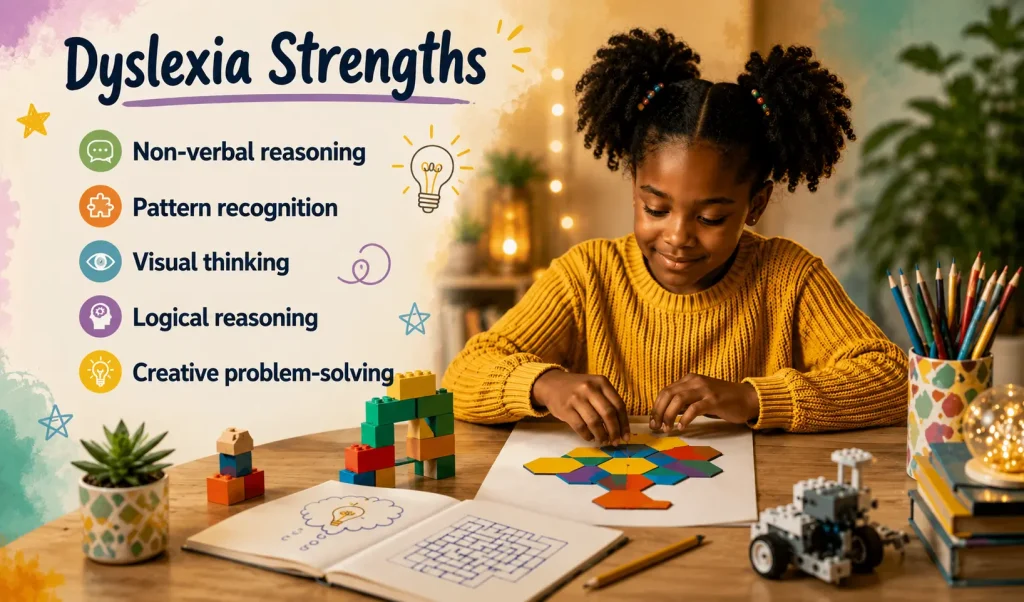
One thing I always enjoy telling parents is that dyslexia does not affect every area equally.
Many children with dyslexia perform extremely well in:
- Non-verbal reasoning
- Pattern recognition
- Visual thinking
- Logical reasoning
- Creative problem-solving
In fact, many dyslexic learners have exceptional strengths in these areas.
Every child has a unique profile of strengths and challenges, which is why one assessment score should never define their ability.

Can children receive extra support?
If a child has a formal diagnosis of dyslexia, schools may be able to apply for access arrangements, depending on the type of GL Assessment being used and the school’s policies.
These might include:
- Extra time
- Supervised rest breaks
- A reader for certain assessments
- Other reasonable adjustments where appropriate
If your child has recently been diagnosed, it’s always worth speaking with their school well before the assessment date to discuss what support may be available.
Preparation is about confidence, not cramming
One of the biggest misconceptions about GL Assessments is that children need endless practice papers.
In my experience, this rarely produces the best results.
Children tend to perform much better when they understand the question styles, feel confident in their own abilities and approach assessments calmly.
For dyslexic learners, preparation often works best when it is engaging and multi-sensory.
Rather than completing worksheet after worksheet, I like to use games, discussion, visual resources and practical activities to develop reading, vocabulary and reasoning skills in an enjoyable way.
When children enjoy learning, they usually remember much more.
Remember: A score is only one snapshot
Perhaps the most important thing for parents to remember is that a GL Assessment score is simply one piece of information.
It is not a measure of intelligence.
It does not predict future success.
It certainly doesn’t define your child’s potential.
Some of the most creative, innovative and successful people in the world are dyslexic. They simply learn differently.
Every child deserves the opportunity to demonstrate what they know in a way that allows them to succeed.
Final Thoughts
If your child has dyslexia, it’s understandable to feel anxious about GL Assessments. However, with the right preparation, appropriate support and growing confidence, many dyslexic learners perform far better than they or their parents expected.
Most importantly, remember that assessments measure performance on one particular day—not your child’s worth, intelligence or future.
Here at Bedford Tutor, I have supported many children with dyslexia preparing for GL Assessments in international schools across the UK and around the world. Through personalised, multi-sensory English tuition and confidence-building lessons, I help learners develop the reading, vocabulary, spelling and reasoning skills they need to approach assessments with greater confidence and success.
To find out more, please click on the relevant links below:
Bel 😊
Related Posts