Bedford, UK


If your child is preparing for a GL Assessment English paper, you’ve probably wondered how to help them improve their vocabulary. Many parents imagine they need to buy expensive vocabulary books or spend hours memorising long lists of unfamiliar words. Whilst learning new vocabulary is certainly important, that isn’t how most children develop a rich and lasting understanding of language.
Having worked with many children preparing for GL Assessments, one thing has become very clear to me. The children who make the greatest progress are usually those who encounter new words naturally through reading, conversation, games and everyday experiences. Vocabulary isn’t simply about knowing a definition. It’s about understanding how words are used, recognising them in different contexts and feeling confident enough to use them in both speech and writing.
The good news is that building vocabulary doesn’t have to feel like hard work. In fact, some of the most effective learning happens when children don’t even realise they’re practising.
Why Vocabulary Matters in GL Assessment English
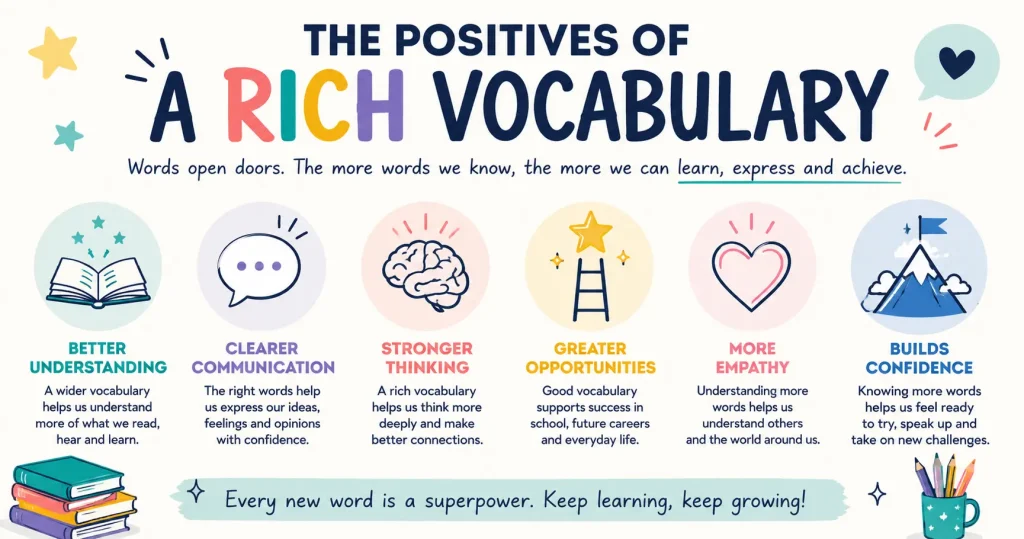
Vocabulary underpins almost every part of the English assessment.
A broad vocabulary helps children to:
- Understand reading comprehension passages.
- Work out the meaning of unfamiliar words.
- Answer inference questions more confidently.
- Recognise subtle differences between similar words.
- Write with greater precision and imagination.
Sometimes one unfamiliar word can make an entire paragraph difficult to understand. Equally, a child with a wide vocabulary often finds it easier to identify clues within a text and make sensible predictions about what an author is trying to say.
Fortunately, vocabulary grows steadily over time, making it one of the easiest areas to improve through enjoyable daily habits rather than intensive last-minute revision.
Read Widely and Read Often
If I could recommend just one activity for building vocabulary, it would be reading.
Books expose children to thousands of words they may never encounter in everyday conversation. Unlike vocabulary lists, stories provide context. They show how words behave, the emotions they convey and how different authors use language to create atmosphere.
Encourage your child to read a wide variety of material, including:
- Adventure stories
- Mystery novels
- Non-fiction books
- Children’s magazines
- Newspapers aimed at young readers
- Biographies
- Poetry
Each genre introduces different vocabulary and helps children become more flexible readers.
One thing I always reassure parents about is that children don’t need to understand every unfamiliar word immediately. Often, simply seeing a word several times allows its meaning to become clear naturally.
Talk About New Words
Vocabulary learning doesn’t stop when the book closes.
Whenever an interesting word appears whilst reading together, watching television or even chatting at home, take a moment to explore it.
You might ask:
- What do you think that word means?
- Can we work it out from the sentence?
- Have you heard anything similar before?
- Can you think of another word with the same meaning?
These relaxed conversations often develop a much deeper understanding than asking a child to memorise a dictionary definition.
Sometimes we even discuss why an author has chosen one word instead of another. Why describe a character as furious rather than simply cross? Why write whispered instead of said? These conversations help children appreciate how carefully chosen words create stronger writing.
Make Vocabulary Part of Everyday Conversation
One of the easiest ways to build vocabulary is simply by using richer language yourself.
Vocabulary doesn’t belong only in English lessons.
Some of the best conversations happen during car journeys, whilst walking the dog or sitting around the dinner table.
Instead of always choosing familiar words, naturally introduce more ambitious vocabulary into everyday speech.
Rather than saying something is big, you might describe it as enormous, vast or immense.
Instead of saying someone is happy, perhaps they’re delighted, thrilled, content or ecstatic.
Children gradually absorb these words because they hear them being used naturally.
Over time, they begin to use them themselves.
Play Vocabulary Games
One of the biggest misconceptions about vocabulary building is that children need to sit quietly with worksheets.
In reality, some of the best vocabulary learning happens through games.
One activity I regularly play with students is a vocabulary version of I Spy.
Rather than saying, “I spy with my little eye something beginning with B,” I’ll ask them to find something that is transparent, circular, fragile, tiny, gigantic, ancient or colourful.
Sometimes we’ll choose one object and think of as many describing words as we possibly can.
A tree might become towering, leafy, gnarled, majestic, windswept or ancient.
Not only does this build vocabulary, but it also encourages children to observe the world around them more carefully. The game quickly becomes less about spotting objects and more about selecting exactly the right word.
Children usually don’t even realise they’re practising English.
We also enjoy playing synonym challenges, category games and “Can you think of a better word?” These simple activities encourage children to become curious about language rather than seeing vocabulary as something to memorise.
Learn One New Word Every Day
One of my favourite routines is learning just one new word each day.
Rather than overwhelming children with long vocabulary lists, we choose a single interesting word and spend time exploring it properly.
We discuss:
- What the word means.
- Where it might be used.
- Whether it has any synonyms or antonyms.
- How we could use it naturally in conversation.
- Whether we’ve heard it before in a book or film.
Sometimes we challenge ourselves to use the word several times during the lesson.
For example, if our word of the day is reluctant, we might talk about being reluctant to tidy our bedrooms, reluctant to try a new food or reluctant to leave for school after a holiday.
Connecting vocabulary to real experiences makes the word much more memorable than simply copying out a definition.
The results soon add up.
One new word every day becomes seven each week, dozens every month and hundreds over the course of a year.
Keep a Favourite Words Notebook
Many children enjoy collecting words they find interesting.
Rather than writing endless lists, encourage your child to keep a notebook filled only with words they genuinely like.
They could include:
- The new word.
- Its meaning.
- A sentence using it.
- A small picture to help remember it.
- Similar words.
Because the words are personally meaningful, they’re often remembered far more easily.
It’s also lovely to look back through the notebook after a few months and see just how much vocabulary has been learnt.
Become a Word Detective
Children preparing for GL Assessments don’t need to know every word they encounter.
Instead, they need the confidence to work out unfamiliar vocabulary independently.
I often encourage children to become “word detectives”.
When they come across an unfamiliar word, we look for clues.
Can we spot a familiar prefix or suffix?
Does the rest of the sentence help?
Does the word remind us of another word we already know?
Developing these detective skills helps children approach challenging texts with confidence rather than immediately giving up.
Build Vocabulary Through Real Life
Some of the strongest vocabulary learning happens away from books altogether.
A visit to a museum introduces historical language.
Cooking together teaches words such as measure, combine, whisk and simmer.
Nature walks introduce vocabulary like habitat, camouflage, predator, migration and evergreen.
Shopping provides opportunities to discuss words such as budget, compare, quality and ingredients.
Because children experience these words in real situations, they often remember them much more successfully.
Final Thoughts
Preparing for a GL Assessment English paper isn’t about cramming hundreds of ambitious words the week before the assessment.
Vocabulary develops steadily through reading, conversation, curiosity and enjoyable everyday experiences.
Some of the richest learning happens during simple moments: spotting descriptive words during a game of I Spy, discussing an unfamiliar word whilst reading together or discovering a new “Word of the Day” and finding opportunities to use it naturally.
These small habits gradually build the confidence children need when they encounter unfamiliar vocabulary in their GL Assessments. More importantly, they help children become thoughtful readers, confident writers and lifelong lovers of language.
In my experience, children make the greatest progress when learning feels like an adventure rather than another task on the to-do list.
Here at Kite Tutoring, the online division of Bedford Tutor, we have supported many children preparing for GL Assessments in international schools around the world. We specialise in supporting learners with SEND, including ADHD, dyslexia, dyscalculia and autism, as well as children who are learning English as a second or additional language. Through engaging, personalised lessons, we help students develop rich vocabularies alongside their reading comprehension, grammar and writing skills. Whether your child is preparing for an upcoming GL Assessment or simply wants to become a more confident reader and writer, our lessons are designed to make learning enjoyable whilst building the skills they need to succeed.
To find out more, please click on the relevant link below:
Bel 😊