Supporting Dyslexic Learners in International Schools

Child working with a private tutor on a personalised learning activity in a welcoming study space with books, plants and educational materials.

Children attending international schools often have wonderful opportunities to experience different cultures, languages and ways of learning. For many families living in countries such as the UAE, Singapore, Malaysia, Thailand and Saudi Arabia, international education provides access to excellent academic programmes and a truly global outlook.

However, for dyslexic learners, studying within an international environment can sometimes bring additional challenges.

Having worked with many children attending international schools around the world, I have seen first-hand how dyslexia can sometimes be misunderstood, particularly when a child is learning in a multicultural environment. Yet I have also seen how the right support, understanding and teaching strategies can help dyslexic learners thrive.

Understanding Dyslexia Beyond Reading Difficulties

When people hear the word dyslexia, they often think exclusively about reading.

Whilst reading difficulties can certainly be part of dyslexia, the reality is often much more complex.

Many dyslexic learners may struggle with spelling, writing, working memory, sequencing, organisation and processing information. They are often highly intelligent, creative and capable, but may find certain aspects of traditional education far more demanding than their peers.

One of the most important lessons I have learned through supporting neurodivergent learners is that no two children experience dyslexia in exactly the same way. This mirrors a wider truth across neurodiversity: every learner has their own unique strengths, challenges and learning profile.

The Unique Challenges of International Schools

International schools often bring together students from a wide range of educational backgrounds.

Some children may be studying in English despite it not being their first language. Others may move between countries and curricula multiple times throughout their education.

For dyslexic learners, these transitions can sometimes magnify existing difficulties.

I recently worked with a student who had moved between a number of different countries in just a few years. Whilst academically capable, they had experienced different spelling conventions, curriculum expectations and teaching approaches. Unsurprisingly, their confidence had begun to suffer.

This is something I encounter quite regularly.

Parents often worry that their child is falling behind when, in reality, they are managing multiple educational adjustments alongside dyslexia. Sometimes what appears to be a literacy difficulty is actually a combination of dyslexia, language differences and educational transitions.

Confidence Matters More Than Many Parents Realise

One thing I consistently notice when working with dyslexic learners is that confidence often has a greater impact than ability.

Many children spend years feeling that reading and writing are harder for them than for their classmates. Over time, this can affect their willingness to participate, attempt challenging tasks or take risks in their learning.

I often describe confidence as being like a bucket.

Every success adds a little more water. Every setback removes a little.

For dyslexic learners, particularly those adapting to life in an international school, that bucket sometimes needs careful refilling.

This is why celebrating small achievements is so important. A successful reading activity, an improvement in spelling, or simply showing perseverance with a difficult task can all help rebuild confidence over time.

Multi-Sensory Learning Makes a Difference

Many dyslexic learners benefit from approaches which engage multiple senses simultaneously.

Rather than relying solely on reading from a page, children often learn more effectively when they can see, hear, say and physically manipulate information.

Over the years, I have used a wide variety of multi-sensory techniques, including:

  • Breaking words into syllables
  • Exploring vowel sounds and spelling patterns
  • Using magnetic letters and word-building activities
  • Creating visual memory prompts
  • Drawing pictures to represent difficult words
  • Using games and interactive learning activities

When children can physically interact with language, learning often becomes more accessible and far less intimidating. This approach has proven particularly effective for many of the dyslexic learners I support through personalised tuition.

Supporting Dyslexic Learners Overseas

Families living overseas often face an additional challenge: finding specialist support.

Whilst many international schools provide excellent learning support services, access can vary considerably between countries and schools.

One of the reasons online tuition has become increasingly valuable is that geography no longer limits access to specialist support. Over the years, I have worked with dyslexic learners across the UK and internationally, helping students develop literacy skills whilst building the confidence needed to succeed in their chosen curriculum.

Whether a child is studying the British Curriculum, American Curriculum, preparing for GL Assessments or following another international programme, personalised support can make a significant difference.

Final Thoughts

Dyslexia should never be viewed as a barrier to success.

Some of the most creative, innovative and accomplished individuals throughout history have been dyslexic. The key is ensuring that learners receive the support, encouragement and strategies that allow their strengths to shine.

International schools offer incredible opportunities for young people. When dyslexic learners are understood, supported and given access to appropriate teaching approaches, they can flourish both academically and personally.

After all, success is not about learning exactly like everyone else. It is about finding the approach that allows each child to thrive.

Here at Bedford Tutor, I have supported many dyslexic learners attending international schools across the UAE, Singapore, Malaysia, Thailand, Saudi Arabia and beyond. Through personalised English tuition, multi-sensory learning approaches and confidence-building strategies, I help children develop the literacy skills they need whilst ensuring they feel understood, capable and successful. Whether a student is following the British Curriculum, American Curriculum, preparing for GL Assessments or receiving home education support, my aim is always to help them discover that dyslexia does not limit their potential.

To find out more, please click on the relevant links below:

Bel 😊


Related Posts

Related Blog Posts

  • British Curriculum vs American Curriculum: What Parents Living Abroad Should Know


    One of the questions I am frequently asked by parents living overseas is whether there is a significant difference between the British and American curricula.

    The short answer is yes… and no!

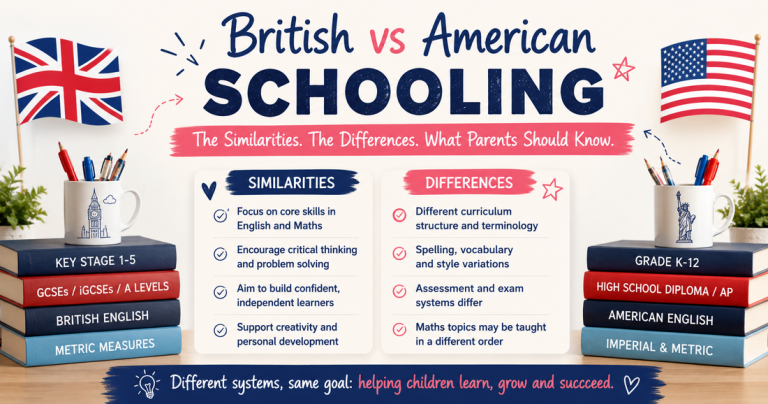
    Having taught children following both educational systems for many years in countries such as the UAE and Thailand, I am often surprised by how similar they really are. Whilst there are certainly some differences in terminology, assessment and curriculum content, both ultimately aim to help children develop the same core skills: confidence in reading, competence in writing and a secure understanding of mathematics. That being said, there are some important distinctions which can occasionally catch families by surprise, particularly when children move between schools or educational systems.​

    One of the most obvious differences appears in English.

    Although British English and American English are essentially the same language, there are some spelling variations which can occasionally cause confusion. For example, a child attending a British school may write colour, favourite and centre, whilst a child following the American curriculum will be expected to write color, favorite and center.

    I often teach both British and American English and one of the first things I reassure children about is that neither version is “wrong”. The important thing is consistency. If a child is studying within an American school, they should use American spellings. If they are following the British curriculum, British spellings are usually expected.

    Fortunately, children tend to adapt remarkably quickly once they understand the differences.

    Over the years, I have also gained extensive experience preparing students for the GL Assessments used by many international schools. These assessments often form an important part of school entry procedures and provide valuable information about a child’s strengths and areas for development. Supporting children through these assessments has given me a strong understanding of the skills many international schools expect students to demonstrate.

    Alongside this, I regularly support students studying iGCSE English Language. I particularly enjoy helping learners develop their reading, writing and analytical skills whilst building the confidence needed to tackle longer pieces of writing and examination questions.

    My experience is not limited to the British curriculum, however.

    I have also worked with students in countries such as Saudi Arabia who follow Common Core English and Mathematics programmes, and regularly support children studying both the British and American curricula. Over the years, working across different educational systems has taught me that successful teaching is rarely about the curriculum itself. More often, it is about understanding the child sitting in front of you and adapting your approach to suit the way they learn best.​

    Mathematics is perhaps where some of the most noticeable differences occur.

    When I first began supporting a student studying the American mathematics curriculum over a longer period of time, I quickly realised that certain concepts were approached differently. The methods were not necessarily better or worse, but they were sometimes presented in a different order or explained using different terminology.

    One area which particularly expanded my own knowledge was the use of imperial measurements.

    Whilst British children are often familiar with miles and occasionally encounter other imperial units, the American curriculum tends to make much greater use of feet, inches, yards, pounds and gallons. Supporting students with these concepts helped me become far more confident teaching measurement systems which are not always covered in depth within the British curriculum.

    Experiences like these have been invaluable because they have allowed me to become more adaptable as a tutor.

    Perhaps the biggest lesson I have learnt is that children are often far more flexible than adults give them credit for. Whether they are learning colour or color, converting centimetres or inches, preparing for GL Assessments or studying iGCSE English Language, the underlying goal remains exactly the same: helping them become confident, capable learners.

    Curricula may vary from country to country, but curiosity, confidence and a love of learning are universal.

    As someone who works with children from a wide range of countries and educational backgrounds, I genuinely enjoy helping students navigate these differences and discover that, regardless of which curriculum they follow, they are capable of achieving great things.

    Here at Bedford Tutor, I have supported children following both the British and American curricula for many years. From GL Assessments and iGCSE English Language to Common Core English and Mathematics, working with learners from different educational systems has helped me develop a flexible approach that allows every child to build confidence whilst developing the skills they need to succeed.

    To find out more, please click on the link below:

    Bel 😊


    Related Posts

  • How to Choose an Online Tutor for a Child with ADHD

    As an ADHDer myself, I completely understand the struggle.

    Whilst ADHD children are often some of the most creative, imaginative and intuitive learners you’ll ever meet, we’re not exactly famous for our ability to sit still and focus on something we find boring. Give us a topic that captures our imagination and we can disappear down a rabbit hole for hours. Ask us to complete a repetitive task that doesn’t spark our interest and our attention can evaporate faster than a puddle on a hot summer’s day.

    I should know.

    As a child, I loved learning, but only when it grabbed my attention. If a lesson fired up my imagination, I was completely invested. If it didn’t, my thoughts would quickly wander elsewhere. Looking back, I can see that I wasn’t being lazy or difficult. My ADHD brain simply needed a different approach.

    That’s why I believe tutoring for children with ADHD should always work with their natural way of thinking rather than against it.

    Of course, we need to prepare young people for a world which often demands organisation, resilience and sustained effort. However, that doesn’t mean tuition should feel like an exercise in corporate boardroom levels of concentration.

    ADHD learners are distractible, impulsive and prone to wandering thoughts, but we’re also incredibly curious, creative and capable of making connections that other people sometimes miss.

    When looking for an online tutor for a child with ADHD, there are three things I would always recommend considering.

    A Tutor Who Offers Flexible Session Lengths

    Many children with ADHD find long lessons exhausting.

    Whilst some students thrive during hour-long sessions, others achieve far more during shorter, highly-focused lessons. For some children, thirty minutes of engaging learning can be significantly more productive than an hour spent battling mental fatigue.

    Every child is different, but flexibility is important. A good tutor should be willing to adapt lesson length to suit the learner rather than expecting every student to fit the same model.

    A Tutor Who Makes Learning Interesting

    One of the most important things to understand about ADHD is that we have interest-driven nervous systems.

    When something genuinely interests us, learning happens naturally. When it doesn’t, maintaining attention can feel like trying to catch smoke with a butterfly net.

    This is why engagement matters so much.

    Look for a tutor who brings energy, creativity and enthusiasm into their teaching. Games, discussion, humour, challenges and interactive activities can transform learning from something a child has to do into something they genuinely enjoy.

    In my experience, if a child looks forward to their tuition sessions, you’ve probably found the right tutor.

    A Tutor Who Sees The Whole Child

    Whilst academic progress is often the reason parents initially seek tuition, successful learning involves much more than grades and test scores.

    Many children with ADHD struggle with confidence. After years of forgotten homework, careless mistakes and being told they need to “try harder”, some begin to doubt their own abilities.

    The right tutor should recognise strengths as well as difficulties.

    They should understand that motivation is often linked to personal interests and that confidence can be just as important as academic knowledge. They should also appreciate that ADHD frequently exists alongside other differences, including anxiety, autism, dyslexia and sensory processing challenges.

    Most importantly, they should see your child as a unique individual rather than a list of symptoms.

    Finding The Right Fit

    There is no such thing as the perfect tutor for every ADHD child because there is no such thing as a typical ADHD child.

    Some are quiet dreamers. Others are energetic whirlwinds. Some love structure, whilst others thrive on flexibility. What works brilliantly for one child may be completely ineffective for another.

    The best tutors understand this.

    Rather than trying to change how an ADHD child thinks, they help them understand their strengths, develop strategies for their challenges and build confidence in their own abilities.

    After all, ADHD isn’t a lack of potential. Sometimes it’s simply a different way of seeing the world.

    Here at Bedford Tutor, we have been working with children who have ADHD for over fourteen years; being neurodivergent myself has helped me create a style of tuition that works to the strengths of the ADHD brain.

    ​To find out more, please click on the link below:

    Bel 😊


    Related Posts

  • Does Dyslexia Affect GL Assessment Scores? A Guide for Parents

    If your child has dyslexia and is preparing for GL Assessments, it’s completely natural to wonder whether their diagnosis will affect their results.

    Over the years, this is one of the questions I’ve been asked most often by parents whose children attend international schools. Many worry that a lower score might mean their child isn’t capable academically.

    The reassuring news is this: dyslexia can affect GL Assessment scores, but it does not measure intelligence or potential.

    Why can dyslexia affect GL Assessments?

    Many GL Assessments include tasks involving reading, comprehension, spelling, grammar and written language. Whilst these assessments are designed to measure attainment, children with dyslexia often have to work much harder to access the questions in the first place.

    Imagine two children who understand exactly the same concept.

    One child reads the question quickly and begins answering almost immediately.

    The other child has to spend extra time decoding unfamiliar words before they can even begin thinking about the answer.

    Although both children may have the same understanding, the second child has already used valuable time and mental energy.

    This is why dyslexia can sometimes affect assessment performance.


    Which areas are most affected?

    Depending on the assessment, dyslexic learners may find some sections more challenging than others.

    These can include:

    • Reading comprehension
    • Grammar and punctuation
    • Spelling
    • Vocabulary
    • Timed written tasks

    Children may know the answers but struggle to work at the same speed as their peers.

    Many dyslexic learners also experience slower processing speed or reduced working memory, making timed assessments particularly demanding.

    What about reasoning tests?

    One thing I always enjoy telling parents is that dyslexia does not affect every area equally.

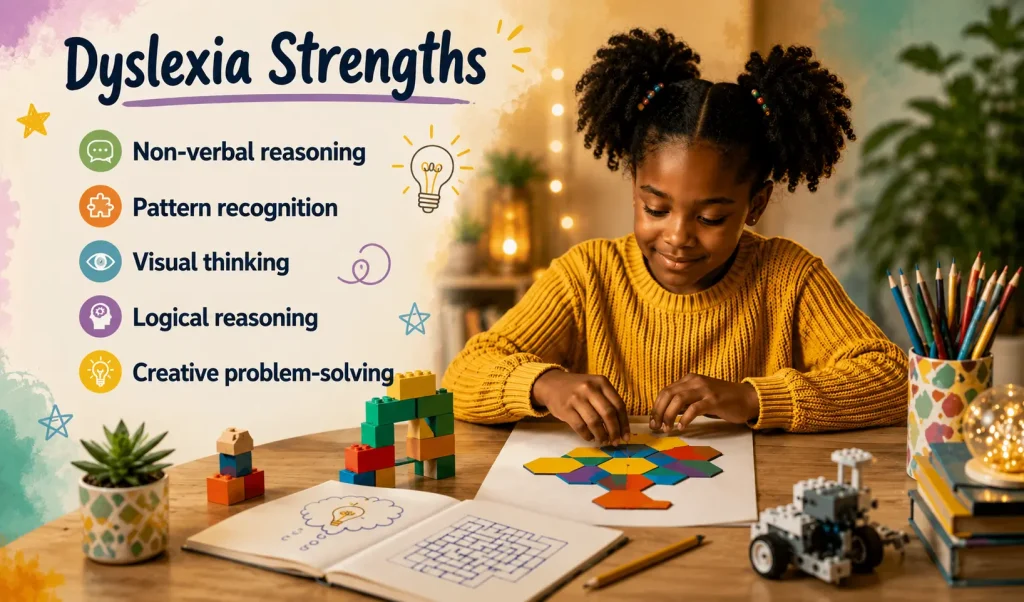
    Many children with dyslexia perform extremely well in:

    • Non-verbal reasoning
    • Pattern recognition
    • Visual thinking
    • Logical reasoning
    • Creative problem-solving

    In fact, many dyslexic learners have exceptional strengths in these areas.

    Every child has a unique profile of strengths and challenges, which is why one assessment score should never define their ability.

    A young girl enjoys a colourful pattern-building activity at a cosy learning table beside an illustrated list of dyslexia strengths, including non-verbal reasoning, pattern recognition, visual thinking, logical reasoning and creative problem-solving.

    Can children receive extra support?

    If a child has a formal diagnosis of dyslexia, schools may be able to apply for access arrangements, depending on the type of GL Assessment being used and the school’s policies.

    These might include:

    • Extra time
    • Supervised rest breaks
    • A reader for certain assessments
    • Other reasonable adjustments where appropriate

    If your child has recently been diagnosed, it’s always worth speaking with their school well before the assessment date to discuss what support may be available.

    Preparation is about confidence, not cramming

    One of the biggest misconceptions about GL Assessments is that children need endless practice papers.

    In my experience, this rarely produces the best results.

    Children tend to perform much better when they understand the question styles, feel confident in their own abilities and approach assessments calmly.

    For dyslexic learners, preparation often works best when it is engaging and multi-sensory.

    Rather than completing worksheet after worksheet, I like to use games, discussion, visual resources and practical activities to develop reading, vocabulary and reasoning skills in an enjoyable way.

    When children enjoy learning, they usually remember much more.

    Remember: A score is only one snapshot

    Perhaps the most important thing for parents to remember is that a GL Assessment score is simply one piece of information.

    It is not a measure of intelligence.

    It does not predict future success.

    It certainly doesn’t define your child’s potential.

    Some of the most creative, innovative and successful people in the world are dyslexic. They simply learn differently.

    Every child deserves the opportunity to demonstrate what they know in a way that allows them to succeed.

    Final Thoughts

    If your child has dyslexia, it’s understandable to feel anxious about GL Assessments. However, with the right preparation, appropriate support and growing confidence, many dyslexic learners perform far better than they or their parents expected.

    Most importantly, remember that assessments measure performance on one particular day—not your child’s worth, intelligence or future.


    Wondering How We Can Help?

    Whether you’re exploring tuition options, looking for specialist support or simply have a question, we’d love to hear from you. Tell us a little about your child and what you’re looking for, and we’ll be in touch as soon as possible.


    Current Availability

    Super Summer Learning (August): Good availability throughout the holiday

    Weekday daytime tuition (from September): Good availability for international students, home-educated learners and families with flexible schedules

    🗓️ After-school, Saturday & Sunday morning tuition (from September): Waiting list currently in operation


    Please include Area Code if Outside UK

    Related Posts

  • ADHD in Dubai Schools: Ways Students Can Thrive

    Moving to Dubai can be an exciting new chapter for families. The city is home to some of the world’s leading international schools, offering British, American, IB and other internationally recognised curricula. For many children, the transition brings new friendships, opportunities and experiences.

    However, for students with ADHD, starting or attending an international school can present some additional challenges. New routines, unfamiliar expectations and the fast pace of school life can all place extra demands on executive functioning skills.

    The good news is that children with ADHD can absolutely thrive in international schools when they receive the right understanding and support. As someone who was diagnosed with ADHD as an adult and who has spent many years supporting neurodivergent learners both in the UK and overseas, I’ve seen first-hand just how transformative the right environment can be.

    ADHD Looks Different in Every Child

    One of the biggest misconceptions surrounding ADHD is that every child experiences it in the same way.

    Some children are highly energetic and impulsive, whilst others appear quiet, thoughtful and easily distracted. Some excel academically but struggle with organisation, whilst others find traditional classroom learning difficult from an early age.

    My own experience taught me this lesson. I loved learning, achieved well at school and was often described as organised, yet I also experienced distractibility, impulsivity and difficulties with attention that weren’t recognised until adulthood. ADHD is incredibly diverse, and understanding that diversity is often the first step towards effective support.

    Rather than asking, “Does this child look like someone with ADHD?” it is far more helpful to ask, “How does this particular child’s brain work best?”

    Why International Schools Can Be Both Wonderful and Challenging

    Dubai’s international schools are incredibly diverse. Children often learn alongside classmates from dozens of different nationalities, creating rich cultural experiences that many ADHD learners genuinely enjoy.

    At the same time, international education often involves:

    • High academic expectations.
    • Frequent assessments.
    • Busy timetables.
    • Large social environments.
    • Transitions between different curricula.

    Executive functioning skills such as organisation, working memory, planning and time management are essential for navigating these demands. These are precisely the areas where many ADHD learners need additional support.

    When schools recognise these differences and adapt accordingly, children often flourish.

    Creating Predictable Routines

    Children with ADHD generally cope far better when they know what to expect.

    Predictable classroom routines reduce uncertainty and free up mental energy for learning. Visual timetables, written instructions and clear expectations can make an enormous difference.

    Many international schools in Dubai already make excellent use of technology. Homework platforms, digital calendars and online learning systems can all become valuable organisational tools when used consistently.

    Consistency between school and home also helps children feel secure.

    Supporting Executive Function Skills

    Executive functioning is often described as the brain’s management system.

    Students with ADHD may know exactly what they need to do but struggle to begin, remember instructions or organise materials efficiently.

    Practical strategies include:

    • Breaking larger tasks into manageable sections.
    • Providing checklists.
    • Using colour coding for subjects.
    • Allowing extra planning time.
    • Teaching organisation explicitly rather than assuming children naturally acquire these skills.

    These strategies benefit many learners, not just those with ADHD.

    Movement Helps Learning

    One of the greatest myths surrounding education is that good learning always happens whilst sitting perfectly still.

    Many ADHD learners actually concentrate better when movement is incorporated into their day.

    Simple adjustments might include:

    • Standing while completing part of a task.
    • Short movement breaks.
    • Stretching between activities.
    • Using discreet fidget tools where appropriate.
    • Interactive learning activities.

    Looking back, many of my happiest learning experiences involved active participation rather than simply listening. For many children, movement supports attention rather than distracting from it.

    Confidence Is Just as Important as Academic Support

    Perhaps the greatest danger facing many ADHD learners isn’t the ADHD itself.

    It’s losing confidence.

    Children who regularly forget homework, misplace equipment or struggle to complete tasks may begin believing they’re lazy or incapable.

    Nothing could be further from the truth.

    Many ADHD learners are incredibly creative, curious and imaginative. They often ask insightful questions, think laterally and approach problems from fresh perspectives.

    The role of parents and teachers is to ensure these strengths are recognised alongside the challenges.

    A child who believes in themselves is far more likely to persevere through difficult moments.

    Working Together Makes the Difference

    The strongest outcomes happen when parents, teachers and tutors communicate openly.

    This is particularly valuable in international schools where families may also be adapting to life in a new country.

    Regular conversations about:

    • What is working well.
    • Current challenges.
    • Helpful classroom strategies.
    • Emotional wellbeing.
    • Academic progress.

    allow everyone to support the child consistently.

    When children receive the same messages of encouragement both at home and at school, their confidence often grows remarkably quickly.

    Online Tuition Can Complement International School Learning

    Many families in Dubai choose online tuition to reinforce learning without adding unnecessary pressure.

    One-to-one lessons provide opportunities to revisit concepts, strengthen executive functioning skills and build confidence in a calm environment.

    Because lessons are personalised, they can adapt to the individual learner rather than expecting the learner to adapt to a rigid teaching style.

    This flexibility is particularly valuable for ADHD learners, who often benefit from engaging, interactive lessons that match their interests and learning preferences.

    Final Thoughts

    Children with ADHD don’t need to become different learners.

    They need learning environments that recognise how their brains naturally work.

    International schools in Dubai already offer exceptional educational opportunities. When these are combined with understanding, flexible teaching and strong communication between home and school, ADHD learners can achieve remarkable things.

    Most importantly, children need to know that ADHD is not a limitation on their potential. Every learner’s strengths and challenges are unique, and with the right support they can develop the confidence, resilience and skills to flourish both academically and personally.


    Wondering How We Can Help?

    Whether you’re exploring tuition options, looking for specialist support or simply have a question, we’d love to hear from you. Tell us a little about your child and what you’re looking for, and we’ll be in touch as soon as possible.


    Current Availability

    Super Summer Learning (August): Good availability throughout the holiday

    Weekday daytime tuition (from September): Good availability for international students, home-educated learners and families with flexible schedules

    🗓️ After-school, Saturday & Sunday morning tuition (from September): Waiting list currently in operation


    Please include Area Code if Outside UK

    Related Posts

  • Choosing an Online Tutor for British Curriculum Children Abroad

    When families move overseas, one of the biggest priorities is ensuring their children continue to receive a high-quality education. Whether you’re living in the UAE, Saudi Arabia, Singapore, Malaysia, Thailand or elsewhere, international schools offer wonderful opportunities, but they can also present unique academic challenges.

    Over the years, I have worked with many children following the British Curriculum whilst living abroad, and one thing has become increasingly clear: choosing the right online tutor is about far more than finding someone who knows the curriculum.

    It’s about finding someone who understands your child.

    Why Families Living Abroad Often Seek Additional Support

    Moving overseas is exciting, but it also brings change.

    Children may be adapting to a new country, making new friends, learning alongside classmates from many different cultures and settling into an unfamiliar school environment. Even confident learners can take time to adjust.

    Some children need support because they’ve missed parts of the curriculum during an international move. Others simply benefit from having one consistent adult outside school who understands both the British education system and the realities of international life.

    I’ve often found that parents contact me not because their child is struggling, but because they want to build confidence before small gaps become larger ones.

    Experience with the British Curriculum Matters

    A tutor who understands the British Curriculum can provide reassurance for both parents and children.

    From Key Stage 1 through to Key Stage 4, English and maths develop in carefully planned stages. Understanding those expectations allows lessons to focus on exactly what a child needs, whether that’s strengthening phonics, improving reading comprehension, building mathematical reasoning or preparing for iGCSE English Language.

    Many international schools also use GL Assessments to monitor progress, meaning tutors who understand these assessments can provide targeted support without turning learning into endless test preparation.

    Every Child Learns Differently

    One lesson I’ve learnt after many years of tutoring is that no two children learn in quite the same way.

    Some thrive with structured explanations and routine.

    Others learn best through discussion, creativity and practical activities.

    Children with ADHD, dyslexia, dyscalculia or autism often need lessons adapted to suit the way their brains naturally process information rather than being expected to fit one teaching method.

    As someone diagnosed with ADHD myself, I understand how misleading educational stereotypes can be. ADHD looks different in every individual, and the same is true of every learner. The most effective tuition starts with understanding the child before the curriculum.

    Look Beyond Qualifications

    Qualifications certainly matter.

    Parents deserve to know their tutor has strong subject knowledge and appropriate experience.

    However, when I think back to my own education, the teachers who had the greatest impact weren’t necessarily those with the longest list of qualifications.

    They were the ones who listened.

    They noticed when confidence was slipping.

    They explained things differently when the first explanation didn’t quite make sense.

    Those qualities are just as important in online tuition.

    A tutor who builds trust will often achieve far more than one who simply delivers information.

    Flexibility Makes a Huge Difference

    One of the greatest strengths of online tuition is flexibility.

    Families living abroad often follow different school calendars from the UK. Whilst British schools may be enjoying their summer holidays, many international schools are preparing for a new academic year.

    Having a tutor who can adapt lessons around these schedules makes learning far less stressful.

    Flexibility also extends to teaching methods.

    Some children benefit from visual resources.

    Others enjoy games and interactive challenges.

    Some need additional time to process new concepts before moving on.

    The best tutors recognise that adapting to the learner is often the key to long-term success.

    Communication with Parents is Essential

    One aspect of tutoring that parents often overlook is communication.

    When families are living overseas, parents may not always have daily contact with teachers in the same way they would in the UK.

    Regular updates from a tutor can therefore become incredibly valuable.

    Knowing which areas are improving, where confidence is growing and what to continue practising at home helps everyone work together towards the same goals.

    Confidence Comes Before Progress

    One of my favourite moments as a tutor isn’t when a child achieves a high score.

    It’s when they say, “I think I can do this.”

    Confidence changes everything.

    Children begin asking more questions.

    They become willing to tackle more challenging work.

    Mistakes stop feeling frightening and become part of learning instead.

    I’ve seen this happen countless times with students across the UK and around the world. Often, academic progress follows naturally once confidence has been rebuilt.

    Questions to Ask Before Choosing an Online Tutor

    Before making your decision, consider asking:

    • Do they have experience teaching the British Curriculum?
    • Have they worked with international school students?
    • Can they support children with different learning styles or SEND?
    • How do they personalise lessons?
    • Do they communicate regularly with parents?
    • Do they focus on confidence as well as academic achievement?

    The answers will often tell you far more than a long list of qualifications.

    Final Thoughts

    Choosing an online tutor for your child whilst living abroad is an important decision.

    The right tutor should provide more than curriculum knowledge. They should understand children as individuals, adapt their teaching to suit different learning styles and help learners feel confident, supported and motivated.

    Whether your family is based in Dubai, Abu Dhabi, Riyadh, Jeddah, Kuala Lumpur, Singapore, Bangkok or elsewhere, personalised online tuition can provide valuable continuity alongside an excellent international education.

    After all, children don’t simply need someone to teach them English or maths.

    They need someone who helps them believe they can succeed.


    Related Posts


  • Moving to a New Country With ADHD: The Challenges Nobody Talks About

    Moving to a new country is often described as an exciting adventure. New opportunities. New friends. New experiences. Social media is full of smiling family photographs outside famous landmarks and stories about fresh starts.

    But if you have ADHD, there is another side to relocation that rarely gets talked about.

    The reality is that moving abroad can quietly turn everyday ADHD challenges up to maximum volume. Even positive life changes can place enormous demands on executive functioning, emotional regulation and working memory. As someone diagnosed with ADHD myself, I’ve come to realise that our brains don’t necessarily distinguish between good stress and bad stress—they simply recognise that everything has changed.

    That doesn’t mean moving overseas can’t be wonderful. It absolutely can. But understanding the hidden challenges can make the transition much kinder on yourself and your family.

    Every Routine Suddenly Disappears

    Many people think ADHD means disliking routine.

    Ironically, many of us actually depend on it far more than we realise.

    Our brains often build invisible systems that keep life running. We know which supermarket sells our favourite foods. We know which road to take to work without thinking. We know where everything belongs in the house.

    Then one day…

    Everything changes.


    Suddenly you’re learning a new transport system, different shopping habits, unfamiliar road signs and perhaps even a new language. Every simple task requires conscious thought instead of automatic memory.

    By the end of the day, your brain can feel completely exhausted.

    Decision Fatigue Becomes Constant

    One thing people rarely mention is just how many decisions relocation involves.

    Which school?

    Which doctor?

    Which phone provider?

    Where do you buy familiar foods?

    What paperwork needs completing next?

    For someone with ADHD, decision fatigue can become overwhelming surprisingly quickly.

    Many ADHDers already spend significant mental energy organising everyday life. Relocating adds hundreds of additional decisions every single week.

    Sometimes it’s not the “big” decisions that become difficult—it’s choosing breakfast after spending the morning completing immigration paperwork.

    Your Mask Can Become Harder to Maintain

    Many adults with ADHD spend years learning how to appear organised, calm and in control. I often describe my own life as a mixture of genuine strengths alongside countless strategies that quietly compensate for ADHD. Those coping mechanisms become part of everyday life without us even noticing.

    Moving abroad often removes those carefully-built supports overnight.

    Without familiar routines, trusted people and predictable environments, ADHD traits may suddenly become far more noticeable.

    You haven’t become “worse.”

    You’re simply operating without the systems that previously helped you succeed.

    Homesickness Isn’t Just Missing Home

    For ADHD brains, homesickness can feel unusually intense.

    It’s not only about missing family or favourite places.

    It’s grieving predictability.

    It’s missing knowing where everything is.

    It’s missing the café where nobody needed directions.

    It’s missing tiny routines that quietly reduced cognitive load every day.

    These seemingly insignificant losses can accumulate until your brain feels permanently overloaded.

    Children Often Show It Differently

    Children with ADHD may not tell you they’re struggling.

    Instead, you might notice:

    • Increased emotional outbursts
    • Difficulty sleeping
    • Greater distractibility
    • More frequent meltdowns
    • Reduced confidence
    • Reluctance to attend school
    • Increased forgetfulness

    From the outside, it can look like “bad behaviour.”

    More often, it’s a child whose brain is working incredibly hard simply to process change.

    This is particularly true for children adjusting to international schools, different teaching styles and unfamiliar friendship groups.

    Give Yourself Permission to Start Small

    One lesson I’ve learnt from both my own ADHD journey and years supporting neurodivergent learners is that confidence rarely grows through pressure.

    It grows through understanding.

    When everything feels unfamiliar, simplify wherever possible.

    Keep meals predictable.

    Create one or two daily routines before trying to establish ten.

    Celebrate finding the supermarket before worrying about making dozens of new friends.

    Allow yourself to be a beginner.

    None of this means you’ve failed—it simply means your ADHD brain is adapting to an enormous life transition.

    The Hidden Strengths of ADHD Abroad

    Despite the challenges, ADHD can also bring unexpected advantages.

    Many ADHDers are naturally curious.

    We notice details others overlook.

    We often embrace new experiences with enthusiasm once initial anxiety settles.

    Our creativity helps us solve unfamiliar problems.

    Our willingness to explore can turn a foreign city into an endless adventure.


    Some of the qualities that once felt like weaknesses can become remarkable strengths when living overseas.

    The key is recognising that adjustment takes time.

    Final Thoughts

    Moving to another country changes far more than your address.

    For someone with ADHD, it reshapes routines, identity, confidence and daily functioning in ways that many people never see.

    If you’re finding the transition harder than expected, you’re certainly not alone.

    Sometimes the biggest challenge isn’t learning a new language or finding your way around a different city.

    Sometimes it’s simply teaching your wonderfully unique ADHD brain that this new place can become home too.

    Here at Bedford Tutor, I have supported many families relocating overseas, alongside home-educated learners across the UK and around the world. Whether a child is adjusting to an international school, following the British or American curriculum, or needs personalised support for ADHD, dyslexia, dyscalculia or autism, I create calm, flexible lessons that help learners rebuild confidence during times of change. If moving abroad has disrupted your child’s education, I’d love to help them settle into learning again.

    To find out more, please click on the relevant link below:

    Bel 😊


    Related Posts