Moving Abroad With an ADHD Child: How to Support a Smooth Transition

Family with children arriving at a school carrying suitcases, symbolising international education, school transitions and learning around the world.

Moving abroad is an exciting adventure. New countries, new cultures, new opportunities and experiences can open doors for children in remarkable ways.

However, when your child has ADHD, an international move can bring additional challenges that are sometimes overlooked.

Over the years, I have worked with many families who have relocated overseas, particularly to countries such as the UAE, Saudi Arabia, Singapore, Malaysia and Thailand. Whilst every family’s journey is unique, one theme appears time and time again: children with ADHD often need more support with transitions than people realise.

As someone with ADHD myself, I completely understand why.

Why Moving Abroad Can Feel Overwhelming

Many children with ADHD thrive on familiarity, even if they appear adventurous on the surface.

A move overseas often involves:

  • Leaving friends behind
  • Starting a new school
  • Adapting to different routines
  • Navigating cultural differences
  • Managing uncertainty

For neurotypical children, these changes can be challenging enough. For an ADHD child, they can feel like someone has shaken up every part of their world at once.

I often compare it to trying to complete a jigsaw puzzle whilst somebody keeps changing the picture on the box.

Many ADHD children work incredibly hard to stay organised, manage emotions and navigate everyday life. When familiar structures disappear, it can temporarily increase anxiety, emotional outbursts, forgetfulness and difficulties with concentration.

Remember: Every ADHD Child Is Different

One of the biggest misconceptions about ADHD is that all children experience it in the same way.

They don’t.

Some children become highly anxious before a move. Others seem completely relaxed until several weeks later when the reality begins to sink in. Some throw themselves into new experiences immediately, whilst others need time to observe and adjust before they feel comfortable.

This is something I feel strongly about because ADHD is incredibly diverse. No two ADHD children are exactly alike, and understanding your individual child is always more important than following generic advice.

Preparing Before You Move

One of the most effective ways to reduce anxiety is to involve your child in the process early.

Talk openly about:

  • Where you are moving
  • What their new school looks like
  • What daily life might be like
  • The exciting opportunities ahead

Many ADHD learners benefit from visual preparation.

Photos, videos, maps and virtual tours can help transform an unknown destination into something more familiar and manageable.

If possible, create a countdown calendar so your child can clearly see when different events will happen. Predictability often helps reduce uncertainty.

Supporting School Transitions

Starting a new school can be one of the biggest worries for ADHD learners.

International schools can vary significantly in their approach to supporting neurodivergent students. Before moving, it can be helpful to discuss:

  • Available SEND support
  • Classroom accommodations
  • Communication systems
  • Homework expectations
  • Pastoral care

The earlier these conversations happen, the smoother the transition is likely to be.

Many families also find that maintaining some educational continuity through online tuition can provide reassurance during this period. Having one familiar adult, one familiar routine and one consistent learning space can make a tremendous difference when everything else feels new.

Expect an Adjustment Period

One mistake parents sometimes make is assuming that a child who appears happy has adjusted immediately.

In reality, ADHD children can take time to process major life changes.

I often tell families that settling into a new country is a marathon, not a sprint.

There may be emotional ups and downs along the way.

Your child may initially love their new environment and then suddenly miss home several months later. This is completely normal.

Give them space to talk about their feelings without trying to “fix” everything straight away.

Sometimes children simply need someone to listen.

Focus on Confidence First

Whenever I support a child through a significant transition, confidence becomes my priority.

Academic progress is important, but confidence is often the foundation that makes everything else possible.

When children feel safe, understood and capable, they are far more likely to engage with learning, build friendships and embrace new experiences.

Small successes matter.

  • Making one new friend.
  • Finding their way around school.
  • Trying a new activity.
  • Completing a piece of work independently.

These moments gradually build a sense of belonging.

Final Thoughts

Moving abroad with an ADHD child can feel daunting, but it can also be an incredible opportunity for growth.

With patience, preparation and understanding, many ADHD learners develop remarkable resilience through international experiences.

The goal is not to remove every challenge.

The goal is to provide enough support that your child feels confident navigating those challenges for themselves.


After all, children with ADHD are often wonderfully adaptable, creative and resourceful. Sometimes they simply need a little extra time and reassurance whilst finding their feet in a brand-new world.

Here at Bedford Tutor, I have supported many children with ADHD who have relocated overseas or attend international schools across the UAE, Saudi Arabia, Singapore, Malaysia and Thailand. Through personalised English and maths tuition, confidence-building support and ADHD-friendly learning strategies, I help students navigate educational transitions whilst continuing to develop the skills they need to thrive.

To find out more, please click on the relevant link below:

Bel 😊


Related Posts

Related Blog Posts

  • Creative Writing Activities That Inspire Reluctant Writers

    For many children, the words creative writing are enough to make them groan.

    “I don’t know what to write.”

    “I’m not good at stories.”

    “I’ve got no ideas.”

    Over the years, I’ve heard these phrases countless times from children of all ages. Whether I’m supporting home-educated learners, children with ADHD, dyslexia or autism, or students who simply lack confidence in English, reluctant writers often have one thing in common: they believe they have nothing worth writing about.

    The good news is that this is very rarely true.

    In fact, some of the most imaginative stories I’ve ever read have come from children who originally insisted they hated writing.

    The secret isn’t forcing children to write more.

    It’s helping them discover that writing can actually be fun.

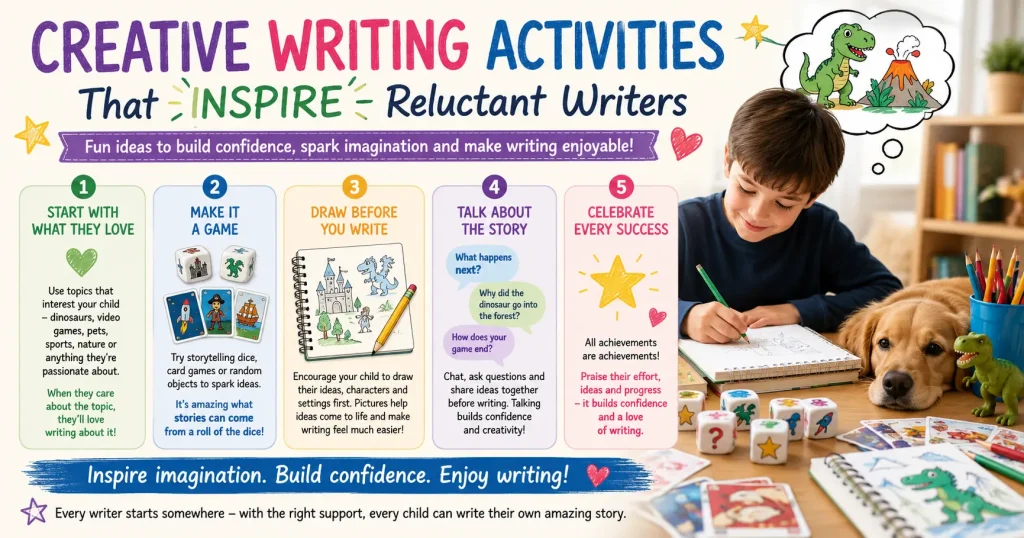
    Start with What Interests Your Child

    One of the biggest mistakes adults sometimes make is choosing the topic for the child.

    If a child has no interest in castles, why ask them to write about knights?

    If they aren’t fascinated by space, why expect them to produce an exciting story about astronauts?

    Instead, I always begin with something the child genuinely enjoys.

    Over the years, I’ve seen some wonderfully creative writing inspired by children’s own interests.

    I’ve worked with children who have written incredible adventures involving dinosaurs, inventing their own prehistoric worlds complete with volcanoes and newly discovered species. Others have designed entire video games on paper, describing characters, magical powers, levels and villains in extraordinary detail.

    Some of my favourite pieces of writing have been about children’s pets. Whether it’s a mischievous Labrador, a cheeky hamster or a much-loved horse, children often have endless ideas when they’re writing about something they already know and love.

    When children care about the topic, they stop worrying about “doing writing” and simply start telling a story.

    Turn Writing Into a Game

    Creative writing doesn’t have to begin with a blank sheet of paper.

    In fact, I often try to avoid that altogether.

    Children are naturally imaginative when they’re playing, so why not build writing around play?

    One activity I regularly recommend is using storytelling dice.

    A few simple pictures rolled onto the table can become the beginning of an exciting adventure.

    Perhaps the dice show a dragon, a treasure chest and a bicycle.

    How did the dragon learn to ride a bike?

    Why is the treasure hidden?

    Who discovers it?

    Suddenly, ideas begin flowing naturally.

    Storytelling card games work just as well and can be adapted for children of different ages.

    The wonderful thing is that you don’t need expensive resources.

    Many storytelling games are available online, and it’s surprisingly easy to make your own using pieces of card, magazine pictures or even objects from around the house.

    A spoon, a toy dinosaur and a pair of sunglasses might sound like a strange combination—but I’ve seen children create fantastic stories from far less!

    When writing feels like a game rather than a lesson, children often become far more willing to have a go.

    Draw Before You Write

    Many children find planning the hardest part of creative writing.

    Traditional planning sheets filled with bullet points simply don’t work for every learner.

    Instead, I often encourage children to draw first.

    Rather than asking them to write about a dragon, I ask them to draw it.

    What colour is it?

    Does it breathe fire?

    Where does it live?

    Who are its friends?

    Without realising it, children begin developing characters, settings and story ideas before they’ve written a single word.

    This approach works particularly well for many neurodivergent learners, including children with ADHD and dyslexia, who often think visually.

    Once the picture is complete, the writing usually feels much easier because the story already exists in their imagination.

    Sometimes a single drawing can inspire several pages of writing.

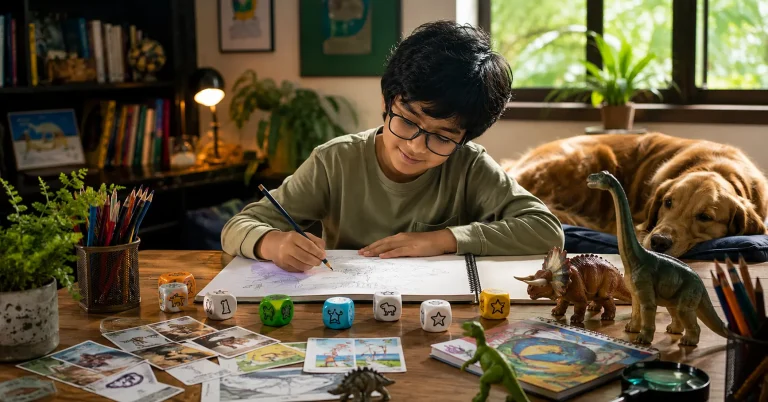
    Colourful infographic showing creative writing activities that help reluctant writers build confidence through play and imagination.

    Encourage Talking Before Writing

    Writing doesn’t always need to begin silently.

    Some children are brilliant storytellers long before they become confident writers.

    Ask them questions.

    “What happens next?”

    “Why did the dinosaur go into the forest?”

    “How does your video game end?”

    As they answer, they’re already building the structure of their story.

    Sometimes I’ll even jot down their ideas as they speak before asking them to expand them in their own words.

    This removes much of the pressure and allows children to focus on their creativity rather than worrying about spelling every word perfectly.

    Remember That Every Writer Starts Somewhere

    One of the most important things I’ve learnt over many years of tutoring is that confidence comes before great writing.

    Children who believe they’re “bad at writing” often avoid it altogether.

    That’s why praise matters so much.

    Every achievement deserves to be recognised.

    Perhaps they’ve thought of an imaginative character.

    Maybe they’ve written one excellent sentence.

    Perhaps they’ve remembered to use speech marks for the first time.

    These are all successes.

    I make a point of celebrating every step forward because every small success builds confidence for the next challenge.

    I’ve watched many reluctant writers gradually begin to enjoy writing—not because they suddenly became perfect spellers or expert authors overnight, but because they started believing they could write.

    Confidence grows through encouragement.

    Make Creative Writing Enjoyable

    Writing should never feel like a punishment.

    The children who make the greatest progress are usually the ones who laugh during lessons, become excited by their ideas and forget they’re even practising English.

    By choosing topics they genuinely love, turning activities into games, drawing before writing and celebrating every achievement, creative writing becomes something children look forward to rather than something they avoid.

    After all, every confident writer was once a beginner.

    Sometimes all a child needs is someone who believes in their ideas before they believe in them themselves.


    Wondering How We Can Help?

    Whether you’re exploring tuition options, looking for specialist support or simply have a question, we’d love to hear from you. Tell us a little about your child and what you’re looking for, and we’ll be in touch as soon as possible.


    Current Availability

    Super Summer Learning (August): Good availability throughout the holiday

    Weekday daytime tuition (from September): Good availability for international students, home-educated learners and families with flexible schedules

    🗓️ After-school, Saturday & Sunday morning tuition (from September): Waiting list currently in operation


    Please include Area Code if Outside UK

    Related Posts

  • British Curriculum Online Tuition: Powerful Benefits Abroad

    Why British Curriculum Online Tuition Works So Well for Families Living Abroad

    Moving abroad is an exciting adventure for families. Whether you’ve relocated to Dubai, Abu Dhabi, Riyadh, Jeddah, Singapore, Kuala Lumpur, Bangkok or elsewhere, international life offers children wonderful opportunities to experience new cultures, make lifelong friendships and develop a global outlook.

    However, alongside the excitement often comes a familiar concern for parents:

    “How do we make sure our child keeps up with the British Curriculum?”

    Over the years, I have worked with many families living overseas, supporting children attending British international schools, home educating, or preparing to return to the UK. One thing has become increasingly clear to me: online tuition isn’t simply a convenient alternative to face-to-face lessons—it is often the ideal solution.

    For many internationally based families, British Curriculum online tuition provides consistency, flexibility and personalised support that can be difficult to find locally.

    Learning With a Tutor Who Understands the British Curriculum

    One of the biggest advantages of working with a specialist British tutor is continuity.

    Whilst many international schools provide an excellent education, children sometimes need additional support with particular topics, exam preparation or confidence building. Parents often tell me they simply want someone who understands exactly what their child is learning.

    Whether a student is studying Key Stage 1 Maths, Key Stage 2 English, Key Stage 3 Creative Writing, GCSE, iGCSE or preparing for GL Assessments, lessons can be tailored to complement what is happening in school rather than working against it.

    This consistency becomes particularly valuable for families who relocate regularly. A child may move between schools in different countries whilst continuing to follow the British Curriculum, and having the same tutor throughout those changes provides welcome stability.

    Flexibility That Fits Around International Life

    Life overseas rarely follows exactly the same pattern as life in the UK.

    School terms differ between countries. Public holidays vary enormously. Some families travel frequently for work, whilst others return to Britain during school holidays.

    Online tuition adapts to those changing schedules.

    Rather than travelling across a city after school or trying to find a local tutor with suitable experience, lessons take place from home. Children can learn in familiar surroundings whilst maintaining a regular routine regardless of where they happen to be living.

    Over the years, I’ve supported families studying the British Curriculum across the UAE, Saudi Arabia, Singapore, Malaysia and Thailand, and one thing I’ve learnt is that flexibility matters. Every family’s timetable is slightly different, particularly when balancing school commitments, extracurricular activities and different time zones.

    Personalised Learning Makes a Huge Difference

    One-to-one tuition allows every lesson to focus entirely on the individual child.

    Unlike a busy classroom, there is time to revisit difficult concepts, answer questions immediately and adjust the pace of learning without worrying about keeping up with thirty other pupils.

    Some children need additional practice with fractions.

    Others want to improve their creative writing.

    Some simply need reassurance that they’re capable.

    Every child is different, and personalised tuition recognises that.

    As someone who has supported children for many years, I have found that confidence often grows surprisingly quickly once learning is tailored to the child rather than expecting the child to adapt to the lesson.

    Supporting Neurodivergent Learners Overseas

    Many of the families I work with have children who have ADHD, dyslexia, dyscalculia or autism.

    Living abroad can sometimes make accessing specialist educational support more difficult, particularly if English-language SEND services are limited or waiting lists are long.

    Online tuition can bridge that gap.

    Rather than expecting every learner to fit one teaching style, lessons can be adapted to suit how each child learns best.

    Some learners benefit from visual resources.

    Others enjoy discussion-based learning.

    Some need movement breaks or learning broken into smaller chunks.

    Having ADHD myself has reinforced something I’ve always believed: neurodivergent learners don’t all look the same. Every child has their own strengths, challenges and ways of learning. Understanding the individual child is always more important than relying on stereotypes.

    Confidence Travels Better Than Knowledge Alone

    When families move between countries, children sometimes worry about fitting into a new school.

    They may wonder whether they’ll make friends, understand different teaching styles or keep up academically.

    Academic support certainly helps, but confidence is often the biggest factor.

    One of the most rewarding parts of tutoring the British Curriculum internationally is watching children gradually become more willing to ask questions, tackle unfamiliar challenges and believe in themselves.

    When children feel safe making mistakes, learning accelerates naturally.

    This is particularly important for children preparing for transitions into new schools or returning to the UK after living overseas.

    Parents Stay Closely Involved

    Another benefit of online tuition is communication.

    Parents living abroad often appreciate regular updates about their child’s progress with the British Curriculum, particularly if work commitments mean they cannot always speak with teachers during the school day.

    A strong partnership between tutor, parent and child creates consistency.

    Small concerns can be identified early, achievements celebrated together and future learning planned collaboratively.

    Children thrive when the adults around them work as a team.

    Technology Has Made Online Learning Better Than Ever

    When online learning first became widespread, many people viewed it as a temporary solution.

    Today, the experience is completely different.

    Interactive whiteboards, shared documents, educational games, visual resources and instant feedback make lessons engaging and highly effective.

    Many children actually prefer learning online.

    Without the distractions of a busy classroom, they often feel more comfortable asking questions and participating fully. During the growth of online learning, I found many students became more engaged and confident in one-to-one virtual lessons than they had been in traditional classroom settings.

    A Long-Term Investment in Your Child’s Education

    Families living abroad often move several times during a child’s education.

    Schools may change.

    Countries may change.

    Curricula may occasionally vary.

    However, having a trusted tutor provides one constant throughout those transitions.

    Whether your child is preparing for GL Assessments, studying iGCSE English Language, strengthening maths skills or building confidence in reading and writing as part of the British Curriculum, consistent support can make those challenges feel far less overwhelming.

    Ultimately, successful online tuition isn’t just about improving grades.

    It’s about helping children become resilient, confident learners who know they can succeed wherever life takes them.


    Wondering How We Can Help?

    Whether you’re exploring tuition options, looking for specialist support or simply have a question, we’d love to hear from you. Tell us a little about your child and what you’re looking for, and we’ll be in touch as soon as possible.


    Current Availability

    Super Summer Learning (August): Good availability throughout the holiday

    Weekday daytime tuition (from September): Good availability for international students, home-educated learners and families with flexible schedules

    🗓️ After-school, Saturday & Sunday morning tuition (from September): Waiting list currently in operation


    Please include Area Code if Outside UK

    Related Posts

  • Working Memory Strategies: Fun Ways to Boost Learning

    Working memory is often described as the brain’s “mental notepad”. It allows us to hold information in our minds whilst using it. Whether a child is remembering a set of instructions, solving a maths problem, following a sentence whilst reading or recalling how to spell a word, working memory is constantly at work.

    For many children, particularly those with ADHD, dyslexia, dyscalculia or other special educational needs, working memory can become overloaded very quickly. This doesn’t mean they aren’t intelligent. In fact, many highly capable children have weaker working memory and simply need the right strategies to help them succeed.

    One of the questions parents often ask me is whether working memory can be improved.

    The answer is encouraging: whilst every child is different, working memory skills can often be strengthened through regular practice. Better still, many of the most effective activities feel like games rather than formal learning.

    At Bedford Tutor and our online division, Kite Tutoring, we naturally build working memory activities into our lessons because children are far more likely to make progress when they’re engaged and enjoying themselves. Rather than endless worksheets, we use practical, visual and interactive activities that develop memory alongside confidence.

    Why Working Memory Matters

    Working memory plays a role in almost every aspect of learning.

    Children use it when:

    • Following multi-step instructions.
    • Remembering what they’ve just read.
    • Solving mathematical calculations.
    • Learning spellings.
    • Writing sentences whilst remembering punctuation and grammar.
    • Holding information in mind whilst answering questions.

    When working memory is under pressure, children may forget what they were doing halfway through a task, lose track of instructions or become frustrated because they know the answer but can’t quite hold onto it.

    Fortunately, there are lots of enjoyable ways to strengthen these skills.

    Matching Pairs

    One of our favourite working memory activities is the classic matching pairs game.

    Although it seems simple, matching pairs encourages children to store visual information before retrieving it moments later. Every time they turn over two cards, they’re practising concentration, visual memory and recall.

    During our face-to-face lessons, we use physical matching cards which can easily be adapted to suit different ages and interests. Sometimes the cards contain pictures, whilst other times they focus on letters, words, numbers or curriculum topics.

    Our online learners certainly don’t miss out. We regularly use interactive Wordwall matching activities which recreate exactly the same challenge on screen. Children often become so engaged in trying to beat their previous score that they forget they’re developing an important learning skill at the same time.

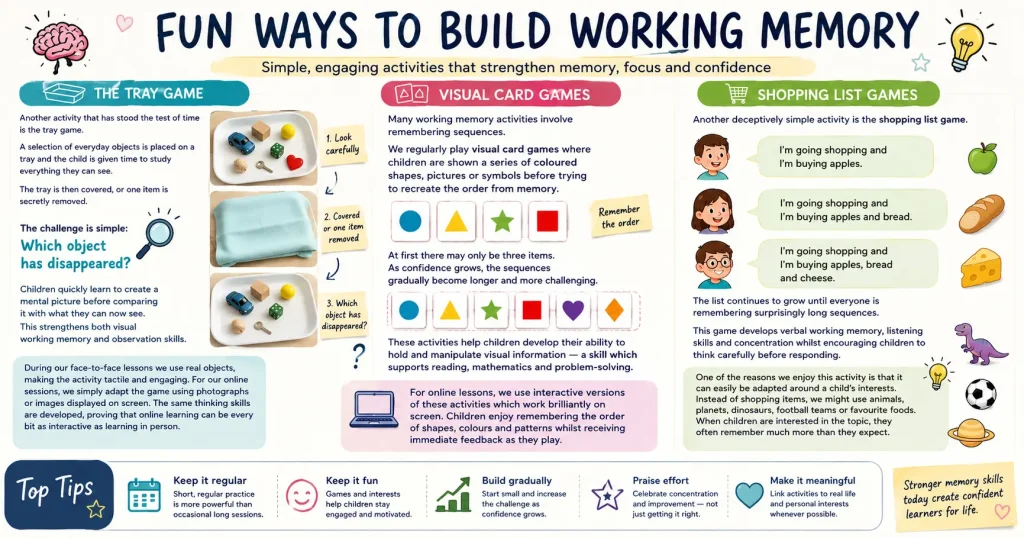
    The Tray Game

    Another activity that has stood the test of time is the tray game.

    A selection of everyday objects is placed on a tray and the child is given time to study everything they can see.

    The tray is then covered, or one item is secretly removed.

    The challenge is simple:

    Which object has disappeared?

    Children quickly learn to create a mental picture before comparing it with what they can now see. This strengthens both visual working memory and observation skills.

    It’s a game that children of all ages enjoy because it naturally becomes more challenging as they improve.

    During our face-to-face lessons we use real objects, making the activity tactile and engaging. For our online sessions, we simply adapt the game using photographs or images displayed on screen. The same thinking skills are developed, proving that online learning can be every bit as interactive as learning in person.

    Visual Card Games

    Many working memory activities involve remembering sequences.

    We regularly play visual card games where children are shown a series of coloured shapes, pictures or symbols before trying to recreate the order from memory.

    At first there may only be three items.

    As confidence grows, the sequences gradually become longer and more challenging.

    These activities help children develop their ability to hold and manipulate visual information — a skill which supports reading, mathematics and problem-solving.

    For online lessons, we use interactive versions of these activities which work brilliantly on screen. Children enjoy remembering the order of shapes, colours and patterns whilst receiving immediate feedback as they play.

    Shopping List Games

    Another deceptively simple activity is the shopping list game.

    It begins with one item.

    “I’m going shopping and I’m buying apples.”

    The next person repeats the first item before adding another.

    “I’m going shopping and I’m buying apples and bread.”

    The list continues to grow until everyone is remembering surprisingly long sequences.

    This game develops verbal working memory, listening skills and concentration whilst encouraging children to think carefully before responding.

    One of the reasons I enjoy this activity is that it can easily be adapted around a child’s interests. Instead of shopping items, we might use animals, planets, dinosaurs, football teams or favourite foods. When children are interested in the topic, they often remember much more than they expect.

    Colourful educational infographic explaining three working memory activities for children. The first section shows the Tray Game, where children study everyday objects on a tray before identifying which item has been removed. The second section illustrates visual card games using coloured shapes and symbols to remember sequences, with examples for both face-to-face and online learning. The third section explains the Shopping List Game, where players repeat and add items to build verbal working memory. A tips section at the bottom encourages regular practice, keeping activities fun, gradually increasing difficulty, praising effort and linking games to children's interests.

    Why Games Work So Well

    Children rarely develop stronger working memory by completing endless worksheets.

    Instead, they improve through repeated opportunities to remember, retrieve and manipulate information in enjoyable ways.

    Games naturally encourage repetition without boredom.

    Children are willing to have another go because they’re focused on winning the challenge rather than practising a cognitive skill.

    This is particularly important for many neurodivergent learners. Children with ADHD, dyslexia, dyscalculia or autism often benefit from highly interactive learning which keeps them actively involved rather than passively completing written exercises.

    Over the years, I’ve found that confidence often grows alongside working memory. As children experience success, they become more willing to tackle increasingly challenging activities, creating a positive cycle of progress.

    Final Thoughts

    Working memory is an essential foundation for successful learning, but it doesn’t have to be developed through formal exercises alone.

    Simple activities such as matching pairs, the tray game, visual sequencing games and shopping list challenges all strengthen important cognitive skills whilst making learning enjoyable.

    Whether we’re working together face-to-face or online using interactive Wordwall activities and other digital resources, our aim is always the same: to help children develop stronger working memory in an environment where they feel relaxed, engaged and confident.

    After all, when children enjoy learning, they’re far more likely to remember it.


    Wondering How We Can Help?

    Whether you’re exploring tuition options, looking for specialist support or simply have a question, we’d love to hear from you. Tell us a little about your child and what you’re looking for, and we’ll be in touch as soon as possible.


    Current Availability

    Super Summer Learning (August): Good availability throughout the holiday

    Weekday daytime tuition (from September): Good availability for international students, home-educated learners and families with flexible schedules

    🗓️ After-school, Saturday & Sunday morning tuition (from September): Waiting list currently in operation


    Please include Area Code if Outside UK

    Related Posts

  • Six Years Since My ADHD Diagnosis: The Day Everything Finally Made Sense

    It’s strange really, because in some ways it feels like yesterday, and in other ways it feels as though I’ve lived an entirely different lifetime since that appointment.

    The date has always carried extra meaning for me because it’s also my late grandmother’s birthday. She was one of those people who believed in me long before I fully believed in myself. I’d like to think she’d be proud—not because I have ADHD, of course, but because of what I’ve chosen to do with the understanding that diagnosis gave me.

    Looking back now, I don’t really see my diagnosis as the beginning of my ADHD journey.

    It was the beginning of my self-understanding.


    For 31 years, I thought I was the problem

    Before my diagnosis, I spent decades trying to work out why some things seemed so effortless for other people but felt exhausting for me.

    Why could I happily spend twelve hours hyperfocused on something I loved, yet struggle to answer an email?

    Why did my brain collect ideas like a magpie collecting shiny objects?

    Why did people describe me as enthusiastic, energetic and creative, yet also tell me I needed to slow down, listen more carefully and stop rushing?

    The answers had actually been following me around since childhood.

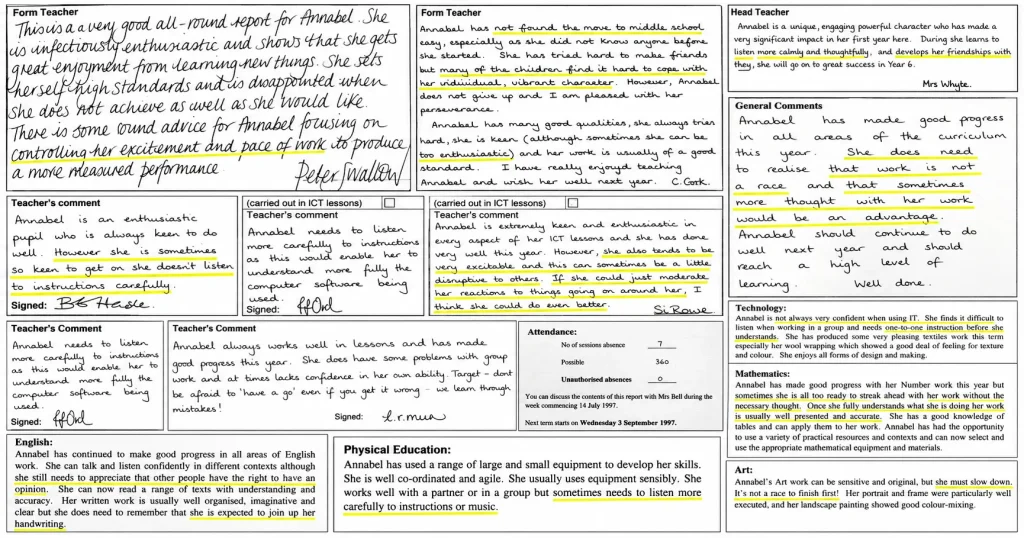
    When I requested my old school reports before my assessment, I expected to find the occasional comment.

    Instead, I found pages and pages of teachers describing the same child.

    “Infectiously enthusiastic.”

    “Needs to listen more carefully.”

    “Too keen to get on.”

    “Must slow down.”

    “Controlling her excitement.”

    “Work is not a race.”

    Reading those reports as a 31-year-old was emotional.

    Not because they criticised me.

    Because they saw me.

    Long before ADHD was even mentioned, they were describing exactly the same traits that would eventually contribute to my diagnosis.

    When my psychiatrist assessed me in July 2020, it wasn’t based on one conversation. It drew together my childhood reports, detailed questionnaires, information from my mum and my own lifelong experiences before confirming Combined ADHD.

    Suddenly, thirty-one years of confusion began to make sense.

    A collage of historical school report comments from primary and middle school, featuring handwritten teacher feedback across multiple subjects including English, Mathematics, Art, Technology, ICT, Physical Education, and general comments. Many passages are highlighted, revealing recurring themes such as enthusiasm for learning, creativity, listening more carefully to instructions, slowing down, thinking work through, and building confidence. The reports document the student's academic progress, strengths, and personal development over several school years.

    My diagnosis didn’t change who I was

    People sometimes imagine receiving an ADHD diagnosis changes everything overnight.

    It doesn’t.

    I didn’t wake up the next morning with a different brain.

    I was still the same person who became fascinated by new ideas.

    The same person who interrupted because my excitement arrived before my patience.

    The same person who could lose an afternoon researching one tiny question I’d accidentally asked myself.

    The diagnosis didn’t change me.

    It changed the way I understood myself.

    Instead of asking,

    “What’s wrong with me?”

    I started asking,

    “What works for me?”

    That tiny shift changed everything.


    The biggest surprise wasn’t the diagnosis…

    …it was realising how hard I’d been working just to appear “normal.”

    Like many women with ADHD, I’d developed coping strategies without even realising it.

    Systems.

    Lists.

    Routines.

    Calendars.

    Colour coding.

    Structure.

    From the outside, people often assumed I couldn’t possibly have ADHD because I ran a business, arrived on time and appeared organised.

    What they couldn’t see was the amount of energy it took to hold all those systems together.

    Looking back, I wasn’t organised because ADHD hadn’t affected me.

    I was organised because I had spent years building scaffolding around the parts of my brain that found organisation difficult.


    ADHD has shaped my work in ways I never expected

    One of the biggest gifts my diagnosis gave me was understanding why I connected so naturally with so many of the children I teach.

    Long before I knew I had ADHD myself, I was already drawn towards children who learned differently.

    The child who couldn’t sit still.

    The child who had brilliant ideas but couldn’t get them onto paper.

    The child who had been told they talked too much.

    The child whose confidence had quietly disappeared because school had become a place where they constantly felt they were getting things wrong.

    Now I understand why.

    I recognise so much of myself in them.

    Not every child with ADHD is the same—I often say, “My ADHD isn’t your ADHD.” We all experience it differently. But understanding my own brain has made me a better tutor, a better listener and, I hope, someone who helps children feel understood rather than judged.


    Six years later…

    People sometimes ask whether I still think about my diagnosis.

    The answer is yes.

    Not because I question it anymore.

    Quite the opposite.

    Every so often, I’ll stumble across another childhood memory, another school report or another family story and think,

    “Well… that makes sense now.”

    It’s almost amusing how many clues there were.

    The child who was constantly told to slow down.

    The teenager whose enthusiasm was often bigger than the room.

    The adult who built a business around curiosity, creativity and helping other people.

    The signs were there all along.

    I just didn’t know what I was looking at.

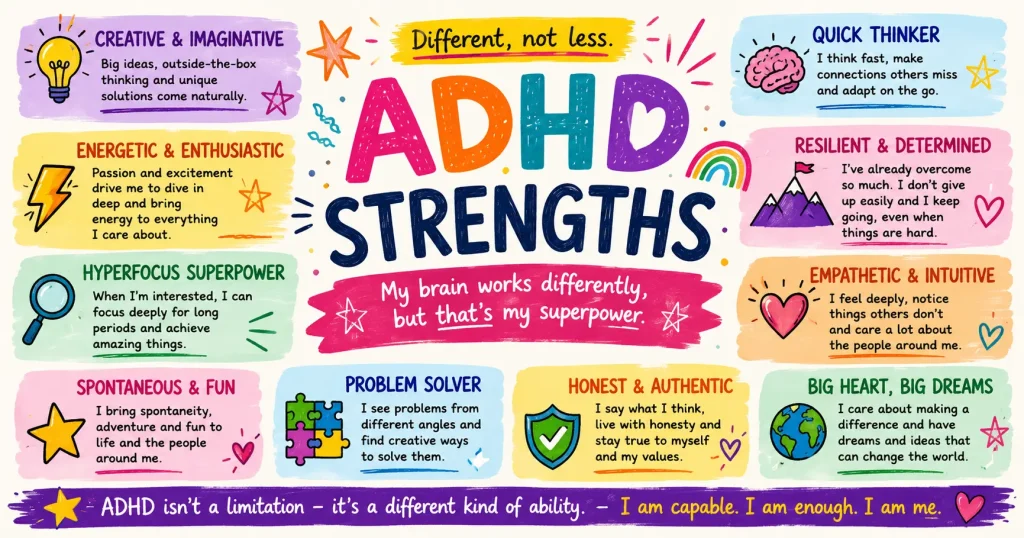
    A colourful infographic celebrating ADHD strengths with the bold title "ADHD Strengths" and the message "Different, not less." The poster highlights positive qualities including creativity and imagination, quick thinking, energy and enthusiasm, resilience, hyperfocus, empathy, spontaneity, problem solving, honesty, and having big dreams. Bright illustrations of a lightbulb, brain, rainbow, mountains, heart, globe, puzzle pieces, shield, magnifying glass, and stars accompany each section. A banner at the bottom reads, "ADHD isn't a limitation, it's a different kind of ability. I am capable. I am enough. I am me."

    If you’re still wondering…

    One thing I wish someone had told me six years ago is this:

    You don’t have to become a different person after an ADHD diagnosis.

    You don’t need to lose your enthusiasm.

    Or your creativity.

    Or your energy.

    Those things aren’t the problem.

    Learning how to regulate them is.

    Understanding yourself isn’t about changing who you are.

    It’s about giving yourself permission to stop fighting your own brain and start working with it instead.


    Looking back with gratitude

    To celebrate today, I bought myself a wonderfully colourful ADHD hoodie from Vinted.

    A small thing perhaps.

    But sometimes milestones deserve celebrating.

    Because six years ago I walked into an assessment hoping for answers.

    I walked out with something much bigger.

    Understanding.

    And from that understanding grew acceptance, confidence, ADHD Galaxy, Bedford Tutor, countless conversations with families who finally felt understood, and a career helping children realise that struggling doesn’t mean they’re broken.

    If sharing my story helps just one parent recognise their child, or one adult finally feel understood, then every word has been worth writing.

    Six years on…

    I wouldn’t change a thing.


    Wondering How We Can Help?

    Whether you’re exploring tuition options, looking for specialist support or simply have a question, we’d love to hear from you. Tell us a little about your child and what you’re looking for, and we’ll be in touch as soon as possible.


    Current Availability

    Super Summer Learning (August): Good availability throughout the holiday

    Weekday daytime tuition (from September): Good availability for international students, home-educated learners and families with flexible schedules

    🗓️ After-school, Saturday & Sunday morning tuition (from September): Waiting list currently in operation


    Please include Area Code if Outside UK

    Related Posts

  • Home Education: Positive Ways to Make Learning Fun

    Home education offers something that traditional schooling cannot always provide: freedom.

    Freedom to slow down when something is difficult. Freedom to explore an unexpected interest. Freedom to spend a morning outside, learn through conversation or return to a subject when a child is ready.

    But there can also be a funny little trap.

    Once you have made the decision to home educate, it is very easy to feel that you now have to recreate school at home.

    There are timetables. Worksheets. Workbooks. Spelling lists. Tests. Perhaps even a small desk in the corner which slowly begins to resemble a miniature classroom.

    And whilst structure can be incredibly helpful, particularly for some children, home education does not have to feel like school.

    In fact, for many children, particularly those with ADHD, dyslexia, dyscalculia, autism or low confidence, one of the greatest advantages of home education is being able to find a way of learning which feels natural to them.

    Home education does not need to look like school

    One of the things I love most about supporting home-educated children is the freedom to adapt learning.

    Over the years, I have worked with home-educated learners across the UK and internationally, and I have seen just how different their educational journeys can be. Some children love routine and feel reassured by knowing exactly what will happen next. Others become much more engaged when learning is flexible, creative and connected to their interests.

    Neither approach is wrong.

    The important thing is finding what works for the child.

    A child who loves dinosaurs might practise reading by exploring dinosaur facts. A child fascinated by baking can develop mathematical skills through weighing ingredients and working with fractions. Another child might discover that writing becomes much easier when they are allowed to create a story about their favourite game or animal.

    The learning is still happening.

    It simply does not always look like a traditional lesson.

    Follow the interest

    One of the simplest ways to make learning feel less like school is to pay attention to what your child is already interested in.

    This does not mean abandoning the curriculum.

    It means using curiosity as the doorway into it.

    If your child is fascinated by space, for example, you might explore non-fiction reading, new vocabulary, descriptive writing, research skills and even mathematical problems involving planets.

    If they love animals, you could read animal stories, compare sizes and measurements, write descriptions, create charts or investigate habitats.

    Children are often far more willing to practise a skill when they can see a reason for using it.

    This is particularly valuable for children who have previously struggled with motivation or confidence. In Kite Tutoring sessions, I regularly use games, challenges, creative activities and discussion because engagement is often the key to successful learning.

    Learning through play is still learning

    Sometimes parents worry that if learning is fun, it cannot possibly be rigorous.

    I understand why.

    We are used to thinking about education as something which happens at a desk, with a pencil in one hand and a worksheet in the other.

    But children can learn an enormous amount through play, conversation and practical experiences.

    A game involving money can develop mathematical reasoning. Building something can involve measurement, planning and problem-solving. Playing a word game can strengthen vocabulary and spelling. Cooking can involve fractions, sequencing and reading instructions.

    For some dyslexic learners, making words physically using magnetic letters, wooden blocks or other hands-on resources can make learning much more meaningful than simply copying words from a page. Creative associations and visual approaches can also help ideas stick.

    The activity may look like play.

    Underneath it, there may be a great deal of learning taking place.

    Do not be afraid of flexibility

    One of the greatest advantages of home education is being able to learn at the child’s pace.

    Perhaps your child understands fractions immediately but needs several weeks to become comfortable with spelling.

    Perhaps they are full of energy in the morning but concentrate beautifully after lunch.

    Perhaps they need movement between activities rather than sitting still for an hour.

    Home education gives families the opportunity to respond to those differences rather than constantly asking the child to fit a predetermined timetable.

    This can be especially helpful for neurodivergent learners.

    Children with ADHD, for example, may benefit from movement, visual resources, interactive activities and smaller chunks of learning. Others may need additional processing time, practical examples or opportunities to revisit a concept without feeling that they have fallen behind.

    The aim is not to remove structure completely.

    It is to create the right structure.

    Keep some routine, but leave room to breathe

    Interestingly, making learning feel less like school does not necessarily mean having no routine.

    Some children thrive on predictability.

    A simple rhythm to the day can provide reassurance: breakfast, reading, outdoor time, maths, lunch, creative activity, perhaps some independent work.

    The key is allowing the routine to breathe.

    If an interesting conversation develops over breakfast, perhaps that becomes part of the day’s learning.

    If your child is deeply absorbed in a project, perhaps you do not need to stop simply because the timetable says it is time to move on.

    And if everyone is exhausted, sometimes the most sensible educational decision is to step away from the books.

    Learning does not stop because the timetable does.

    Protect confidence as carefully as you protect progress

    This is something I feel particularly strongly about.

    Academic progress matters, but so does the child’s relationship with learning.

    Many children arrive at home education after difficult experiences in traditional educational environments. Some have begun to believe that they are “bad” at reading, maths or school generally.

    That can take time to undo.

    For these children, success might initially look very small.

    Reading a paragraph without giving up.

    Attempting a difficult maths problem.

    Writing three sentences independently.

    Asking for help instead of saying, “I can’t do it.”

    These moments matter.

    When children feel understood and supported, they are more willing to make mistakes, ask questions and take risks with their learning. Our approach at Kite Tutoring is deliberately strengths-based, with the aim of helping learners feel capable as well as developing their academic skills.

    Confidence is not an optional extra.

    It is part of learning.

    What if my child still needs academic support?

    Home education does not mean parents have to do everything alone.

    Sometimes a child simply needs another person who understands their learning profile and can provide additional structure without recreating the school environment.

    One-to-one tuition can be particularly useful when lessons are personalised around the child’s pace, interests and strengths. Online learning can also provide flexibility for home-educated families, including those living overseas or following British, American or international programmes.

    The important thing is that additional tuition should complement home education rather than turning it into another version of school.

    A good lesson might involve discussion, games, visual explanations, practical activities and plenty of encouragement alongside the academic content.

    There is room for both learning and enjoyment.

    Home education is allowed to be different

    Perhaps the most important thing I would say to any parent beginning or continuing a home education journey is this:

    You do not have to prove that your child is learning by making home look like school.

    Education can happen around the kitchen table, on a walk, through a conversation, during a game, while cooking or through a subject that your child suddenly becomes completely fascinated by.

    Of course, there will be times when structured learning is important. There may be qualifications to work towards, specific English or maths skills to develop, or Functional Skills assessments to prepare for.

    But even then, learning does not have to become joyless.

    After all, the whole point of home education is often to create an educational experience which genuinely meets the needs of the individual child.

    Sometimes the most successful learning happens when we stop asking, “How can I make this look like school?” and start asking, “How can I help my child learn in a way that works for them?”

    A little support can make a big difference


    Wondering How We Can Help?

    Whether you’re exploring tuition options, looking for specialist support or simply have a question, we’d love to hear from you. Tell us a little about your child and what you’re looking for, and we’ll be in touch as soon as possible.


    Current Availability

    Super Summer Learning (August): Good availability throughout the holiday

    Weekday daytime tuition (from September): Good availability for international students, home-educated learners and families with flexible schedules

    🗓️ After-school, Saturday & Sunday morning tuition (from September): Waiting list currently in operation


    Please include Area Code if Outside UK

    Related Posts

  • Why Some Children Flourish Outside a Traditional Classroom

    Why Some Children Flourish Outside a Traditional Classroom

    For many years, school has been viewed as the only “normal” way for children to learn. Classrooms, timetables, uniforms and school bells have become so familiar that it’s easy to forget education doesn’t have to look the same for every child.

    Over the years, I have worked with children from a wide range of educational backgrounds, including many who are home educated. One thing has become increasingly clear to me: whilst some children absolutely thrive in a busy classroom, others truly begin to flourish when learning takes place in a different environment.

    That isn’t because they are less capable.

    Often, it’s because they have finally found a way of learning that suits who they are.

    Every Child Learns Differently

    One of the biggest lessons I have learnt as both a tutor and someone with ADHD is that no two learners are the same. We often expect children to adapt to education, when perhaps education should spend a little more time adapting to children.

    Some learners enjoy the structure and social interaction of school. Others become overwhelmed by the constant noise, transitions and demands of a busy classroom.

    Children with ADHD, dyslexia, dyscalculia or autism may spend so much energy simply coping with the school environment that there is very little left for learning itself.

    That doesn’t mean they can’t learn.

    Sometimes it simply means they need a different environment to show what they are truly capable of.

    Having been diagnosed with ADHD myself as an adult, I know first-hand how varied neurodivergent experiences can be. ADHD doesn’t look the same in everyone, and the same is true of every learning difference. We need to move away from expecting children to fit a single educational mould and instead recognise the incredible diversity in how young minds develop.

    The Freedom to Learn at the Right Pace

    One of the greatest advantages of home education is flexibility.

    There is no pressure to keep up with thirty other children or rush through a topic before a lesson ends.

    If a child finds fractions difficult, they can spend extra time building confidence before moving on. If they develop a sudden fascination with volcanoes, Ancient Egypt or space, those interests can become opportunities to strengthen reading, writing, mathematics and research skills.

    Learning becomes something children actively participate in rather than something that simply happens to them.

    I’ve seen children who once dreaded English begin writing imaginative stories because they were finally exploring topics they genuinely cared about. Equally, reluctant mathematicians often become enthusiastic problem-solvers when learning feels practical, engaging and relevant.

    Confidence Often Comes Before Progress

    Many children who move into home education have experienced setbacks in school.

    Perhaps they’ve struggled with anxiety, bullying, unmet SEND needs or simply felt that they never quite fitted in.

    Over time, repeated difficulties can begin to affect confidence far more than academic ability.

    One of the first things I notice when working with home-educated learners is how quickly confidence can begin to return when pressure is reduced.

    Without the fear of getting answers wrong in front of classmates, many children become more willing to ask questions, experiment and make mistakes.

    Ironically, it is often when children stop worrying about learning that they begin learning most effectively.

    Personalised Learning Makes a Difference

    One-to-one tuition allows every lesson to be shaped around the individual child.

    Some learners benefit from movement breaks every fifteen minutes. Others enjoy visual resources, games or discussion-based activities. Some prefer quiet routines, whilst others love creative projects that bring learning to life.

    There isn’t one correct approach.

    There is simply the approach that works best for that particular child.

    Over the years, I’ve supported home-educated learners across the UK and internationally, including families in the UAE, Saudi Arabia, Singapore, Malaysia and Thailand. Although every family’s reasons for choosing home education are different, they often share one common goal: providing an education that genuinely meets their child’s needs.

    Flourishing Looks Different for Every Child

    Success isn’t always measured by test scores alone.

    Sometimes success is the child who finally enjoys reading.

    Sometimes it’s the anxious learner who volunteers an answer without fear.

    Sometimes it’s the child who believes, perhaps for the first time in years, that they really are clever.

    As tutors, teachers and parents, it can be tempting to compare children with one another.

    In reality, each learner follows their own path.

    Some children thrive in large classrooms. Others blossom in smaller, calmer environments where learning can move at their pace.

    Neither path is better.

    They’re simply different.


    Final Thoughts

    Traditional classrooms work brilliantly for many children, and for those learners they provide wonderful opportunities to grow academically and socially.

    However, it’s equally important to recognise that there is no single definition of educational success.

    For some children, particularly those who are neurodivergent, anxious or home educated, a personalised approach can unlock confidence and abilities that may have remained hidden in a more traditional setting.

    When we stop asking children to fit education into one narrow shape and instead shape learning around the child, remarkable things can happen.

    After all, education isn’t about where a child learns.

    It’s about helping them discover that they are capable of learning at all.


    Here at Bedford Tutor, I have supported home-educated learners across the UK and around the world for many years. Whether a family has chosen home education from the outset or is looking for an alternative after school has become challenging, I provide personalised English and maths tuition that helps children with ADHD, dyslexia, dyscalculia, autism and other learning differences build confidence whilst developing the essential skills they need to thrive.

    To find out more, please click on the relevant link below:

    Bel 😊


    Related Posts