Morphology for Dyslexia: Powerful Ways to Improve Spelling

Teenager learning morphology through creative drawing and word family activities to strengthen spelling and confidence.

When most people think about improving spelling, they imagine practising word lists over and over again.

For many children, particularly those with dyslexia, that approach can quickly become repetitive, frustrating and, ultimately, ineffective.

Over the years, I’ve found that one of the best ways to help children become more confident spellers is to help them understand why words are built the way they are. Rather than relying solely on memorisation, we explore the building blocks of language itself.

This is where morphology becomes such a powerful learning tool.

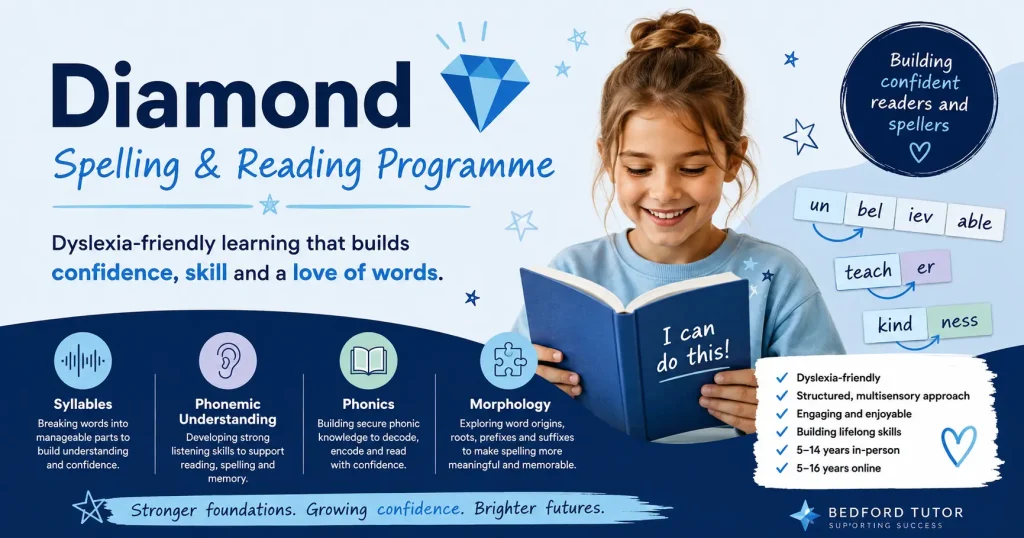
Although we’ve been incorporating elements of morphology into our tuition for many years through our Diamond Spelling & Reading Programme, from September we’ll be expanding this aspect of our lessons even further, giving children even more opportunities to discover the fascinating stories hidden inside words.

What Is Morphology?

Morphology is simply the study of the parts that make up words.

Many English words are built from prefixes, suffixes and root words. Once children begin to recognise these patterns, spelling starts to feel far less random.

Instead of seeing a long, unfamiliar word as one enormous challenge, they begin to spot familiar pieces they already know.

For example, understanding that helpful, careful and playful all share the suffix -ful helps children make connections between words rather than learning each one in isolation.

Likewise, recognising prefixes such as un-, re- or dis- allows children to decode and spell new vocabulary with much greater confidence.

Rather than memorising hundreds of individual spellings, they start recognising the patterns that link them together.

Why Morphology Can Be Particularly Helpful for Dyslexic Learners

Many children with dyslexia are excellent pattern spotters.

Once they begin recognising how words fit together, spelling often becomes much more logical and far less overwhelming.

Instead of asking, “How do I remember this word?”, they begin asking, “What parts can I already recognise?”

That small shift in thinking can make a remarkable difference.

Morphology also supports vocabulary development and reading comprehension. As children learn what different roots and affixes mean, they often find it much easier to work out the meanings of unfamiliar words when reading independently.

It’s another example of one skill supporting several areas of literacy at once.

Making Spelling Memorable Through Creativity

One thing I’ve learnt over the years is that children rarely remember something simply because they’ve copied it twenty times.

They remember experiences.

That’s why creativity plays such an important role in my lessons.

If we’re learning a new root word, we might draw it as a cartoon character. If we’re exploring a prefix, we may invent a silly story explaining where it came from. Sometimes we’ll create ridiculous sentences that make everyone laugh, because humour has a wonderful way of helping information stick in our memories.

Drawing, storytelling and imaginative activities transform spelling from something children have to do into something they actually enjoy.

Many neurodivergent learners are highly visual thinkers, and creating funny images or memorable stories often helps words stay in long-term memory far more effectively than repetition alone.

The more senses involved in learning, the more opportunities the brain has to create lasting connections.
Learning Should Be Fun

This has always been one of my guiding principles.

Children learn best when they are engaged.

Over the years, we’ve used games, visual resources, discussion, word-building activities and creative challenges to help children understand how English works. Morphology has quietly been part of that process for a long time, even if we haven’t always labelled it as such.

From September, however, we’ll be placing an even greater emphasis on exploring word families, roots, prefixes and suffixes in a structured but highly creative way.

The aim isn’t simply to improve spelling accuracy.

It’s to help children become curious about language.

When children begin asking questions like, “Why does that word end like that?” or “Where did this word come from?”, they’re no longer just memorising spellings. They’re becoming language detectives.

Looking Ahead to September

One student I’m particularly excited to continue working with is a wonderful young learner I tutor online in Dubai, UAE.

We’ve already made fantastic progress in developing confidence with reading and spelling, and from September we’ll be exploring morphology in much greater depth together. I can’t wait to see the connections they begin making as they discover how words are built and how those patterns can make spelling both easier and far more enjoyable.

Watching those moments of understanding is one of the greatest pleasures of teaching.

Suddenly, words that once seemed impossible begin to make sense.

Confidence grows.

And perhaps most importantly of all, children begin to realise that spelling isn’t simply about remembering random letters. It’s about understanding a wonderfully interconnected language that is full of patterns, history and fascinating discoveries waiting to be explored.

Wondering How We Can Help?

Whether you’re exploring tuition options, looking for specialist support or simply have a question, we’d love to hear from you. Tell us a little about your child and what you’re looking for, and we’ll be in touch as soon as possible.


Current Availability

Super Summer Learning (August): Good availability throughout the holiday

Weekday daytime tuition (from September): Good availability for international students, home-educated learners and families with flexible schedules

🗓️ After-school, Saturday & Sunday morning tuition (from September): Waiting list currently in operation


Please include Area Code if Outside UK

Related Posts

Related Blog Posts

  • Should My Child Have Tuition Over The Summer Holidays?

    Is Summer Holiday Tuition Worth It?

    As the summer holidays approach, many parents begin asking the same question:

    ​Should my child have tuition over the summer?

    It’s an interesting debate and one which doesn’t really have a universal answer.

    For many families, summer is a precious opportunity to slow down. After months of early mornings, homework, packed lunches and busy schedules, children deserve time to relax, recharge and simply enjoy being children. Looking back at my own school holidays, some of my happiest memories involve long days outdoors, building dens, reading books and becoming completely absorbed in whatever strange obsession had captured my imagination that particular week.

    Summer should never feel like an extension of school.

    However, there is another side to the story.

    Teachers often talk about the “summer slump”, that period during the long break when some children forget skills they worked hard to develop during the academic year. This is completely normal. In fact, many schools spend the first few weeks of the autumn term revisiting previous learning before introducing new concepts.

    For some children, particularly those who have struggled with confidence or have gaps in their learning, a small amount of support over the summer can make a surprisingly big difference.

    Learning Doesn’t Have To Feel Like School

    When people hear the word “tuition”, they often imagine children sitting at a desk completing worksheets while everyone else is outside enjoying the sunshine.

    Thankfully, good summer tuition looks very different.

    Some of the most effective holiday learning happens through games, creative challenges, discussion activities and hands-on tasks. Without the pressure of school assessments and deadlines, children often feel more relaxed and willing to take risks in their learning.

    In many ways, summer provides an opportunity to revisit skills at a gentler pace.

    Whether a child needs support with reading, writing, spelling, times tables or mathematical fluency, a few well-planned sessions can help keep important skills ticking over without dominating the holiday period.

    What About Children With SEND?

    For children with SEND, summer tuition can sometimes be particularly valuable.

    Many neurodivergent children thrive on routine and predictability. Whilst a complete break from school can be beneficial, six weeks without any structured learning can feel unsettling for some children.

    As someone with ADHD, I understand this feeling well. Although I desperately needed breaks from school, I also found comfort in having something meaningful to focus on. Too much structure felt restrictive, but no structure at all often left my thoughts bouncing around like pinballs in an arcade machine.

    Every child is different, but many children with ADHD, autism, dyslexia and other learning differences benefit from maintaining a small amount of routine during the summer months.

    The quieter pace of the holidays also allows tutors to spend more time exploring how a child learns best. Without the demands of the school timetable, sessions can focus on building confidence, strengthening key skills and developing strategies which can later be transferred back into the classroom.

    So, Is It Worth It?

    The honest answer is: sometimes.

    Not every child needs summer tuition and not every family wants it. Holidays should still be holidays.
    However, if your child has gaps in learning, struggles with confidence, is preparing for a transition to a new school or simply benefits from additional support, summer tuition can be a valuable investment.

    The most successful summer learning programmes are flexible, enjoyable and tailored to the individual child. They don’t aim to replace summer adventures with worksheets and timetables. Instead, they provide just enough support to help children return to school feeling confident, capable and ready for a new academic year.

    After all, the goal isn’t to fill every moment of the holidays with learning.

    It’s to ensure children begin September believing they can succeed.​

    If you are considering summer tuition in Bedford or online, our Super Summer Learning sessions provide personalised support for children aged 5-16 in a fun, engaging, and encouraging environment.

    ​To find out more, please click on the link below:

    Bel 😊


    Related Posts

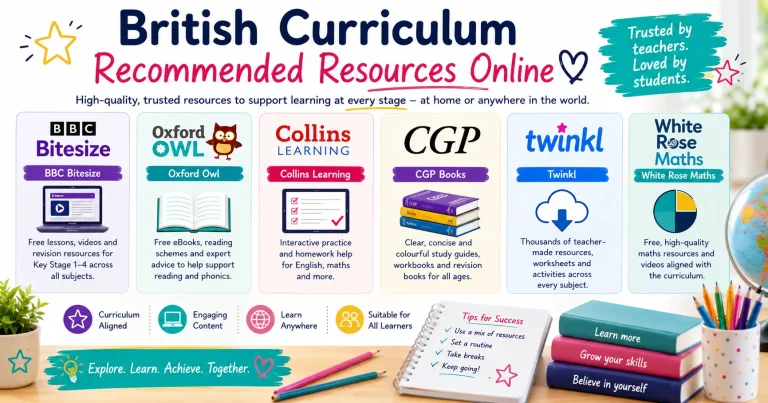
  • The Best British Curriculum Resources for Families Living Overseas

    Moving abroad is an exciting adventure, but when children begin following the British Curriculum outside the UK, many parents quickly discover that finding high-quality learning resources isn’t always straightforward.

    Whether you’re living in Dubai, Abu Dhabi, Riyadh, Jeddah, Singapore, Kuala Lumpur, Bangkok or elsewhere, you’ll probably find yourself asking similar questions.

    • Which websites actually follow the British Curriculum?
    • Are free resources good enough?
    • How can I support my child without buying dozens of expensive workbooks?

    Having worked with children following the British Curriculum in countries across the Middle East and Asia for many years, I’ve seen first-hand which resources genuinely help children develop confidence and which simply create more stress.

    The good news is that there are some excellent options available.

    Start with Your Child’s School

    Before purchasing anything, it’s always worth asking your child’s school which resources they already recommend.

    Many British international schools subscribe to online learning platforms that families can access from home. Teachers often use the same terminology, teaching methods and curriculum sequence within these platforms, making them ideal for reinforcing classroom learning.

    Using resources that match your child’s school can prevent confusion, particularly in mathematics where different methods may be taught.

    BBC Bitesize

    BBC Bitesize remains one of the best free educational resources available.

    Although originally designed for UK pupils, it works equally well for British Curriculum learners living overseas.

    I used BBC Bitesize extensively throughout my GCSEs and A Levels, and it played a significant role in my own academic success. Whenever I needed a clear explanation of a difficult topic or a quick way to revise before an exam, it was one of the first places I turned. Even now, I still recommend it to students and regularly use it when planning lessons because the explanations are concise, engaging and easy to understand.

    Children can revise:

    • English
    • Maths
    • Science
    • History
    • Geography

    The explanations are clear, age-appropriate and broken into manageable sections, making them particularly useful for independent learners.

    For older students preparing for GCSEs or iGCSEs, Bitesize is also excellent for revision.

    Oxford Owl

    If your child is developing reading confidence, Oxford Owl is a wonderful resource.

    I’ve used Oxford Owl many times when planning lessons, particularly when looking for engaging reading activities and age-appropriate eBooks. It also brings back happy memories for me because I learnt to read with the Oxford Reading Tree books as a child. Biff, Chip and Kipper were a huge part of my own reading journey, and I still have a real fondness for them today. It’s lovely to be able to recommend a resource that not only supports so many of my students but also helped me discover a love of reading myself.

    Alongside its extensive collection of books, Oxford Owl also offers phonics, grammar and maths activities, making it a fantastic all-round resource for families following the British Curriculum.

    It includes:

    • Free eBooks
    • Reading activities
    • Phonics support
    • Grammar resources
    • Maths activities

    Parents often tell me they struggle to know what books are suitable for their child’s age. Oxford Owl helps remove much of the guesswork.

    Collins Learning

    Collins produces many of the workbooks used in UK schools.

    Their books provide structured practice for:

    • English
    • Maths
    • Grammar
    • Spelling
    • Reasoning
    • SATs preparation

    I particularly like Collins because the progression is logical and the activities are usually short enough to avoid overwhelming children.

    CGP Books

    If you’ve ever visited a UK bookshop, you’ve almost certainly seen CGP books.

    They’re popular for good reason.

    I actually used CGP books myself when I was at school and found them incredibly helpful when revising for GCSEs and A Levels. Their clear explanations, straightforward layout and little touches of humour made even the more challenging topics feel far less intimidating. Years later, I still regularly use CGP books when planning lessons and recommending additional practice to students. They’re a fantastic resource that I return to time and time again.

    Older learners studying Key Stage 2, Key Stage 3 or GCSE material often enjoy their straightforward style, and the explanations are clear enough to help build confidence without feeling overwhelming.

    Twinkl

    Twinkl has become one of the largest educational resource websites available, and it is definitely one of my favourite places to go for inspiration, lesson ideas and ready-made teaching resources. Whether I’m looking for creative activities, engaging games or adaptable lesson templates, I often find something that can be tailored to suit the individual needs of my students.

    Parents can download:

    • Worksheets
    • Games
    • Display materials
    • Reading activities
    • Writing prompts
    • Maths investigations

    One advantage of Twinkl is the sheer variety.

    Whether your child needs additional support with fractions, handwriting or creative writing, you’ll usually find something suitable.

    White Rose Maths

    White Rose Maths has transformed mathematics teaching across many UK schools.

    Its resources focus on developing understanding rather than memorising procedures.

    Many British international schools now follow White Rose or use similar approaches, making it particularly helpful for families wanting to reinforce classroom learning at home.

    Reading Is Still the Most Powerful Resource

    One thing surprises many parents.

    The most valuable educational resource usually isn’t an app.

    It’s books.

    Children who read regularly tend to develop:

    • Vocabulary
    • Comprehension
    • Writing skills
    • General knowledge
    • Confidence

    Reading together, discussing stories and encouraging curiosity often has a greater long-term impact than completing another worksheet.

    For children living overseas, reading also helps maintain familiarity with British vocabulary, expressions and cultural references that appear throughout the curriculum.

    Don’t Feel You Need Every Resource

    One of the biggest mistakes I see is parents purchasing everything.

    A shelf full of workbooks rarely leads to better learning.

    Children usually benefit far more from using a small number of resources consistently than constantly switching between different programmes.

    Consistency builds confidence.

    When Additional Support Can Help

    Even with excellent resources, some children benefit from personalised guidance.

    This is especially true if they are:

    Resources provide practice.

    A tutor can identify misconceptions, adapt explanations and tailor learning to the individual child.

    That’s something no worksheet can fully replace.

    Final Thoughts

    Living overseas doesn’t mean compromising on educational quality.

    Today, families have access to an incredible range of British Curriculum resources from almost anywhere in the world.

    The key isn’t finding the most expensive programme.

    It’s finding resources that suit your child’s personality, confidence level and learning style.

    Sometimes one engaging lesson, one enjoyable book or one encouraging conversation achieves far more than hours spent working through endless exercises.

    After all, education isn’t simply about completing work.

    It’s about helping children become curious, confident learners who enjoy discovering new things.


    Wondering How We Can Help?

    Whether you’re exploring tuition options, looking for specialist support or simply have a question, we’d love to hear from you. Tell us a little about your child and what you’re looking for, and we’ll be in touch as soon as possible.


    Current Availability

    Super Summer Learning (August): Good availability throughout the holiday

    Weekday daytime tuition (from September): Good availability for international students, home-educated learners and families with flexible schedules

    🗓️ After-school, Saturday & Sunday morning tuition (from September): Waiting list currently in operation


    Please include Area Code if Outside UK

    Related Posts

  • British Curriculum vs American Curriculum: What Parents Living Abroad Should Know


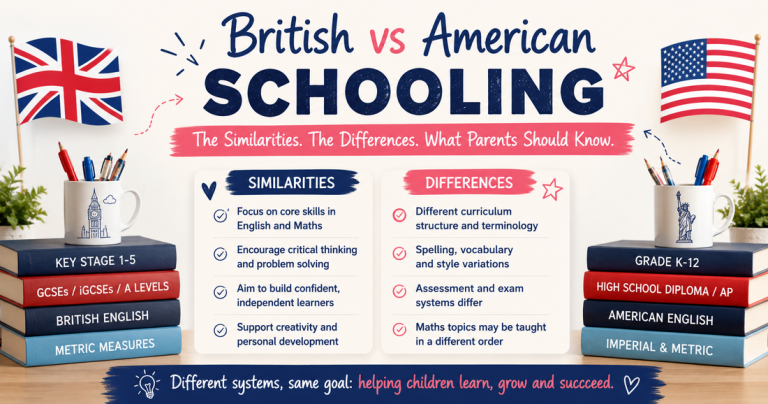
    One of the questions I am frequently asked by parents living overseas is whether there is a significant difference between the British and American curricula.

    The short answer is yes… and no!

    Having taught children following both educational systems for many years in countries such as the UAE and Thailand, I am often surprised by how similar they really are. Whilst there are certainly some differences in terminology, assessment and curriculum content, both ultimately aim to help children develop the same core skills: confidence in reading, competence in writing and a secure understanding of mathematics. That being said, there are some important distinctions which can occasionally catch families by surprise, particularly when children move between schools or educational systems.​

    One of the most obvious differences appears in English.

    Although British English and American English are essentially the same language, there are some spelling variations which can occasionally cause confusion. For example, a child attending a British school may write colour, favourite and centre, whilst a child following the American curriculum will be expected to write color, favorite and center.

    I often teach both British and American English and one of the first things I reassure children about is that neither version is “wrong”. The important thing is consistency. If a child is studying within an American school, they should use American spellings. If they are following the British curriculum, British spellings are usually expected.

    Fortunately, children tend to adapt remarkably quickly once they understand the differences.

    Over the years, I have also gained extensive experience preparing students for the GL Assessments used by many international schools. These assessments often form an important part of school entry procedures and provide valuable information about a child’s strengths and areas for development. Supporting children through these assessments has given me a strong understanding of the skills many international schools expect students to demonstrate.

    Alongside this, I regularly support students studying iGCSE English Language. I particularly enjoy helping learners develop their reading, writing and analytical skills whilst building the confidence needed to tackle longer pieces of writing and examination questions.

    My experience is not limited to the British curriculum, however.

    I have also worked with students in countries such as Saudi Arabia who follow Common Core English and Mathematics programmes, and regularly support children studying both the British and American curricula. Over the years, working across different educational systems has taught me that successful teaching is rarely about the curriculum itself. More often, it is about understanding the child sitting in front of you and adapting your approach to suit the way they learn best.​

    Mathematics is perhaps where some of the most noticeable differences occur.

    When I first began supporting a student studying the American mathematics curriculum over a longer period of time, I quickly realised that certain concepts were approached differently. The methods were not necessarily better or worse, but they were sometimes presented in a different order or explained using different terminology.

    One area which particularly expanded my own knowledge was the use of imperial measurements.

    Whilst British children are often familiar with miles and occasionally encounter other imperial units, the American curriculum tends to make much greater use of feet, inches, yards, pounds and gallons. Supporting students with these concepts helped me become far more confident teaching measurement systems which are not always covered in depth within the British curriculum.

    Experiences like these have been invaluable because they have allowed me to become more adaptable as a tutor.

    Perhaps the biggest lesson I have learnt is that children are often far more flexible than adults give them credit for. Whether they are learning colour or color, converting centimetres or inches, preparing for GL Assessments or studying iGCSE English Language, the underlying goal remains exactly the same: helping them become confident, capable learners.

    Curricula may vary from country to country, but curiosity, confidence and a love of learning are universal.

    As someone who works with children from a wide range of countries and educational backgrounds, I genuinely enjoy helping students navigate these differences and discover that, regardless of which curriculum they follow, they are capable of achieving great things.

    Here at Bedford Tutor, I have supported children following both the British and American curricula for many years. From GL Assessments and iGCSE English Language to Common Core English and Mathematics, working with learners from different educational systems has helped me develop a flexible approach that allows every child to build confidence whilst developing the skills they need to succeed.

    To find out more, please click on the link below:

    Bel 😊


    Related Posts

  • British Curriculum Tuition for Families in Thailand

    Moving to Thailand can be an exciting adventure for families. Whether you are relocating for work, joining an international school community or already settled in Bangkok, Phuket, Chiang Mai or elsewhere in the country, one thing many parents have in common is wanting their children to continue making good progress with the British Curriculum.

    Over the years, I have had the pleasure of supporting students living in Thailand through personalised online English and maths tuition. Every family’s situation is different, but the questions I receive are often remarkably similar.

    Will my child keep up with the UK curriculum?

    How can we prepare for iGCSEs whilst living overseas?

    What happens if my child needs extra support or has ADHD, dyslexia or another additional learning need?

    The good news is that with the right support, children can thrive wherever they are in the world.

    Why Families in Thailand Choose British Curriculum Tuition

    Thailand has a large number of excellent international schools, many of which follow the English National Curriculum or offer qualifications such as iGCSEs and A Levels.

    Even within these schools, however, children sometimes benefit from additional one-to-one support.

    Some need help filling small gaps in their understanding before those gaps become larger. Others want to build confidence in English or mathematics, prepare for GL Assessments or strengthen their reading and writing skills.

    Many parents simply value having an experienced tutor who understands the British education system and can provide consistent support throughout the academic year.

    Personalised Learning Makes a Difference

    One of the greatest advantages of one-to-one tuition is that every lesson can be tailored to the individual learner.

    No two children learn in exactly the same way.

    Some children enjoy discussion-based lessons, whilst others prefer visual resources, games or practical activities. Some thrive with structure and routine, whilst others benefit from a more flexible approach that follows their interests whilst still meeting curriculum objectives.

    Having worked with children from a variety of international schools, I have found that adapting to each learner is often far more important than following a rigid teaching plan.

    When children feel comfortable asking questions and making mistakes, confidence begins to grow naturally.

    Supporting Neurodivergent Learners

    Many of the students I support have ADHD, dyslexia, dyscalculia, autism or other learning differences.

    As someone who was diagnosed with ADHD as an adult, I understand both personally and professionally that neurodivergent learners are incredibly diverse. There is no single “ADHD learner” or “dyslexic learner”. Every child has their own strengths, challenges and preferred ways of learning. This understanding has shaped my tutoring approach, focusing on flexibility, encouragement and building confidence alongside academic skills.
    Rather than expecting children to fit a particular method of teaching, I adapt lessons to suit the child sitting in front of me.

    This might involve:

    • Breaking tasks into manageable steps.
    • Using multi-sensory activities.
    • Building working memory strategies.
    • Encouraging movement and interaction where appropriate.
    • Celebrating progress, however small.

    When children feel understood rather than judged, they often make remarkable progress.

    English and Maths Tuition for the British Curriculum

    I currently support learners across a wide age range, helping them develop confidence in both English and mathematics.

    English lessons may include:

    • Reading comprehension
    • Creative writing
    • Grammar and punctuation
    • Vocabulary development
    • Spelling
    • Functional Skills English
    • iGCSE English Language preparation

    Mathematics tuition can cover:

    • Number and calculation
    • Fractions, decimals and percentages
    • Problem solving
    • Reasoning
    • Algebra
    • Geometry
    • Functional Skills Maths
    • iGCSE Maths support

    Every lesson is adapted to the student’s current level and long-term goals.

    Preparing for GL Assessments and iGCSEs

    Many British international schools in Thailand use GL Assessments to monitor progress.

    Preparation is rarely about memorising endless facts. Instead, it focuses on developing secure reading, mathematical reasoning, grammar, vocabulary and problem-solving skills.

    Likewise, students preparing for iGCSE examinations benefit from steady, confidence-building practice rather than last-minute cramming.

    Having supported many learners through these assessments, I have found that children perform best when they understand the concepts, feel prepared and enjoy the learning process rather than fearing it. This approach reflects the way I work with international school students across the world.

    Learning Across Time Zones

    One of the advantages of online tuition is flexibility.

    Thailand is several hours ahead of the UK, depending on the time of year, but lessons can be arranged to fit around school, extracurricular activities and family life.

    Many families appreciate being able to access specialist British Curriculum tuition without needing to find local support that may not fully align with their child’s educational programme.

    Whether your child attends an international school, is home educated or is preparing to relocate to another country, regular online tuition provides continuity and reassurance.

    Building Confidence for the Future

    Academic progress is important, but confidence is equally valuable.

    Many children begin tuition believing they “aren’t good at English” or “just can’t do maths”. Over time, those beliefs often begin to change.

    As understanding grows, confidence follows.

    Children become more willing to ask questions, attempt challenging tasks and celebrate their own achievements.

    Those moments are often the most rewarding part of tutoring.

    Final Thoughts

    Living overseas should never limit a child’s educational opportunities.

    With personalised British Curriculum tuition, children in Thailand can continue developing strong English and mathematics skills whilst enjoying all the opportunities that international life has to offer.

    Whether your child needs ongoing academic support, preparation for GL Assessments or iGCSEs, or specialist tuition for ADHD, dyslexia, dyscalculia or autism, the right one-to-one support can make a lasting difference.


    Wondering How We Can Help?

    Whether you’re exploring tuition options, looking for specialist support or simply have a question, we’d love to hear from you. Tell us a little about your child and what you’re looking for, and we’ll be in touch as soon as possible.


    Current Availability

    Super Summer Learning (August): Good availability throughout the holiday

    Weekday daytime tuition (from September): Good availability for international students, home-educated learners and families with flexible schedules

    🗓️ After-school, Saturday & Sunday morning tuition (from September): Waiting list currently in operation


    Please include Area Code if Outside UK

    Related Posts

  • What Makes an Online Tutor a Good Fit for a Child with ADHD?

    Finding the right online tutor for a child with ADHD is about far more than finding someone who knows their English or maths curriculum.

    Of course, subject knowledge matters. Experience matters too. But, in my experience, the most important question is whether the tutor understands how that particular child learns.

    ADHD does not look the same in every person. I know this personally. I was not diagnosed with ADHD until I was 31. Because I loved learning and generally did well academically at school, nobody really questioned whether ADHD might be part of the picture. Looking back, however, I can see that I could become intensely absorbed when something captured my imagination, whilst repetitive or uninteresting tasks were much harder to sustain. I also struggled with working memory and multi-step instructions.

    That experience has shaped the way I teach.

    There is no such thing as a standard ADHD learner. My own experience has taught me that my ADHD is not somebody else’s ADHD, and their ADHD is not mine. What works beautifully for one child may be completely wrong for another.

    So, what should parents look for when choosing an online tutor for a child with ADHD?

    A tutor who makes learning interesting

    For me, this is one of the biggest things.

    Many ADHD learners have what we might describe as an interest-driven nervous system. When something is genuinely fascinating, attention can suddenly become incredibly powerful. When something feels repetitive, disconnected from real life or simply boring, maintaining that attention can be much harder.

    This is something I recognise from my own life. As a child, I could put enormous effort into something that had grabbed me, but sustaining effort on something that did not interest me was another matter entirely.

    That is why I don’t believe an ADHD-friendly lesson should simply be a worksheet followed by another worksheet.

    I want lessons to have energy.

    We might play a game, tackle a challenge, discuss an unusual topic, use a visual resource, solve a practical problem or suddenly take the lesson in a completely different direction because the child has become fascinated by something.

    Variation and novelty can make a huge difference.

    This does not mean that learning lacks structure. Quite the opposite. A good tutor can provide a strong framework whilst changing what happens inside it.

    A tutor who starts with the child, not the worksheet

    One of the great advantages of one-to-one online tuition is that there is no need to teach every child in exactly the same way.

    I can look at the child sitting in front of me and think: What is going to make this work for them?

    For one learner, that might mean movement and interactive activities. For another, it could mean visual resources. For someone else, it might mean breaking a difficult task into smaller pieces or using a practical example.

    My current approach is very much strengths-based. Rather than viewing ADHD simply through the difficulties it can create, I want to understand a child’s interests, strengths, personality and ambitions too. This is consistent with the wider approach I use across my SEND tuition, where lessons are adapted to the individual learner rather than expecting the learner to fit a fixed model.

    And sometimes those interests can completely transform a lesson.

    When maths meets motorsport

    One of my current online students is absolutely passionate about motorsports.

    He doesn’t just enjoy watching motorsport. He has a genuine ambition to establish a business connected with the industry.

    So why would I teach him maths using completely unrelated examples if I don’t have to?

    Instead, we have explored mathematics through the things he actually cares about.

    We’ve looked at costings connected with motorsport, discussed business ideas and used real-world situations to make mathematical concepts more meaningful. We’ve also designed logos and talked about what a potential business website might need.

    Suddenly, maths is no longer just maths.

    It is part of his future.

    This is precisely why I believe interests are so powerful for ADHD learners. We are not removing the educational objective. We are changing the route we take to get there.

    A lesson about percentages might become a discussion about profit margins. A problem-solving activity might involve working out costs. English could involve writing website content or thinking about how a business should communicate with customers.

    The curriculum is still there. We have simply given it a reason to matter.

    A tutor who understands the importance of clear steps

    Interest alone is not enough.

    Children with ADHD can understand a concept perfectly well and still become overwhelmed when a task contains too many steps.

    This is something I recognise from my own experiences. Multi-step instructions have historically been an area of difficulty for me, and it is one of the reasons I am very conscious about how I present information to children.

    If a mathematical problem requires five stages, I don’t necessarily expect a child to hold all five stages in their working memory.

    Instead, we might write them down.

    Step 1: What information do we have?

    Step 2: What do we need to find?

    Step 3: Which operation do we need?

    Step 4: Complete the calculation.

    Step 5: Check the answer.

    Colour-coding can be incredibly useful here too.

    Perhaps the important numbers are highlighted in yellow, the operation is blue and the final answer is green. For a child who finds a page visually overwhelming, suddenly there is a pathway through it.

    A large problem becomes a collection of smaller, manageable jobs.

    This is very much in keeping with the ADHD-friendly strategies I use: visual structure, checklists, step-by-step instructions and breaking larger tasks into smaller chunks.

    Client gallery powered by Picflow

    A tutor who has plenty of resources – but knows when to use them

    In a classroom, one of the wonderful things we have is a wealth of resources.

    We don’t have to teach every child with the same book, the same worksheet or the same activity.

    If I know that a child loves dinosaurs, I can find dinosaur-related material. If they love sport, we can use sport. If they are fascinated by space, animals, cars or cooking, those interests can become bridges into learning.

    This is particularly valuable with ADHD because interest can be the doorway into attention.

    I have seen this with a girl I work with who absolutely loves nature. Rather than trying to make every reading comprehension about an arbitrary subject, we have used wildlife and nature-based comprehensions to develop her reading.

    And it works beautifully because she already wants to know the answer.

    She is not simply reading because an adult has told her to read. She is reading because she wants to discover something about an animal or the natural world.

    That distinction matters.

    A tutor who is patient and kind

    Perhaps this sounds obvious, but I think it is one of the most important qualities of all.

    Children with ADHD can spend an enormous amount of time being told to concentrate, stop fidgeting, listen properly, remember things and try harder.

    Eventually, repeated correction can begin to affect confidence.

    I remember how important it was when teachers recognised the things I did well. The teachers I remember most warmly were not necessarily those who were the strictest. They were the ones who noticed my enthusiasm, creativity and determination.

    A good tutor needs patience.

    They need to be able to say, Let’s try that another way.

    They need to be comfortable repeating an explanation without making a child feel silly.

    They need to celebrate the small victories.

    And, perhaps most importantly, they need to help a child understand that finding something difficult does not mean they are incapable.

    The best online tutor sees the whole child

    Ultimately, I don’t think there is one perfect formula for tutoring a child with ADHD.

    Some children love structure. Others need more flexibility. Some want to talk constantly. Others need quiet. Some thrive on games and movement, whilst others become completely absorbed by a particular subject.

    The tutor’s job is to notice.

    My own ADHD has taught me that neurodivergence is wonderfully varied. It has also taught me that children should not have to squeeze themselves into a particular model of what a learner is supposed to look like.

    For me, the best online tuition combines kindness, structure, creativity, variation and genuine interest in the child.

    It is about making learning entertaining without losing the educational purpose.

    It is about taking a difficult multi-step problem and turning it into manageable steps.

    It is about using colour, visuals and practical examples when they help.

    It is about finding the subject that makes a child’s eyes light up and then asking, How can we use this to teach?

    And sometimes, that means turning maths into motorsport.

    Sometimes it means turning reading into wildlife exploration.

    Sometimes it means designing a business logo, discussing a webpage or working out how much something would cost.

    When we start with the child, rather than simply starting with the curriculum, learning can become something very different.

    It can become something they actually want to do.

    A personalised approach to ADHD tuition


    Wondering How We Can Help?

    Whether you’re exploring tuition options, looking for specialist support or simply have a question, we’d love to hear from you. Tell us a little about your child and what you’re looking for, and we’ll be in touch as soon as possible.


    Current Availability

    Super Summer Learning (August): Good availability throughout the holiday

    Weekday daytime tuition (from September): Good availability for international students, home-educated learners and families with flexible schedules

    🗓️ After-school, Saturday & Sunday morning tuition (from September): Waiting list currently in operation


    Please include Area Code if Outside UK

    Related Posts

  • Creative Writing Activities That Inspire Reluctant Writers

    For many children, the words creative writing are enough to make them groan.

    “I don’t know what to write.”

    “I’m not good at stories.”

    “I’ve got no ideas.”

    Over the years, I’ve heard these phrases countless times from children of all ages. Whether I’m supporting home-educated learners, children with ADHD, dyslexia or autism, or students who simply lack confidence in English, reluctant writers often have one thing in common: they believe they have nothing worth writing about.

    The good news is that this is very rarely true.

    In fact, some of the most imaginative stories I’ve ever read have come from children who originally insisted they hated writing.

    The secret isn’t forcing children to write more.

    It’s helping them discover that writing can actually be fun.

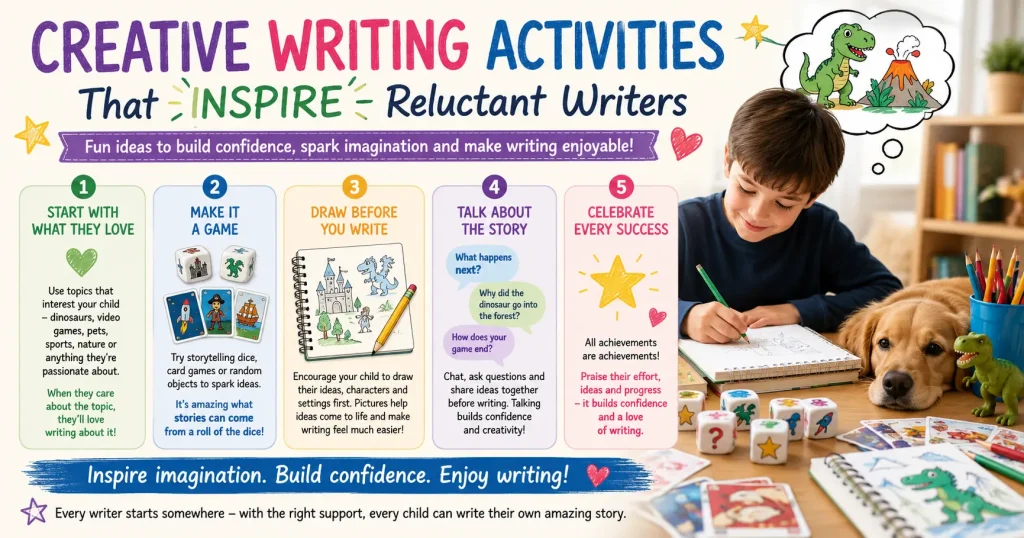
    Start with What Interests Your Child

    One of the biggest mistakes adults sometimes make is choosing the topic for the child.

    If a child has no interest in castles, why ask them to write about knights?

    If they aren’t fascinated by space, why expect them to produce an exciting story about astronauts?

    Instead, I always begin with something the child genuinely enjoys.

    Over the years, I’ve seen some wonderfully creative writing inspired by children’s own interests.

    I’ve worked with children who have written incredible adventures involving dinosaurs, inventing their own prehistoric worlds complete with volcanoes and newly discovered species. Others have designed entire video games on paper, describing characters, magical powers, levels and villains in extraordinary detail.

    Some of my favourite pieces of writing have been about children’s pets. Whether it’s a mischievous Labrador, a cheeky hamster or a much-loved horse, children often have endless ideas when they’re writing about something they already know and love.

    When children care about the topic, they stop worrying about “doing writing” and simply start telling a story.

    Turn Writing Into a Game

    Creative writing doesn’t have to begin with a blank sheet of paper.

    In fact, I often try to avoid that altogether.

    Children are naturally imaginative when they’re playing, so why not build writing around play?

    One activity I regularly recommend is using storytelling dice.

    A few simple pictures rolled onto the table can become the beginning of an exciting adventure.

    Perhaps the dice show a dragon, a treasure chest and a bicycle.

    How did the dragon learn to ride a bike?

    Why is the treasure hidden?

    Who discovers it?

    Suddenly, ideas begin flowing naturally.

    Storytelling card games work just as well and can be adapted for children of different ages.

    The wonderful thing is that you don’t need expensive resources.

    Many storytelling games are available online, and it’s surprisingly easy to make your own using pieces of card, magazine pictures or even objects from around the house.

    A spoon, a toy dinosaur and a pair of sunglasses might sound like a strange combination—but I’ve seen children create fantastic stories from far less!

    When writing feels like a game rather than a lesson, children often become far more willing to have a go.

    Draw Before You Write

    Many children find planning the hardest part of creative writing.

    Traditional planning sheets filled with bullet points simply don’t work for every learner.

    Instead, I often encourage children to draw first.

    Rather than asking them to write about a dragon, I ask them to draw it.

    What colour is it?

    Does it breathe fire?

    Where does it live?

    Who are its friends?

    Without realising it, children begin developing characters, settings and story ideas before they’ve written a single word.

    This approach works particularly well for many neurodivergent learners, including children with ADHD and dyslexia, who often think visually.

    Once the picture is complete, the writing usually feels much easier because the story already exists in their imagination.

    Sometimes a single drawing can inspire several pages of writing.

    Colourful infographic showing creative writing activities that help reluctant writers build confidence through play and imagination.

    Encourage Talking Before Writing

    Writing doesn’t always need to begin silently.

    Some children are brilliant storytellers long before they become confident writers.

    Ask them questions.

    “What happens next?”

    “Why did the dinosaur go into the forest?”

    “How does your video game end?”

    As they answer, they’re already building the structure of their story.

    Sometimes I’ll even jot down their ideas as they speak before asking them to expand them in their own words.

    This removes much of the pressure and allows children to focus on their creativity rather than worrying about spelling every word perfectly.

    Remember That Every Writer Starts Somewhere

    One of the most important things I’ve learnt over many years of tutoring is that confidence comes before great writing.

    Children who believe they’re “bad at writing” often avoid it altogether.

    That’s why praise matters so much.

    Every achievement deserves to be recognised.

    Perhaps they’ve thought of an imaginative character.

    Maybe they’ve written one excellent sentence.

    Perhaps they’ve remembered to use speech marks for the first time.

    These are all successes.

    I make a point of celebrating every step forward because every small success builds confidence for the next challenge.

    I’ve watched many reluctant writers gradually begin to enjoy writing—not because they suddenly became perfect spellers or expert authors overnight, but because they started believing they could write.

    Confidence grows through encouragement.

    Make Creative Writing Enjoyable

    Writing should never feel like a punishment.

    The children who make the greatest progress are usually the ones who laugh during lessons, become excited by their ideas and forget they’re even practising English.

    By choosing topics they genuinely love, turning activities into games, drawing before writing and celebrating every achievement, creative writing becomes something children look forward to rather than something they avoid.

    After all, every confident writer was once a beginner.

    Sometimes all a child needs is someone who believes in their ideas before they believe in them themselves.


    Wondering How We Can Help?

    Whether you’re exploring tuition options, looking for specialist support or simply have a question, we’d love to hear from you. Tell us a little about your child and what you’re looking for, and we’ll be in touch as soon as possible.


    Current Availability

    Super Summer Learning (August): Good availability throughout the holiday

    Weekday daytime tuition (from September): Good availability for international students, home-educated learners and families with flexible schedules

    🗓️ After-school, Saturday & Sunday morning tuition (from September): Waiting list currently in operation


    Please include Area Code if Outside UK

    Related Posts