Bedford, UK


When parents ask me what the most important part of primary maths is, my answer is almost always the same: number sense.
Before children can confidently tackle fractions, algebra or problem solving, they need to develop a deep understanding of numbers themselves. Just as we wouldn’t expect a child to build a house without solid foundations, we shouldn’t expect them to master more complex mathematics until they truly understand the basics.
Over the years, I’ve found that children make their greatest progress when we slow down, build confidence and make sure those mathematical foundations are secure before moving on.
What Is Number Sense?
Number sense is far more than simply being able to count or memorise times tables.
It is a child’s intuitive understanding of how numbers work and how they relate to one another. Children with strong number sense can estimate, recognise patterns, spot relationships and approach problems flexibly rather than relying on memorised procedures.
For example, instead of seeing 8 + 7 as a calculation to memorise, a child with good number sense might think:
“I know 8 needs 2 to make 10, so I’ll take 2 from the 7. That makes 10 + 5 = 15.”
That kind of thinking demonstrates genuine mathematical understanding rather than simple recall.
Moving from Concrete to Visual to Abstract
One of the principles I use throughout my primary maths tuition is moving from concrete, to visual, and finally to abstract learning.
This progression allows children to build understanding gradually rather than expecting them to work with abstract numbers before they’re ready.
Concrete Learning
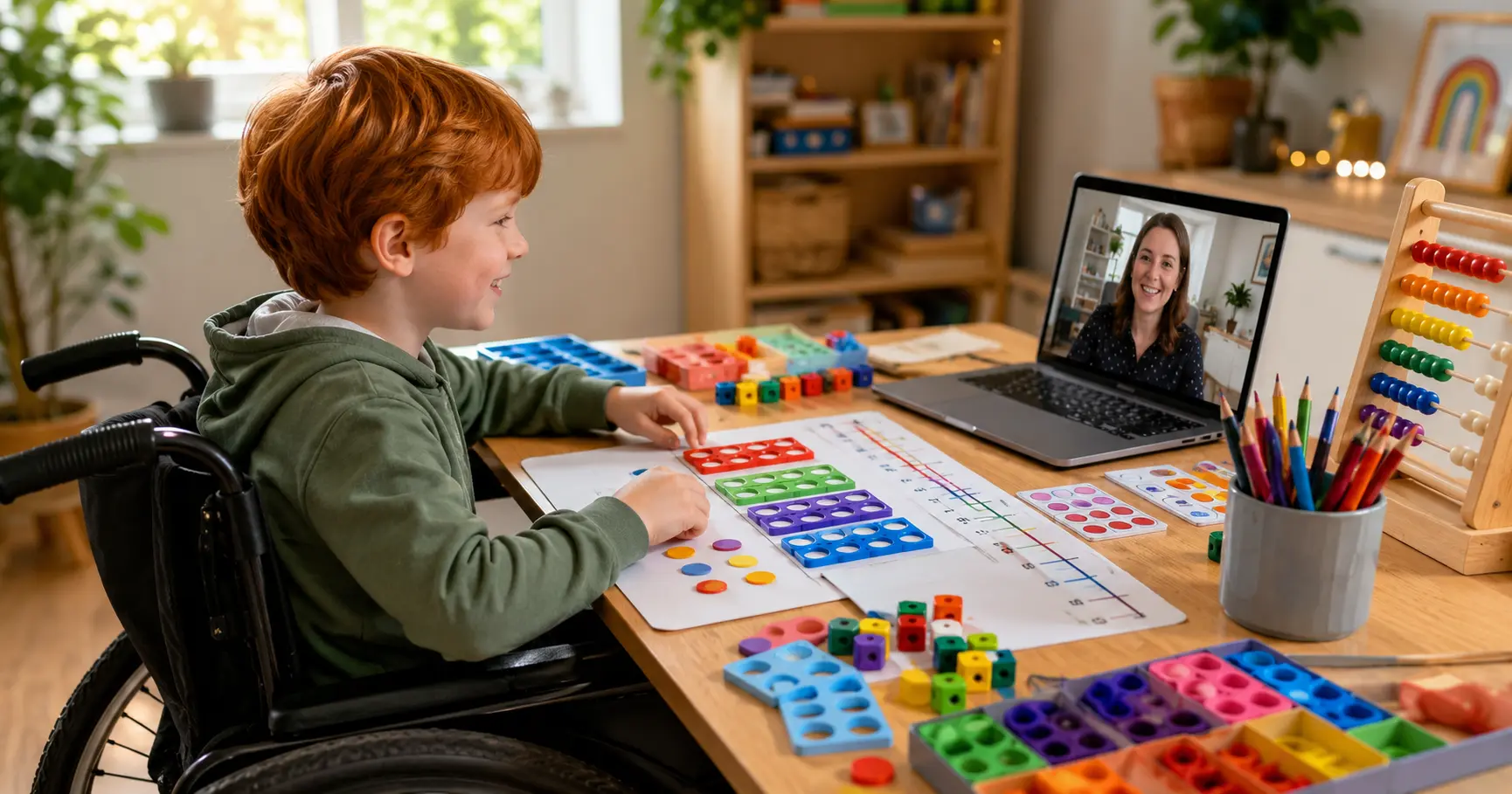
Children first explore mathematical ideas using real objects they can touch and move.
These might include:
- Counters
- Cubes
- Numicon
- Bead strings
- Base ten equipment
- Dice
- Coins
- Dominoes
Physically manipulating objects helps children see what addition, subtraction, multiplication and division actually mean.
Instead of simply hearing that 4 + 3 = 7, they can build it, move it around and discover it for themselves.
Visual Learning
Once children understand a concept using physical resources, we gradually introduce visual representations.
This might include:
- Number lines
- Bar models
- Arrays
- Ten frames
- Part-whole models
- Number bonds
The concrete objects slowly become pictures and diagrams, allowing children to visualise mathematics without needing physical equipment every time.
Abstract Learning
Only when those foundations are secure do we move towards abstract calculations using numbers and symbols alone.
By this stage, the maths isn’t simply something they’ve memorised.
It’s something they genuinely understand.
Most importantly, we move through these stages at the child’s pace, not according to a timetable.
Some children are ready to move quickly.
Others benefit enormously from spending longer exploring concrete resources.
There is no prize for rushing.
Strong foundations almost always save time later.
Mastering the Four Core Operations
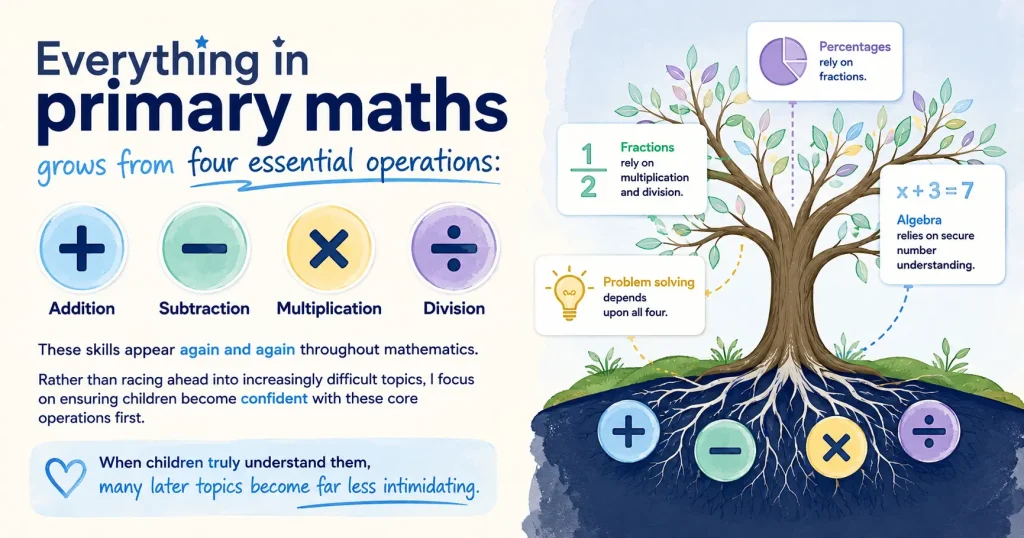
Everything in primary maths grows from four essential operations:
- Addition
- Subtraction
- Multiplication
- Division
These skills appear again and again throughout mathematics.
Fractions rely on multiplication and division.
Percentages rely on fractions.
Algebra relies on secure number understanding.
Problem solving depends upon all four.
Rather than racing ahead into increasingly difficult topics, I focus on ensuring children become confident with these core operations first.
When children truly understand them, many later topics become far less intimidating.
Using Real-World Maths
One question children ask surprisingly often is:
“When am I ever going to use this?”
It’s a fair question.
That’s why I try to teach mathematics through situations children can relate to.
We might calculate the cost of shopping, work out change in a café, divide slices of pizza, measure ingredients while baking or compare football scores and statistics.
Suddenly maths becomes something useful rather than something that only exists inside exercise books.
Children begin to realise they already use mathematics every single day.
Learning Through Socratic Questioning
One of my favourite teaching approaches is Socratic questioning.
Rather than immediately showing children how to solve a problem, I ask carefully chosen questions which help them discover the solution themselves.
Questions such as:
“What do you notice?”
“Can you think of another way?”
“Why do you think that worked?”
“Does your answer make sense?”
These conversations encourage children to think mathematically rather than simply follow instructions.
The confidence that comes from discovering an answer independently is often far more powerful than being shown the method from the beginning.
Online Maths Can Still Be Practical
Some parents worry that online maths lessons can’t be hands-on.
Fortunately, that hasn’t been my experience.
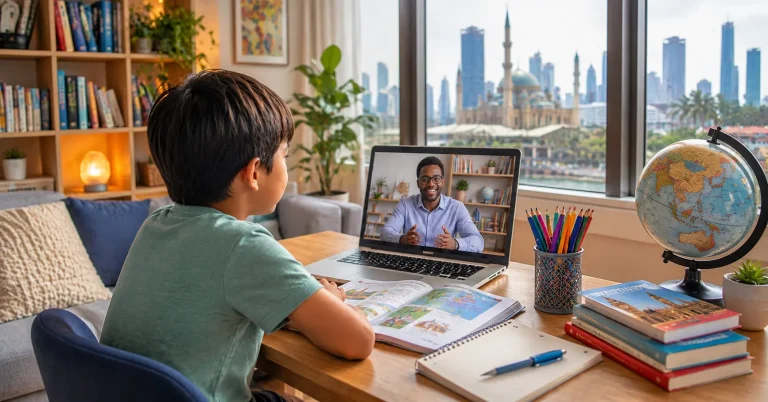
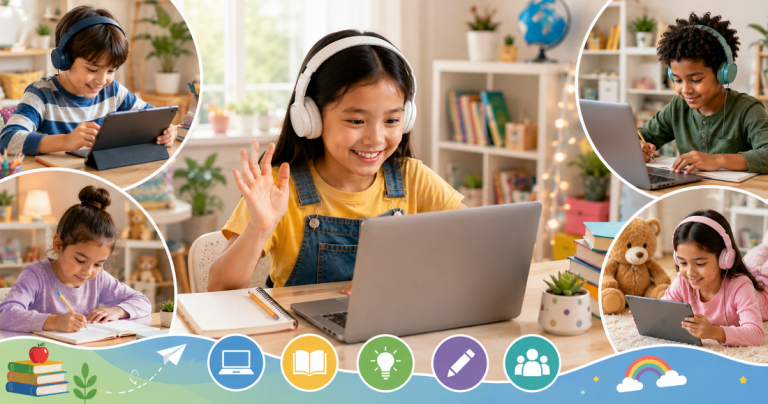
For a number of years, I’ve been supporting one primary maths student living in Saudi Arabia, alongside another wonderful student in Thailand. Although we meet online, our lessons remain highly interactive and practical.
With just a few inexpensive resources at home, children can still manipulate objects, build numbers and explore mathematical ideas exactly as they would during face-to-face lessons.
Simple resources such as counters, cubes, playing cards, dice, Numicon or even dried pasta can make an enormous difference.
Children love being able to pick things up, move them around and physically demonstrate their thinking.
Technology allows us to share screens, draw diagrams and play interactive games, whilst tactile resources provide the hands-on learning that many children still benefit from.
It really can be the best of both worlds.
Maths Should Feel Like Solving a Puzzle
Perhaps the most important thing I try to achieve in every lesson is making maths enjoyable.
Many children come to me believing they “aren’t maths people.”
Very often, they simply haven’t been given enough time to build secure foundations.
I encourage children to think of maths as a giant puzzle.
Every question is simply another mystery waiting to be solved.
Sometimes we solve it quickly.
Sometimes we need to try several different strategies.
Sometimes we make mistakes before finding the answer.
That’s all part of learning.
When children stop fearing mistakes and begin enjoying the challenge, something remarkable happens.
Their confidence grows.
Their curiosity increases.
And mathematics becomes something they look forward to rather than something they dread.
After all, children learn best when they’re having fun.
Final Thoughts
Strong number sense doesn’t develop overnight.
It grows through curiosity, exploration, conversation and plenty of opportunities to play with numbers.
By moving from concrete experiences to visual representations and finally to abstract thinking, children develop genuine mathematical understanding that lasts far beyond primary school.
When we teach through real-world examples, encourage mathematical discussion using Socratic questioning, and make learning enjoyable, maths becomes much more than a school subject.
It becomes an exciting puzzle waiting to be explored.
Here at Bedford Tutor, I have been supporting primary maths learners across the UK and around the world for many years, including children following both British and international curricula. Whether working with learners in Bedfordshire, Saudi Arabia, Thailand or elsewhere, my aim is always the same: to build secure mathematical foundations through engaging, personalised lessons that develop confidence as well as competence. By using practical resources, encouraging curiosity and moving at each child’s individual pace, I help children discover that maths really can be enjoyable.
To find out more, please click on the relevant link below:
Bel 😊