• Supporting Home-Educated Children in English and Maths

    Home education has become increasingly popular in recent years and, having worked with home-educated learners for many years, I have seen first-hand how effective personalised learning can be.

    One of the things I love most about working with home-educated students is the freedom to adapt learning to the individual child. Every learner is different. Some children race ahead in certain subjects whilst needing more time in others. Some thrive with structure and routine, whilst others flourish when lessons are creative, flexible and shaped around their interests.

    Over the years, I have supported home-educated students from all over the UK and from countries across the world. Although every family has chosen home education for different reasons, they often have one thing in common: a desire to provide a learning experience which truly meets the needs of their child.

    My own journey into online tuition expanded significantly during the COVID-19 pandemic. Whilst the world was adjusting to remote learning, I was helping a large number of children continue their education online. What began as a necessity quickly revealed something surprising. Many children actually thrived in a one-to-one online environment. Without the distractions of a busy classroom, they were often more confident, more engaged and more willing to take risks in their learning.

    Since then, online tuition has become a major part of my work and I now support home-educated learners in a variety of locations, helping them develop confidence in both English and mathematics.

    One of my priorities is always to make lessons enjoyable.

    Learning should be engaging, particularly when children are working one-to-one. Whilst it is important to cover key curriculum content and develop essential skills, I strongly believe that children learn best when they are interested in what they are doing. For this reason, I regularly use games, challenges, creative activities and discussion-based learning to bring lessons to life.

    As someone who works with many neurodivergent learners, I know that engagement is often the key to success.

    I currently support home-educated students with ADHD, dyslexia, dyscalculia and autism. Many of these children have previously found traditional educational environments challenging and benefit from a more personalised approach. Rather than expecting every learner to fit a particular mould, I adapt lessons to suit the child sitting in front of me.

    For some students, this means incorporating movement, visual resources and highly interactive activities. For others, it may involve breaking learning into smaller chunks, developing confidence gradually or exploring concepts through practical examples.

    Alongside English and mathematics tuition, I also currently support students working towards Functional Skills English and Functional Skills Maths qualifications. These qualifications provide valuable pathways for many learners and can help build confidence whilst developing essential life skills.

    One of the greatest advantages of home education is the ability to learn at the right pace. There is often more time to revisit areas of difficulty, explore personal interests and celebrate progress without the pressure that can sometimes accompany traditional schooling.

    Whether a child is preparing for Functional Skills qualifications, developing confidence in literacy and numeracy, or simply benefiting from additional support as part of their home education journey, personalised online tuition can provide valuable structure, encouragement and expertise.

    Most importantly, I believe that every child deserves to feel successful.

    When children feel understood, supported and confident in their abilities, remarkable things can happen. My goal is always to create lessons which are engaging, encouraging and tailored to the unique strengths and needs of each learner.

    After all, successful education is not about forcing every child down the same path. Sometimes it is about finding the path which works best for them.

    Here at Bedford Tutor, I have supported home-educated learners across the UK and around the world for many years. From Functional Skills English and Maths to personalised learning programmes for children with ADHD, dyslexia, dyscalculia and autism, I have developed a flexible and engaging approach that helps students build confidence whilst developing the essential skills they need to thrive.

    To find out more, please click on the relevant link below:

    Bel 😊



    Related Posts

  • One Thing Parents Should Look For In An Online Tutor

    When parents contact me looking for an online tutor, they often ask about qualifications, experience and academic results.

    Those things are important, of course.

    However, if I could recommend just one thing that parents should look for, it would be flexibility.

    Not flexibility in the sense of cancelling lessons at the last minute or constantly changing plans. I mean the ability to adapt to a child’s individual circumstances, learning style and educational journey.

    Over the years, I’ve worked with children from many different countries and educational backgrounds. Although every student has been unique, one thing has become very clear: children learn best when the adults supporting them are willing to adapt.

    One of the greatest advantages of online tuition is that geography doesn’t really matter. From my little corner of Bedfordshire, I’ve been fortunate enough to work with children in Saudi Arabia, the UAE, Thailand and many other parts of the world. Whilst mathematics may still be mathematics and English may still be English, every child’s educational experience is slightly different.

    One area where flexibility has been particularly important is school holidays.

    When I first began working with international students, I quickly realised that not everyone follows the same academic calendar. Whilst children in the UK might be enjoying their summer holidays, some of my students overseas are preparing to return to school. Equally, there have been times when UK schools have been in full swing whilst students in Saudi Arabia or the UAE have been enjoying a well-earned break.

    Rather than seeing this as a challenge, I’ve always viewed it as an opportunity.

    The quieter periods often allow us to focus on confidence-building, revisit areas of learning that need strengthening or simply learn at a pace that isn’t always possible during a busy school term. Some of my most productive lessons have taken place when a child has been on holiday and finally had the mental space to breathe, reflect and enjoy learning again.

    Flexibility is equally important when it comes to different curricula.

    Not every child follows the British Curriculum. Over the years, I’ve supported students studying within British international schools, American curricula and a variety of international programmes. I’ve worked with children in Saudi Arabia preparing for assessments that look quite different from those taken by students in Bedford. I’ve taught learners in the UAE whose schools approach mathematics in a slightly different way. I’ve also worked with students in Thailand whose educational experiences have been shaped by an entirely different cultural and academic environment.

    At first glance, these differences might seem significant.

    In reality, good teaching is often about identifying the skills which sit beneath the curriculum. Whether a child is learning persuasive writing in Dubai, developing reading comprehension skills in Riyadh or strengthening mathematical reasoning in Bangkok, the core goal remains the same: helping them become confident, capable learners.

    This is where flexibility becomes so valuable.

    A tutor who rigidly follows one method or one curriculum may struggle when working with international learners. A flexible tutor, however, can adapt resources, explanations and teaching approaches to suit the child sitting in front of them.

    As someone with ADHD, I think this is one of the reasons I value flexibility so highly. My own brain has never enjoyed being squeezed into neat little boxes. Looking back, the teachers who helped me most were rarely the ones who insisted there was only one way to do something. They were the people who recognised that different minds often need different routes to reach the same destination.

    The same principle applies to tutoring.

    Qualifications matter. Experience matters. Subject knowledge matters.

    But if I were choosing an online tutor for a child, I would look for someone who is willing to adapt, willing to listen and willing to see the individual behind the curriculum.

    Because when a tutor is flexible enough to meet a child where they are, learning often becomes far more successful than anyone imagined possible.

    ​​If you’re considering online tuition, our worldwide lessons offer one-to-one support for children aged 5 to 16 in an engaging, inspiring and encouraging learning environment. Each lesson is tailored to your child’s needs, helping them develop confidence, build key skills, and achieve their potential from the comfort of your home. 

    ​To find out more, please click on the link below:

    Bel 😊


    Related Posts

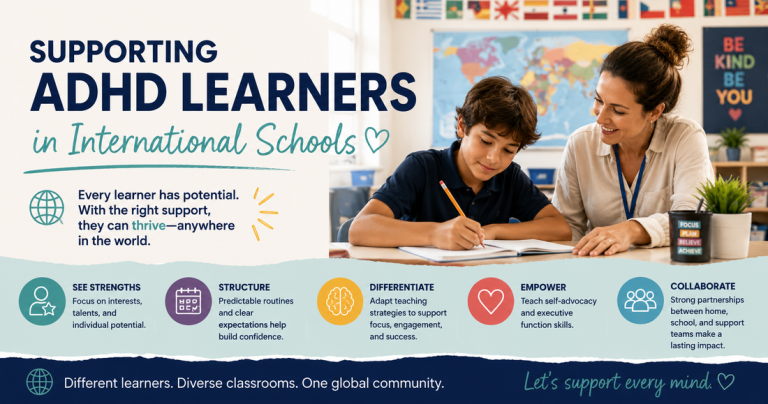
  • Supporting ADHD Learners in International Schools

    What is ADHD?

    When most people think of ADHD, they picture a child who can’t sit still, constantly interrupts and bounces from one activity to the next. Whilst that can certainly be part of the picture, ADHD is far more complex than many people realise.

    Attention Deficit Hyperactivity Disorder (ADHD) is a neurodevelopmental condition which affects attention, organisation, impulse control and executive functioning. However, no two people experience it in exactly the same way.

    I wasn’t diagnosed with ADHD until I was 31. Looking back, the signs were there in bright neon lights. I was energetic, excitable, impulsive and intensely curious about almost everything. I struggled with multi-step instructions, often forgot things that had been said to me moments earlier and found repetitive tasks about as appealing as watching paint dry. Yet I also did well in school, loved learning and was often described as organised and conscientious. For years, those apparent contradictions stopped me from recognising my own ADHD.

    That experience taught me something important: ADHD doesn’t look the same in every child.

    In international schools, where learners arrive with different languages, cultures, educational experiences and life stories, it is especially important to look beyond stereotypes. The child who constantly calls out answers may have ADHD. Equally, the child quietly staring out of the window, lost in a world of their own, may be experiencing exactly the same condition.

    How Does ADHD Affect Learners?

    One of the greatest misconceptions about ADHD is that it is simply a problem with paying attention. In reality, it is often a difficulty with regulating attention.

    Many ADHD learners can focus brilliantly when something captures their imagination. As a child, I could happily spend hours immersed in a topic which fascinated me. If a lesson sparked my curiosity, I was fully engaged and often had more questions than anyone else in the room. However, if a task felt repetitive, disconnected from my interests or required sustained concentration, keeping my attention on it could feel like trying to hold onto a handful of sand.

    ADHD can affect working memory, organisation, emotional regulation, time management and task initiation. A child may know exactly what they need to do but struggle to get started. They may understand the instructions but forget half of them by the time they reach their desk. They may desperately want to succeed whilst appearing disengaged on the surface.

    Sadly, these difficulties are often misunderstood. Many ADHD learners spend years being told they are careless, lazy or not trying hard enough. I remember making mistakes which seemed obvious in hindsight and feeling frustrated because I genuinely was trying. The gap between what I knew I could do and what I actually managed to produce was often a source of anxiety.

    Creating ADHD-Friendly Learning Environments

    The good news is that many of the strategies which help ADHD learners also benefit other students.

    Clear routines can be incredibly powerful. Predictability reduces cognitive load and frees up mental energy for learning. Visual timetables, checklists and step-by-step instructions provide useful anchors throughout the day. Breaking larger tasks into smaller chunks can transform an overwhelming mountain into a series of manageable hills.

    The classroom environment also matters. ADHD learners often notice everything. A flickering light, a conversation in the corridor or a bird landing outside the window can suddenly become the most interesting thing in the universe. Simple adjustments such as thoughtful seating plans, reduced visual clutter and access to quieter workspaces can make a remarkable difference.

    Movement is equally important. Throughout my own education, opportunities to move helped me concentrate far more effectively. Some of my clearest memories involve lessons where activity was built into the learning process. Children were never designed to sit perfectly still for hours on end and many ADHD learners think best when their bodies are allowed to move.

    The Power of Understanding

    Perhaps the most important support schools can provide is understanding.
    Many ADHD learners experience frequent setbacks and begin to view themselves through the lens of their difficulties rather than their strengths. A child who hears constant corrections can eventually start believing they are the problem.

    The teachers I remember most fondly were not necessarily the strictest or the most knowledgeable. They were the ones who noticed what I did well. They recognised my enthusiasm, creativity and determination. They celebrated small successes and helped me see strengths which I couldn’t always recognise in myself.

    In international schools, this understanding becomes even more important. When children are learning in a language that is not their first language, attention difficulties can sometimes be confused with language barriers and vice versa. Close collaboration between teachers, families and specialists helps ensure that support is both accurate and effective.

    Ultimately, supporting ADHD learners is not about fixing children. It is about understanding them.

    When schools embrace neurodiversity and recognise that every brain works differently, they create environments where all learners can flourish. Sometimes the most powerful support is not a complex intervention or expensive resource. Sometimes it is simply helping a child understand that there is nothing wrong with the way their brain works and giving them the tools they need to shine.

    Here at Bedford Tutor, we have been working with children who have ADHD for over fourteen years; being neurodivergent myself has helped me create a style of tuition that works to the strengths of the ADHD brain.

    ​To find out more, please click on the link below:

    Bel 😊


    Related Posts

  • How to Choose an Online Tutor for a Child Living Overseas

    How Do I Choose an Online Tutor for a Child Living Overseas?

    Living abroad can be an incredible adventure for children. New cultures, new experiences and opportunities to see the world can help young people develop confidence, resilience and a broader understanding of life.

    However, moving overseas can also create educational challenges.

    Whether your child attends an international school, follows the British Curriculum, studies the American Curriculum or learns at home, there may come a point when they need some additional support. When that happens, finding the right tutor can make a remarkable difference.

    The problem is that choosing a tutor isn’t always straightforward.

    A quick online search produces hundreds of options, all promising excellent results, personalised lessons and experienced teaching. Faced with so many choices, many parents find themselves wondering where to start.

    Having worked with children from a wide range of countries, backgrounds and educational systems, I’ve learnt that finding the right tutor is about far more than qualifications alone.

    Qualifications Matter… But They Aren’t Everything

    Of course, qualifications are important. Parents want reassurance that a tutor understands the subjects they teach and has the knowledge needed to support their child.

    However, qualifications only tell part of the story.

    When I think back to my own education, the teachers who made the biggest difference were not always the most academically impressive. They were the people who understood me, encouraged me and helped me believe I could succeed.

    The same is true in tutoring.

    A child who feels comfortable with their tutor is far more likely to ask questions, admit when they are confused and persevere through challenges. Learning flourishes when children feel safe enough to make mistakes.

    For this reason, I would always encourage parents to look beyond certificates and consider whether a tutor has experience working with children of a similar age, personality and learning profile to their own child.

    Understanding How Your Child Learns

    Every child learns differently.

    Some need support with reading, writing or mathematics. Others need help developing confidence, organisation, study skills or motivation.

    As someone who was diagnosed with ADHD at the age of 31, I know first-hand that learning differences can have a huge impact on the educational experience. Looking back, I wasn’t lacking intelligence or enthusiasm. In fact, I loved learning. What I struggled with was working memory, multi-step instructions and maintaining focus on tasks that didn’t capture my imagination.

    Because of this, I strongly believe that understanding how a child learns is just as important as understanding what they are learning.

    If your child has ADHD, autism, dyslexia, dyscalculia or another learning difference, it can be incredibly helpful to find a tutor who genuinely understands those experiences. Sometimes the strongest learning relationships develop when a tutor recognises the challenges a child faces because they have walked a similar path themselves.

    Finding the Right Fit

    Curriculum knowledge, communication skills and lesson structure are all important considerations. However, the best tutor is rarely the one who promises the fastest results.

    Meaningful progress usually develops through trust, consistency and a supportive relationship built over time.

    Children need someone who celebrates their successes, helps them navigate difficulties and reminds them of their strengths when confidence begins to wobble.

    Particularly for families living overseas, strong communication between tutor and parents is essential. When everyone works together, children receive consistent support and are far more likely to thrive.

    More Than Academic Support

    When parents begin searching for a tutor, they are often looking for help with English or maths.

    What many discover is that the right tutor provides much more than that.

    Good tutoring develops skills. Great tutoring develops confidence.

    Over time, confidence becomes the foundation on which future learning is built. A child who believes they can succeed is far more likely to take risks, ask questions and persevere when learning becomes challenging.

    Ultimately, choosing an online tutor for a child living overseas is not about finding the most impressive profile or the longest list of qualifications. It is about finding someone who understands your child, values their individuality and helps them grow both academically and personally.

    With the right support, children can flourish wherever in the world they happen to be learning.

    If you’re considering online tuition, our international sessions offer personalised support for children aged 5 to 16 in a fun, engaging, and encouraging learning environment. Each lesson is tailored to your child’s individual needs, helping them build confidence, develop key skills, and achieve their full potential from the comfort of home. 

    ​To find out more, please click on the link below:

    Bel 😊


    WORLDWIDE ONLINE TUITION

    Related Posts

  • Should My Child Have Tuition Over The Summer Holidays?

    Is Summer Holiday Tuition Worth It?

    As the summer holidays approach, many parents begin asking the same question:

    ​Should my child have tuition over the summer?

    It’s an interesting debate and one which doesn’t really have a universal answer.

    For many families, summer is a precious opportunity to slow down. After months of early mornings, homework, packed lunches and busy schedules, children deserve time to relax, recharge and simply enjoy being children. Looking back at my own school holidays, some of my happiest memories involve long days outdoors, building dens, reading books and becoming completely absorbed in whatever strange obsession had captured my imagination that particular week.

    Summer should never feel like an extension of school.

    However, there is another side to the story.

    Teachers often talk about the “summer slump”, that period during the long break when some children forget skills they worked hard to develop during the academic year. This is completely normal. In fact, many schools spend the first few weeks of the autumn term revisiting previous learning before introducing new concepts.

    For some children, particularly those who have struggled with confidence or have gaps in their learning, a small amount of support over the summer can make a surprisingly big difference.

    Learning Doesn’t Have To Feel Like School

    When people hear the word “tuition”, they often imagine children sitting at a desk completing worksheets while everyone else is outside enjoying the sunshine.

    Thankfully, good summer tuition looks very different.

    Some of the most effective holiday learning happens through games, creative challenges, discussion activities and hands-on tasks. Without the pressure of school assessments and deadlines, children often feel more relaxed and willing to take risks in their learning.

    In many ways, summer provides an opportunity to revisit skills at a gentler pace.

    Whether a child needs support with reading, writing, spelling, times tables or mathematical fluency, a few well-planned sessions can help keep important skills ticking over without dominating the holiday period.

    What About Children With SEND?

    For children with SEND, summer tuition can sometimes be particularly valuable.

    Many neurodivergent children thrive on routine and predictability. Whilst a complete break from school can be beneficial, six weeks without any structured learning can feel unsettling for some children.

    As someone with ADHD, I understand this feeling well. Although I desperately needed breaks from school, I also found comfort in having something meaningful to focus on. Too much structure felt restrictive, but no structure at all often left my thoughts bouncing around like pinballs in an arcade machine.

    Every child is different, but many children with ADHD, autism, dyslexia and other learning differences benefit from maintaining a small amount of routine during the summer months.

    The quieter pace of the holidays also allows tutors to spend more time exploring how a child learns best. Without the demands of the school timetable, sessions can focus on building confidence, strengthening key skills and developing strategies which can later be transferred back into the classroom.

    So, Is It Worth It?

    The honest answer is: sometimes.

    Not every child needs summer tuition and not every family wants it. Holidays should still be holidays.
    However, if your child has gaps in learning, struggles with confidence, is preparing for a transition to a new school or simply benefits from additional support, summer tuition can be a valuable investment.

    The most successful summer learning programmes are flexible, enjoyable and tailored to the individual child. They don’t aim to replace summer adventures with worksheets and timetables. Instead, they provide just enough support to help children return to school feeling confident, capable and ready for a new academic year.

    After all, the goal isn’t to fill every moment of the holidays with learning.

    It’s to ensure children begin September believing they can succeed.​

    If you are considering summer tuition in Bedford or online, our Super Summer Learning sessions provide personalised support for children aged 5-16 in a fun, engaging, and encouraging environment.

    ​To find out more, please click on the link below:

    Bel 😊


    Related Posts

  • How to Choose an Online Tutor for a Child with ADHD

    As an ADHDer myself, I completely understand the struggle.

    Whilst ADHD children are often some of the most creative, imaginative and intuitive learners you’ll ever meet, we’re not exactly famous for our ability to sit still and focus on something we find boring. Give us a topic that captures our imagination and we can disappear down a rabbit hole for hours. Ask us to complete a repetitive task that doesn’t spark our interest and our attention can evaporate faster than a puddle on a hot summer’s day.

    I should know.

    As a child, I loved learning, but only when it grabbed my attention. If a lesson fired up my imagination, I was completely invested. If it didn’t, my thoughts would quickly wander elsewhere. Looking back, I can see that I wasn’t being lazy or difficult. My ADHD brain simply needed a different approach.

    That’s why I believe tutoring for children with ADHD should always work with their natural way of thinking rather than against it.

    Of course, we need to prepare young people for a world which often demands organisation, resilience and sustained effort. However, that doesn’t mean tuition should feel like an exercise in corporate boardroom levels of concentration.

    ADHD learners are distractible, impulsive and prone to wandering thoughts, but we’re also incredibly curious, creative and capable of making connections that other people sometimes miss.

    When looking for an online tutor for a child with ADHD, there are three things I would always recommend considering.

    A Tutor Who Offers Flexible Session Lengths

    Many children with ADHD find long lessons exhausting.

    Whilst some students thrive during hour-long sessions, others achieve far more during shorter, highly-focused lessons. For some children, thirty minutes of engaging learning can be significantly more productive than an hour spent battling mental fatigue.

    Every child is different, but flexibility is important. A good tutor should be willing to adapt lesson length to suit the learner rather than expecting every student to fit the same model.

    A Tutor Who Makes Learning Interesting

    One of the most important things to understand about ADHD is that we have interest-driven nervous systems.

    When something genuinely interests us, learning happens naturally. When it doesn’t, maintaining attention can feel like trying to catch smoke with a butterfly net.

    This is why engagement matters so much.

    Look for a tutor who brings energy, creativity and enthusiasm into their teaching. Games, discussion, humour, challenges and interactive activities can transform learning from something a child has to do into something they genuinely enjoy.

    In my experience, if a child looks forward to their tuition sessions, you’ve probably found the right tutor.

    A Tutor Who Sees The Whole Child

    Whilst academic progress is often the reason parents initially seek tuition, successful learning involves much more than grades and test scores.

    Many children with ADHD struggle with confidence. After years of forgotten homework, careless mistakes and being told they need to “try harder”, some begin to doubt their own abilities.

    The right tutor should recognise strengths as well as difficulties.

    They should understand that motivation is often linked to personal interests and that confidence can be just as important as academic knowledge. They should also appreciate that ADHD frequently exists alongside other differences, including anxiety, autism, dyslexia and sensory processing challenges.

    Most importantly, they should see your child as a unique individual rather than a list of symptoms.

    Finding The Right Fit

    There is no such thing as the perfect tutor for every ADHD child because there is no such thing as a typical ADHD child.

    Some are quiet dreamers. Others are energetic whirlwinds. Some love structure, whilst others thrive on flexibility. What works brilliantly for one child may be completely ineffective for another.

    The best tutors understand this.

    Rather than trying to change how an ADHD child thinks, they help them understand their strengths, develop strategies for their challenges and build confidence in their own abilities.

    After all, ADHD isn’t a lack of potential. Sometimes it’s simply a different way of seeing the world.

    Here at Bedford Tutor, we have been working with children who have ADHD for over fourteen years; being neurodivergent myself has helped me create a style of tuition that works to the strengths of the ADHD brain.

    ​To find out more, please click on the link below:

    Bel 😊


    Related Posts