Bedford, UK



British Curriculum: Reasons It’s Trusted Worldwide
For families living overseas, choosing the right school is one of the biggest educational decisions they will make. Whether relocating for work, joining an international community or planning for university, many parents spend time exploring the different international curricula available, with the British Curriculum often being one of the most widely recognised.
Having worked with children following the British Curriculum for many years, I can certainly understand why. From supporting students attending international schools in Riyadh and Jeddah in Saudi Arabia to working with learners in Dubai and Bangkok, I have seen first-hand how this curriculum provides children with a consistent, well-structured and highly respected education, regardless of where in the world they happen to live.
So, what makes the British Curriculum such a popular choice for families across the globe?
An Internationally Respected Education
One of the biggest reasons families choose the British Curriculum is its outstanding international reputation.
British international schools can now be found throughout the world, particularly in countries such as Saudi Arabia, the UAE, Thailand, Singapore and Malaysia. For expatriate families, this offers something incredibly valuable: continuity.
When parents relocate between countries, children often experience enough change already. Moving home, making new friends and adapting to a different culture can all feel overwhelming. Remaining within the same educational framework helps make that transition much smoother.
Many students can move from one British international school to another with relatively little disruption, allowing them to continue developing their knowledge and skills without having to adapt to an entirely different curriculum.
A Clear Structure That Builds Confidence
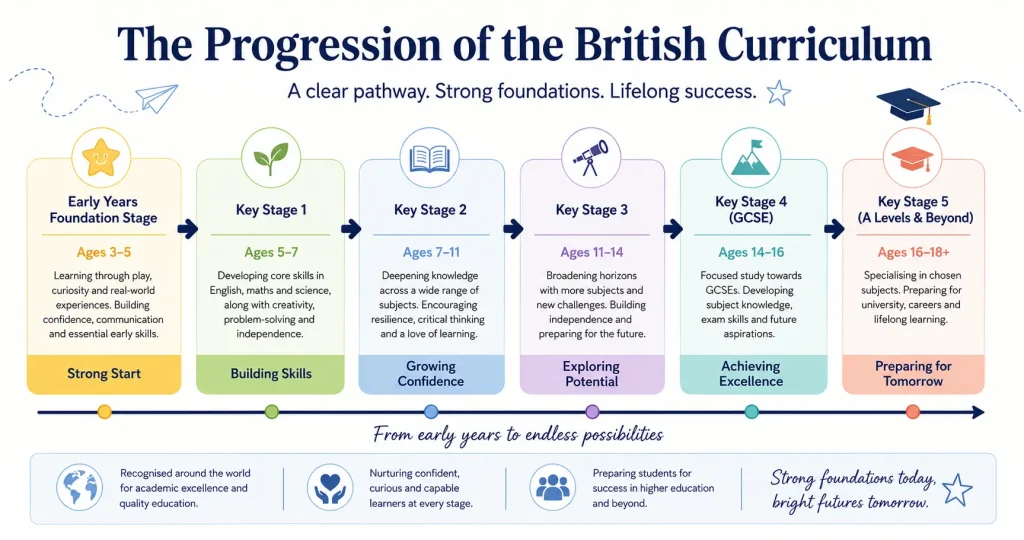
One of the strengths of the British Curriculum is its logical progression.
Each year builds upon the previous one, helping children gradually develop their understanding rather than rushing through concepts before they are fully secure.
This structured approach allows teachers to identify any gaps in learning early whilst giving students the confidence that each new topic builds naturally on what they already know.
As a tutor, I find this particularly helpful. Whether I am supporting a Year 4 pupil with reading comprehension or an older student preparing for iGCSE English Language, it is usually very clear where they are within the curriculum and which skills need further development.
Strong Foundations in English and Mathematics
The British Curriculum places considerable importance on literacy and numeracy.
Children are encouraged not only to read fluently and write accurately but also to think critically, explain their ideas and communicate with confidence.
Similarly, mathematics focuses on developing genuine understanding rather than simply memorising procedures. Children learn to solve problems, explain their reasoning and apply mathematical concepts in unfamiliar situations.
These skills form the foundation for success across every other subject and remain valuable long after children leave school.
Preparing Students for Recognised Qualifications
Another reason the British Curriculum remains so popular is its internationally recognised qualifications.
Many students progress towards GCSEs and iGCSEs before continuing to A Levels, qualifications that are respected by schools, colleges and universities across the world.
Several of my older students are currently preparing for Cambridge and Pearson Edexcel iGCSE English Language, whilst many younger learners are developing the reading, grammar, vocabulary and mathematical skills that will support them throughout their educational journey.
I also work with children preparing for GL Assessments, which are widely used by British international schools to monitor progress and, in some cases, support admissions. Helping students prepare for these assessments has given me a valuable insight into the expectations of many international schools.
Supporting Families Across Saudi Arabia, the UAE and Thailand
One of the aspects of my work that I enjoy most is supporting families living overseas.
I currently teach students attending British international schools in Riyadh and Jeddah (Saudi Arabia), Dubai (UAE) and Bangkok (Thailand). Although these children live in different countries, speak different first languages and experience different cultures, they are all following the same British Curriculum.
It is fascinating to see how the curriculum provides a common educational framework whilst allowing schools to embrace the culture of the country in which they are based.
One lesson might involve helping a student in Riyadh strengthen their grammar before a school assessment. Later that day I may be supporting a child in Dubai with reading comprehension or helping a learner in Bangkok build confidence with mathematics.
Despite the different time zones, the learning objectives are often remarkably similar.
This consistency is one of the reasons online tuition works so well for international families. Wherever a child happens to live, they can receive personalised support that complements what they are learning in school.
A Curriculum That Encourages Independent Thinking
One of my favourite aspects of the British Curriculum is its emphasis on developing independent learners.
Children are encouraged to ask questions, explain their thinking, evaluate evidence and solve problems for themselves rather than simply memorising information.
These habits help develop curiosity and resilience—qualities that become increasingly important as children move through secondary school and eventually into higher education.
Confidence grows when children realise that learning is about understanding, not simply remembering facts.
Supporting Every Learner
Although the British Curriculum provides an excellent educational framework, no two children learn in exactly the same way.
Over the years, I have supported many learners with ADHD, dyslexia, dyscalculia, autism and other additional learning needs. My experience has taught me that successful learning depends far more on adapting lessons to suit the individual child than following any curriculum rigidly.
Some children benefit from visual resources. Others learn best through discussion, games or practical activities. Some need additional time to process information, whilst others thrive when challenged with extension work.
The curriculum provides the destination, but every child deserves a learning journey that suits them.
Why Parents Continue to Choose the British Curriculum
There is no single reason why the British Curriculum has become one of the world’s most popular educational systems.
Its success comes from combining clear academic progression with internationally recognised qualifications, strong foundations in English and mathematics, and an approach that encourages children to become thoughtful, confident and independent learners.
Having supported students studying the British Curriculum in Saudi Arabia, the UAE and Thailand, I have seen how effectively it prepares children for future learning whilst providing consistency for families living internationally.
Wherever children are learning—whether in Riyadh, Jeddah, Dubai, Bangkok or here in the UK—the ultimate goal remains the same: helping them develop the confidence, knowledge and skills they need to succeed both inside and outside the classroom.
Here at Bedford Tutor, I have supported children following the British Curriculum across the UK and around the world for many years. I currently work with students attending international schools in Riyadh, Jeddah, Dubai and Bangkok, helping them build confidence in English and mathematics, prepare for GL Assessments and succeed in iGCSE English Language. Every lesson is tailored to the individual child, creating an engaging and supportive learning environment that helps students thrive wherever they are in the world.
To find out more, please click on the relevant link below:
Bel 😊