Bedford, UK



One of the things I love most about teaching English is discovering what is going on inside a child’s imagination.
Sometimes the ideas are enormous.
A child can tell you an incredibly detailed story about a dragon who lives underneath their school, explain exactly what happened to every character and describe the ending with complete confidence. Then you put a piece of paper in front of them and say, “Now write it down.”
Suddenly, the story seems to disappear.
For many children with ADHD, the difficulty isn’t necessarily coming up with ideas. In fact, some ADHD children have lots of ideas. The challenge can be organising those ideas, holding onto them in working memory and turning them into a structured piece of writing.
As someone with ADHD myself, this is something I understand very personally.
ADHD and English: When the ideas are bigger than the page
ADHD is often associated with difficulties around attention, organisation, working memory and executive functioning. However, ADHD looks different in every person. As I have written previously, my own ADHD has never fitted neatly into the stereotypical picture. I could be highly organised and successful academically whilst still experiencing very real difficulties with listening, distraction and managing certain tasks.
Writing at school was one of those areas where I could sometimes see the problem quite clearly.
I have always loved writing. I was naturally drawn towards words and stories, and I still write frequently today. I particularly love writing poems because poetry allows me to take an emotion and share it quickly through words.
Yet being naturally drawn to writing didn’t mean that I always found school writing easy.
I often didn’t follow plans or instructions effectively, and this could cost me marks. I might understand the subject, have plenty of ideas and genuinely enjoy the task, but somewhere between the instruction, the planning and the finished piece, something would go missing.
Looking back now, I can see how much easier some of those tasks might have been if I had been shown ways of getting my ideas out of my head before worrying about producing the “perfect” written answer.
Try telling the story before writing it
One of my favourite approaches with ADHD learners is wonderfully simple:
Let them talk.
Many ADHD children absolutely love verbalising their ideas. Talking can be a brilliant way of getting thoughts out of the brain and making them more concrete.
If a child is asked to write a story about a mysterious door, for example, I might start by asking:
“What is behind the door?”
They might tell me about a secret laboratory, a talking cat, a spaceship and a forgotten treasure map.
Excellent!
We have a story.
At this point, I don’t want to interrupt that flow by immediately asking them to write a paragraph.
Instead, we can talk through what happens first, next and finally.
That verbal rehearsal can help bring ideas into working memory before we try to capture them on paper. It also allows me to hear what the child actually understands. Sometimes the spoken story is considerably more sophisticated than the written one.
That tells me something important.
The child may not have a language problem at all. They may simply need help transferring their ideas into written form.
Drawing can unlock ideas too
Talking isn’t the only way to get ideas out.
Drawing can be incredibly powerful.
Some children find it much easier to draw what they are imagining before they attempt to describe it. This can be particularly useful for story writing.
A child might draw:
- the setting
- the main character
- the problem
- something important that happens
- the ending
We can then use the picture as a springboard for sentences.
I have seen children who initially say, “I don’t know what to write,” suddenly become incredibly animated once they are allowed to draw.
And that’s the important bit.
We aren’t avoiding writing.
We are finding a route into writing.
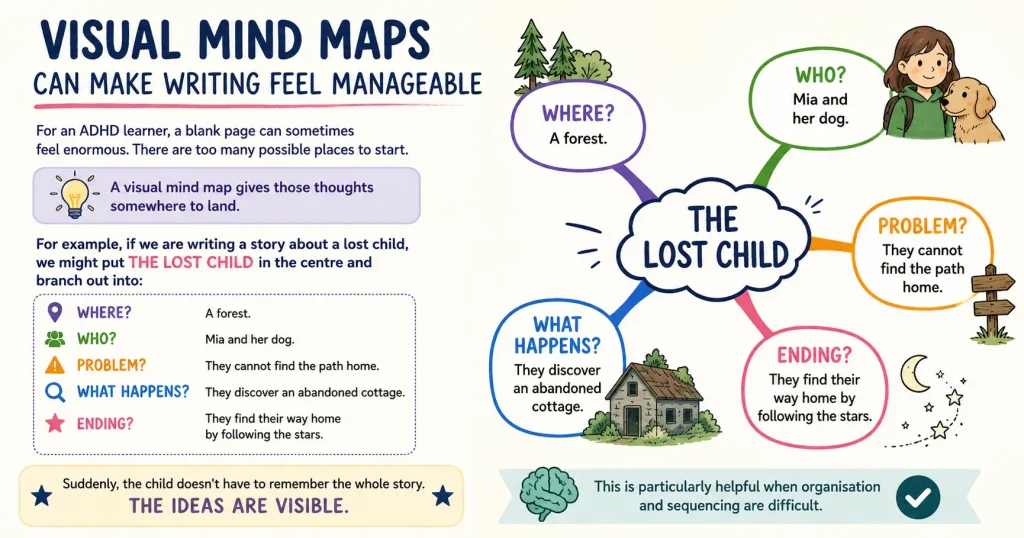
Visual mind maps can make writing feel manageable
Another strategy I regularly use is the humble mind map.
For an ADHD learner, a blank page can sometimes feel enormous. There are too many possible places to start.
A visual mind map gives those thoughts somewhere to land.
For example, if we are writing a story about a lost child, we might put THE LOST CHILD in the centre and branch out into:
Where?
A forest.
Who?
Mia and her dog.
Problem?
They cannot find the path home.
What happens?
They discover an abandoned cottage.
Ending?
They find their way home by following the stars.
Suddenly, the child doesn’t have to remember the whole story.
The ideas are visible.
This is particularly helpful when organisation and sequencing are difficult.
Story planning needs to be practical
I also love using structured story planning resources. We particularly enjoy the story planning documents available through Twinkl because they can make planning feel much more engaging and manageable.
One thing I frequently notice with ADHD learners is that planning and follow-through can be two very different things.
A child might enthusiastically plan an incredible story and then struggle to actually use the plan when writing it.
This is where smaller steps can help.
Instead of saying, “Now write your story,” we might work through:
- Write the opening.
- Introduce the character.
- Explain the problem.
- Add an interesting event.
- Bring the story towards an ending.
- Read it back and improve one section.
The aim isn’t to make writing rigid.
It is to give the child’s ideas a little scaffolding so they don’t disappear halfway through the task.
My own love of writing eventually became my career
Writing has always been part of my life.
In my twenties, I wrote two books (Storme and Spectrum Shift) which I self-published. That experience helped me realise just how much I loved creating stories and putting ideas into words, and it ultimately contributed to me discovering my passion for becoming an English tutor.
I still write poems regularly.
For me, poetry is a particularly lovely form of expression because sometimes an emotion is complicated, messy and difficult to explain. A few carefully chosen words can somehow capture it.
I think this is one of the reasons I enjoy teaching English to children with ADHD so much.
There is something wonderful about watching a child realise that their ideas matter.
ADHD, dyslexia and other forms of neurodivergence
ADHD also doesn’t always appear on its own.
Children with ADHD may also have dyslexia, dyscalculia, autism or other forms of neurodivergence. These differences can overlap, although having ADHD does not automatically mean a child will have another diagnosis.
This is important because difficulties with writing can have many different causes.
A child may struggle with organising ideas because of executive functioning difficulties. Another may find spelling and written language particularly challenging because of dyslexia. Another may have excellent ideas but become overwhelmed by the process of getting everything onto the page.
This is why I don’t believe in a single “ADHD writing strategy”.
The starting point should always be the child.
What happens when they talk?
What happens when they draw?
Can they explain the story verbally?
Do they need a visual plan?
Would a mind map help?
Could they dictate their first ideas before writing them?
Once we understand where the difficulty is happening, we can start finding strategies that genuinely help.
English should help children find their voice
Ultimately, primary English isn’t just about spelling tests, handwriting and writing stories that contain the correct number of paragraphs.
It is about communication.
It is about helping children take the fascinating thoughts inside their heads and share them with somebody else.
For an ADHD child, that process may need to look slightly different.
Perhaps the story starts with a conversation.
Perhaps it begins with a drawing.
Perhaps it grows through a colourful mind map before becoming a paragraph.
Perhaps the child tells the whole story aloud first and then writes it down.
None of these approaches mean that we are lowering expectations.
We are simply giving the child a bridge between having the idea and being able to express it.
And sometimes, that bridge is exactly what a child needs to discover that they really are a writer.
Helping ADHD children become confident writers
After years of working with children with ADHD, dyslexia and other learning differences, I have become increasingly convinced that confidence is one of the most important ingredients in successful learning.
When a child repeatedly experiences writing as something they cannot do, they can quickly begin to avoid it.
But when we show them that their ideas are valuable, give them practical ways to organise those ideas and celebrate the progress they make, their attitude can change.
The child who once said, “I don’t know what to write,” may suddenly have a story to tell.
And once they have a story to tell, we can help them find the words.
Here at Bedford Tutor and our online division, Kite Tutoring, we have supported children with ADHD, dyslexia, dyscalculia, autism and other learning differences for many years. My own experience of ADHD has helped me understand just how differently children can think, learn and express themselves, whilst my experience as an English tutor has shown me the value of finding creative routes into literacy.
Whether a child needs help organising their ideas, developing their writing, building confidence or simply discovering that English can actually be enjoyable, I believe the most important thing is to start with the child sitting in front of you.
Sometimes we just need to give their ideas a little more room to breathe.
To find out more, please see below:
Bel 😊