Bedford, UK



Relocating overseas is an exciting chapter for many families. Whether you’re moving to Dubai, Abu Dhabi, Riyadh, Jeddah, Singapore, Kuala Lumpur or Bangkok, the opportunity to experience different cultures and ways of life can be incredibly rewarding for children.
Alongside the excitement, however, comes a question that many parents ask:
“How can we make sure our child continues to succeed with the British Curriculum?”
It’s a question I hear regularly from families living around the world.
Having worked with British Curriculum learners for many years, both in the UK and internationally, I know that every child’s educational journey is unique. Some children settle into their new school almost immediately, whilst others need a little extra reassurance as they adjust to new teachers, classmates and routines. Some are preparing for GL Assessments, others are working towards iGCSE English Language, and many simply need someone who understands both the curriculum and the challenges of living overseas.
The encouraging news is that children are remarkably adaptable. With consistency, encouragement and the right support, they can flourish wherever they happen to be learning.
Why Families Continue with the British Curriculum Overseas
For many expatriate families, choosing a British international school provides valuable continuity during what can otherwise be a significant life change.
Moving country often means adjusting to a different climate, culture, language and way of life. Keeping a familiar curriculum helps reduce one major uncertainty and allows children to focus on settling into their new environment.
Many parents also appreciate that the British Curriculum provides a clear educational pathway from the primary years through to GCSEs, iGCSEs and A Levels. This continuity can be particularly important for families who relocate frequently or who may eventually return to the UK.
Over the years, I have supported learners attending British international schools across the UAE, Saudi Arabia and Thailand. Although each school has its own character and teaching style, they all share the same fundamental aim: helping children develop confident reading, writing, mathematical reasoning and independent thinking.
British International Schools Are Similar… But Never Identical
One of the biggest misconceptions is that every British international school teaches exactly the same content in exactly the same way.
In reality, schools have considerable flexibility.
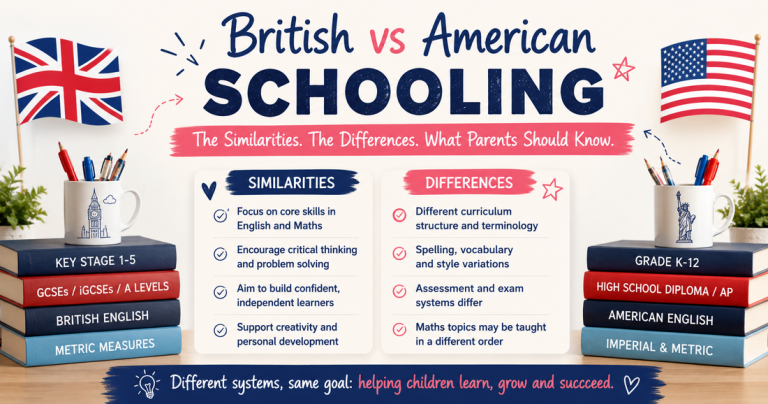
Whilst they broadly follow the National Curriculum for England, they often introduce topics in different sequences, use different textbooks and adopt different approaches to assessment. Some schools regularly use GL Assessments to monitor progress, whilst others place greater emphasis on continuous classroom assessment or prepare students for internationally recognised qualifications such as iGCSEs.
Parents sometimes worry that changing schools will leave gaps in their child’s learning.
In my experience, these gaps are usually much smaller than families imagine.
Good teaching focuses on developing secure underlying skills rather than simply covering pages in a textbook. A child with strong reading comprehension, confident writing skills and secure mathematical understanding can usually adapt quickly, even if the order in which topics are taught changes slightly.
Settling Into a New School Takes Time
Moving schools can feel overwhelming, even for confident children.
New classmates, unfamiliar routines and different expectations all require adjustment. Children who appeared settled in their previous school may suddenly become quieter or less confident whilst they find their feet.
Parents often assume this means their child is struggling academically.
More often than not, they are simply processing a great deal of change at once.
Whenever I begin working with a child who has recently relocated overseas, my first priority is not accelerating through curriculum content. Instead, I focus on helping them rebuild confidence.
Children learn best when they feel emotionally secure.
Once they begin to feel comfortable asking questions, making mistakes and sharing ideas, academic progress often follows naturally.
Learning Doesn’t Stop When the School Day Ends
One of the greatest advantages of living overseas is that learning extends far beyond the classroom.
Visiting historical landmarks, exploring museums, experiencing different cultures and hearing new languages all contribute to a child’s education in meaningful ways.
Parents sometimes underestimate how valuable these experiences can be.
Discussing local traditions, comparing different customs or simply reading information boards together during family outings all help develop vocabulary, comprehension and curiosity.
Reading together remains one of the most powerful ways to support British Curriculum learners.
For younger children, sharing stories develops vocabulary, comprehension and a lifelong love of books.
Older learners benefit from discussing novels, newspaper articles and current affairs.
Rather than asking, “Did you enjoy the book?”, try questions such as:
- Why do you think the character made that decision?
- What clues helped you work that out?
- Would you have handled the situation differently?
These conversations encourage the deeper thinking that sits at the heart of the British Curriculum.
Everyday Maths Is Everywhere
Parents often ask how they can support mathematics without sitting down with worksheets every evening.
Fortunately, maths appears naturally throughout daily life.
Cooking develops measurement skills.
Shopping encourages budgeting and percentages.
Travelling introduces time zones, timetables, distance and currency conversion.
Even planning family holidays creates opportunities to estimate costs, compare exchange rates and calculate journey times.
These practical experiences help children understand that mathematics is not simply something found inside textbooks.
It is part of everyday life.

Different School Calendars Can Be an Advantage
One unexpected aspect of teaching internationally is discovering how varied school calendars can be.
Whilst children in the UK may be enjoying their long summer holiday, some international schools are already preparing for a new academic year.
Likewise, there are times when UK schools are in full swing whilst many overseas students are enjoying extended holidays.
Rather than seeing these differences as a challenge, many families use quieter periods to consolidate learning.
Without the pressure of homework and busy school evenings, children often have more mental space to revisit topics they have found difficult or develop greater confidence before returning to school.
Even one lesson a week during the holidays can help maintain momentum and reduce the anxiety some children experience before a new term begins.
Preparing for GL Assessments and iGCSE English
Many British international schools use GL Assessments to monitor progress in English, mathematics and reasoning.
Parents sometimes become understandably anxious when they hear the word “assessment”.
In reality, these tests are designed to measure a child’s current attainment rather than catch them out.
The most successful preparation rarely involves endless practice papers.
Instead, children benefit from regularly reading, expanding their vocabulary, strengthening grammar and punctuation, developing mathematical reasoning and becoming familiar with the style of questions they may encounter.
Similarly, students preparing for iGCSE English Language develop confidence over time through consistent reading, thoughtful discussion and regular writing practice rather than last-minute revision.
Strong literacy skills are built gradually.
There are no shortcuts.
Supporting Neurodivergent Learners Overseas
Many international schools provide excellent SEND provision, but the level of support available can vary considerably between countries and individual schools.
Over the years, I have worked with many overseas learners with ADHD, dyslexia, dyscalculia and autism.
One thing has become increasingly clear.
There is no single approach that works for every child.
As someone diagnosed with ADHD as an adult, I know first-hand that neurodivergence looks different in everyone. Two children with the same diagnosis may learn in completely different ways, requiring entirely different strategies and levels of support.
Some learners benefit from movement breaks.
Others need visual prompts, colour coding or carefully structured routines.
Many simply need lessons delivered at a pace that allows them to process information without feeling overwhelmed.
When teaching neurodivergent learners, flexibility is often far more valuable than rigidly following a lesson plan.
Understanding the child always comes before covering the curriculum.
Why Confidence Matters More Than Perfection
One lesson I have learnt over many years of tutoring is that confidence influences academic progress far more than many people realise.
Children who believe they can succeed are willing to attempt difficult questions.
They ask for help when they need it.
They persevere when something feels challenging.
Conversely, children who begin to doubt themselves often avoid taking risks, even when they already possess the knowledge needed to solve a problem.
This is why I spend so much time celebrating progress.
Sometimes success is mastering a difficult spelling pattern.
Sometimes it’s remembering a mathematical method independently.
Sometimes it’s simply finding the confidence to say, “I don’t understand.”
These small moments often become the foundations upon which much greater achievements are built.
The Value of Consistent Online Tuition
One of the greatest advantages of online tuition is continuity.
Families relocating internationally no longer need to find a new tutor every time they move country.
Children can continue learning with someone who already understands their personality, learning style and educational history.
During the pandemic, I worked with many children who initially joined online lessons because they had little choice.
What surprised many families was how successful one-to-one online learning became.
Without the distractions of a busy classroom, many children became more engaged, asked more questions and developed greater confidence in their abilities. That experience transformed much of my own teaching and reinforced how effective personalised online tuition can be for learners around the world.
Frequently Asked Questions
Can my child return to a UK school later?
Yes. One of the strengths of following the British Curriculum overseas is that transitions back into UK schools are often much smoother than moving between entirely different educational systems.
Should we continue learning during school holidays?
Children absolutely deserve time to rest and enjoy their holidays.
However, maintaining some light reading, writing and mathematical practice can prevent skills from fading and help children feel more confident when school resumes.
Is online tuition worthwhile?
For many internationally mobile families, online tuition provides valuable consistency. Lessons can continue wherever a family moves, helping children maintain confidence and build long-term relationships with a tutor who understands both their educational journey and their individual learning needs.
Final Thoughts
Living overseas offers children extraordinary opportunities.
They develop resilience, adaptability, cultural awareness and independence alongside their academic studies.
The British Curriculum provides a familiar framework, but successful learning is about much more than following a programme of study.
It is about nurturing curiosity, encouraging confidence and helping every child discover that they are capable of achieving great things.
Whether a learner is attending a British international school in Dubai, preparing for GL Assessments in Singapore, studying iGCSE English in Malaysia or strengthening mathematics from home in Saudi Arabia, the principles remain exactly the same.
When children feel understood, supported and encouraged, they are free to thrive.
Here at Kite Tutoring, the online division of Bedford Tutor, we have supported British Curriculum learners across the UK and around the world for many years. Whether your child attends an international school in the UAE, Saudi Arabia, Singapore, Malaysia or Thailand, is preparing for GL Assessments or iGCSE English Language, or simply needs extra confidence in English or maths, we provide personalised online tuition that adapts to the individual child and helps them develop the skills they need to succeed wherever they are in the world.
To find out more, please click on the relevant link below:
Bel 😊