Why Children With ADHD Know the Answer but Can’t Start the Work
One of the most misunderstood aspects of ADHD is task initiation.
Parents often tell me:
“My child knows how to do it.”
“They answered all the questions verbally.”
“They understood the lesson perfectly.”
“So why are they just sitting there staring at the page?”
The answer is that ADHD is not simply a difficulty with knowledge or intelligence. Very often, it is a difficulty with getting started.
As someone with ADHD myself, this is something I understand deeply. In fact, I often explain it using an analogy from my own experience.
The Bouncy Ball Brain
When people talk about ADHD, they often describe brain fog or daydreaming. For me, that has never quite fitted. My brain rarely feels empty. If anything, it feels too full.
The best way I can describe it is this:
Imagine your head is full of hundreds of brightly coloured bouncy balls.
Ideas.
Thoughts.
Memories.
Questions.
Things you need to do later.
Random observations.
Interesting facts.
Potential solutions.
Every one of those bouncy balls is flying around at high speed.
Now imagine someone places a worksheet in front of you and says, “Right, grab the ball you need and get started.”
The problem isn’t that the ball isn’t there.
The problem is that there are so many balls bouncing around that you can’t catch the right one.
Sometimes I know exactly what I want to write.
I know the answer.
I understand the task.
But my brain feels so busy that I can’t quite grab hold of the thought I need at the exact moment I need it.
It creates a strange feeling of mental traffic. A constant sense of activity. My mind is working incredibly hard, but from the outside it can sometimes look as though I am doing nothing at all.
“I Know It, But I Can’t Do It”
Over the years, I have discussed this feeling with many students who have ADHD and I am always fascinated by how similar their descriptions are.
One student told me:
“It’s like all the tabs are open at once.”
Another said:
“My brain is shouting lots of things at me and I can’t hear the one I need.”
A third explained:
“I know the answer in my head but I can’t get it onto the page.”
Although every child experiences ADHD differently, there is often a common theme. They are not lacking knowledge. They are struggling to organise and direct their attention towards the first step.
This links closely to executive functioning, the collection of mental skills that help us plan, organise, prioritise and initiate tasks.
Many ADHD learners understand perfectly well what needs to happen. The difficulty lies in activating the process.
Why It Can Look Like Laziness
This is why ADHD can be so frustrating for both children and parents.
A child may be able to explain a maths method verbally.
They may answer every question correctly when talking.
Then they pick up a pencil and freeze.
To someone who doesn’t understand ADHD, this can look like avoidance, laziness or a lack of effort.
In reality, the child may be battling a huge amount of internal noise.
Their brain is busy.
Their thoughts are active.
Their knowledge is present.
They simply cannot find the mental “gear change” needed to begin.
As someone diagnosed with ADHD as an adult, I spent many years wondering why there seemed to be a gap between what I knew I could do and what I actually managed to produce. Receiving a diagnosis helped me understand that this wasn’t a lack of intelligence or motivation; it was a difference in how my brain managed attention and executive functioning.
What Helps?
When I work with ADHD learners, I rarely focus on motivation first.
Instead, I focus on reducing the number of bouncy balls.
Breaking tasks into tiny steps.
Writing down the first sentence together.
Using visual prompts.
Turning a large task into a series of small, achievable actions.
Often, once the first step is completed, momentum begins to build. The challenge was never understanding the work.
The challenge was finding a way into it.
This is something I remind parents of regularly: many ADHD children are not struggling because they don’t know the answer. They are struggling because their brains are trying to manage an extraordinary amount of information all at once.
Sometimes the most powerful support we can offer is helping them catch the right bouncy ball. That is often all they need to get started.
Here at Bedford Tutor, I have supported many children with ADHD who understand concepts well but struggle with task initiation, organisation and executive functioning. Through personalised tuition, confidence-building strategies and ADHD-friendly learning approaches, I help learners bridge the gap between knowing and doing whilst developing the skills they need to succeed both in school and beyond.
To find out more, please click on the relevant link below:
Many parents contact me because their child is struggling with maths, but one of the first questions I often find myself asking is this:
“Is this dyscalculia, maths anxiety, or perhaps a combination of both?”
Whilst the two can sometimes look very similar on the surface, they are not the same thing. Understanding the difference can be incredibly important when it comes to providing the right support.
When Maths Feels Frightening
Over the years, I have worked with many children who experience significant maths anxiety.
In some cases, the anxiety is so strong that it creates an immediate physical response. I have seen children freeze completely when presented with a mathematical problem. Some stare silently at the page. Others become visibly distressed. A few will immediately tell me they “can’t do maths” before they have even attempted the question.
What’s particularly striking is that many of these children are perfectly capable mathematicians.
The difficulty is not always the maths itself. Often, it is the fear associated with it.
After experiencing repeated struggles, misunderstandings or feelings of failure, some children begin to view every maths question as a threat. Their brain switches into panic mode and accessing the skills they already possess becomes incredibly difficult.
It is a little like asking somebody to perform a speech whilst standing in front of hundreds of people when they are terrified of public speaking. The knowledge may still be there, but anxiety makes it much harder to access.
What Is Dyscalculia?
Dyscalculia is a specific learning difficulty that affects a person’s ability to understand and work with numbers.
Whilst every learner is different, children with dyscalculia may experience difficulties with:
Understanding number relationships
Remembering basic number facts
Estimating quantities
Learning times tables
Understanding place value
Sequencing mathematical processes
Telling the time
Understanding money
Unlike maths anxiety, these difficulties are not simply caused by nervousness or low confidence.
Even when a child feels calm and supported, the underlying challenges with numerical understanding may still be present.
As someone who specialises in supporting learners with dyscalculia, I know that traditional teaching approaches are not always effective. Many children need concepts to be presented in very different ways before they truly begin to make sense.
Why The Two Are Often Confused
One of the reasons dyscalculia and maths anxiety are so frequently confused is because they often exist together.
Imagine spending years finding maths harder than your peers.
Perhaps you struggle to remember number facts. Maybe concepts seem to disappear as quickly as they are learnt. Over time, it is entirely understandable that confidence begins to suffer.
Eventually, maths anxiety can develop alongside dyscalculia.
Similarly, a child without dyscalculia may develop severe maths anxiety after negative educational experiences.
This is why careful observation and personalised support are so important.
Every child has their own unique learning profile. Just as no two children experience ADHD in exactly the same way, no two learners experience maths difficulties in exactly the same way either.
The Importance of Visual and Tactile Learning
One thing that has become very clear throughout my years of teaching is that abstract explanations rarely help struggling mathematicians.
Whether I am supporting a child with diagnosed dyscalculia, maths anxiety, ADHD, autism or simply low confidence, I almost always begin with strong visual examples.
Children need to see mathematics.
They need opportunities to explore concepts using diagrams, visual models, number lines, counters, cubes, clocks, money, measuring equipment and other practical resources whenever available.
When learning becomes visible and tangible, abstract ideas often become much easier to understand.
A fraction suddenly makes sense when a child can physically divide something into equal parts.
Place value becomes clearer when numbers can be built and manipulated.
Time becomes less mysterious when learners can physically move the hands on a clock.
At Bedford Tutor, many of the multi-sensory techniques we use with dyscalculic learners are beneficial for all maths students. In fact, some of the most significant breakthroughs I see occur when children move away from simply looking at numbers on a page and start interacting with mathematical concepts in a hands-on way. This personalised, engaging approach is central to how we support learners.
Never Underestimate the Power of Fun
If there is one thing I have learnt from teaching hundreds of children, it is that learning and enjoyment should never be viewed as opposites.
In fact, they often work best together.
Humour can completely transform a lesson.
A child who arrives feeling anxious can often relax after a shared laugh. A game can make repetitive practice feel far less intimidating. A silly story can help a difficult concept stick in the memory far more effectively than a worksheet.
Many children are genuinely surprised when they discover that maths lessons can be enjoyable.
When confidence begins to grow, something remarkable often happens. Children stop focusing on what they might get wrong and start becoming curious about what they might learn.
That shift in mindset can be incredibly powerful.
Final Thoughts
Whether a child has dyscalculia, maths anxiety or a combination of both, the most important thing is that they feel understood.
Labels can be useful because they help us understand a learner’s needs, but effective support always begins with the individual child sitting in front of us.
When we combine patience, visual learning, practical resources, humour and encouragement, mathematics often becomes far less frightening and far more accessible.
Sometimes the biggest breakthrough isn’t learning a new mathematical concept.
Sometimes it’s hearing a child say, for the very first time:
“Actually… I think I can do this.”
Here at Bedford Tutor, I have supported many children with dyscalculia, maths anxiety and confidence difficulties both in the UK and internationally. Through using visual teaching methods, multi-sensory resources and plenty of humour, I help learners develop a more positive relationship with mathematics whilst building the skills and confidence they need to succeed. Whether a child is home educated, attending school in Bedfordshire, or studying overseas in the UAE, Singapore, Malaysia or Thailand, my goal is always the same: helping them discover that maths can be accessible, enjoyable and achievable.
To find out more, please click on the relevant link below:
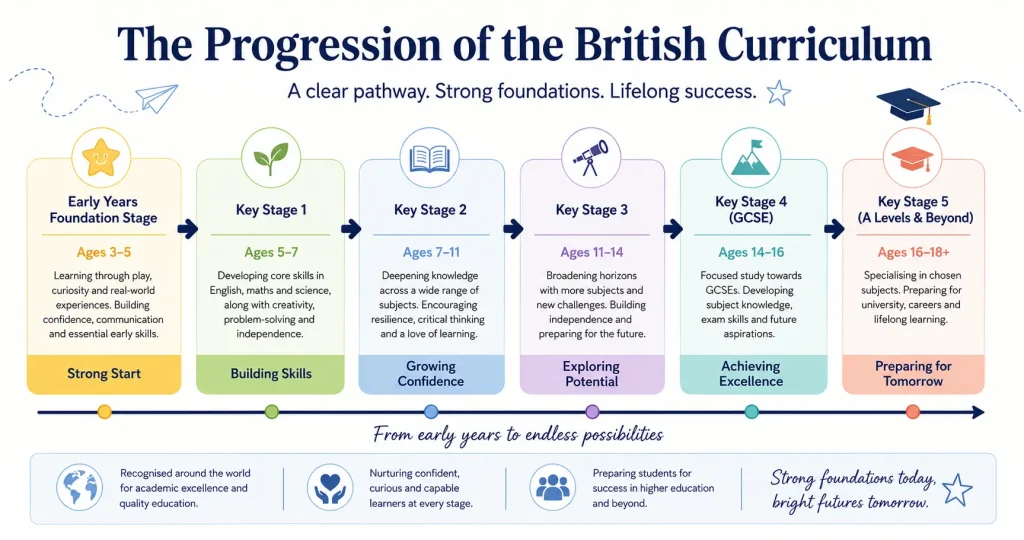
For families living overseas, choosing the right school is one of the biggest educational decisions they will make. Whether relocating for work, joining an international community or planning for university, many parents spend time exploring the different international curricula available, with the British Curriculum often being one of the most widely recognised.
So, what makes the British Curriculum such a popular choice for families across the globe?
An Internationally Respected Education
One of the biggest reasons families choose the British Curriculum is its outstanding international reputation.
British international schools can now be found throughout the world, particularly in countries such as Saudi Arabia, the UAE, Thailand, Singapore and Malaysia. For expatriate families, this offers something incredibly valuable: continuity.
When parents relocate between countries, children often experience enough change already. Moving home, making new friends and adapting to a different culture can all feel overwhelming. Remaining within the same educational framework helps make that transition much smoother.
Many students can move from one British international school to another with relatively little disruption, allowing them to continue developing their knowledge and skills without having to adapt to an entirely different curriculum.
A Clear Structure That Builds Confidence
One of the strengths of the British Curriculum is its logical progression.
Each year builds upon the previous one, helping children gradually develop their understanding rather than rushing through concepts before they are fully secure.
This structured approach allows teachers to identify any gaps in learning early whilst giving students the confidence that each new topic builds naturally on what they already know.
As a tutor, I find this particularly helpful. Whether I am supporting a Year 4 pupil with reading comprehension or an older student preparing for iGCSE English Language, it is usually very clear where they are within the curriculum and which skills need further development.
Strong Foundations in English and Mathematics
The British Curriculum places considerable importance on literacy and numeracy.
Children are encouraged not only to read fluently and write accurately but also to think critically, explain their ideas and communicate with confidence.
Similarly, mathematics focuses on developing genuine understanding rather than simply memorising procedures. Children learn to solve problems, explain their reasoning and apply mathematical concepts in unfamiliar situations.
These skills form the foundation for success across every other subject and remain valuable long after children leave school.
Preparing Students for Recognised Qualifications
Another reason the British Curriculum remains so popular is its internationally recognised qualifications.
Many students progress towards GCSEs and iGCSEs before continuing to A Levels, qualifications that are respected by schools, colleges and universities across the world.
Several of my older students are currently preparing for Cambridge and Pearson Edexcel iGCSE English Language, whilst many younger learners are developing the reading, grammar, vocabulary and mathematical skills that will support them throughout their educational journey.
I also work with children preparing for GL Assessments, which are widely used by British international schools to monitor progress and, in some cases, support admissions. Helping students prepare for these assessments has given me a valuable insight into the expectations of many international schools.
Supporting Families Across Saudi Arabia, the UAE and Thailand
I currently teach students attending British international schools in Riyadh and Jeddah (Saudi Arabia), Dubai (UAE) and Bangkok (Thailand). Although these children live in different countries, speak different first languages and experience different cultures, they are all following the same British Curriculum.
It is fascinating to see how the curriculum provides a common educational framework whilst allowing schools to embrace the culture of the country in which they are based.
One lesson might involve helping a student in Riyadh strengthen their grammar before a school assessment. Later that day I may be supporting a child in Dubai with reading comprehension or helping a learner in Bangkok build confidence with mathematics.
Despite the different time zones, the learning objectives are often remarkably similar.
This consistency is one of the reasons online tuition works so well for international families. Wherever a child happens to live, they can receive personalised support that complements what they are learning in school.
A Curriculum That Encourages Independent Thinking
One of my favourite aspects of the British Curriculum is its emphasis on developing independent learners.
Children are encouraged to ask questions, explain their thinking, evaluate evidence and solve problems for themselves rather than simply memorising information.
These habits help develop curiosity and resilience—qualities that become increasingly important as children move through secondary school and eventually into higher education.
Confidence grows when children realise that learning is about understanding, not simply remembering facts.
Supporting Every Learner
Although the British Curriculum provides an excellent educational framework, no two children learn in exactly the same way.
Some children benefit from visual resources. Others learn best through discussion, games or practical activities. Some need additional time to process information, whilst others thrive when challenged with extension work.
The curriculum provides the destination, but every child deserves a learning journey that suits them.
Why Parents Continue to Choose the British Curriculum
There is no single reason why the British Curriculum has become one of the world’s most popular educational systems.
Its success comes from combining clear academic progression with internationally recognised qualifications, strong foundations in English and mathematics, and an approach that encourages children to become thoughtful, confident and independent learners.
Having supported students studying the British Curriculum in Saudi Arabia, the UAE and Thailand, I have seen how effectively it prepares children for future learning whilst providing consistency for families living internationally.
Wherever children are learning—whether in Riyadh, Jeddah, Dubai, Bangkok or here in the UK—the ultimate goal remains the same: helping them develop the confidence, knowledge and skills they need to succeed both inside and outside the classroom.
Here at Bedford Tutor, I have supported children following the British Curriculumacross the UK and around the world for many years. I currently work with students attending international schools in Riyadh, Jeddah, Dubai and Bangkok, helping them build confidence in English and mathematics, prepare for GL Assessments and succeed in iGCSE English Language. Every lesson is tailored to the individual child, creating an engaging and supportive learning environment that helps students thrive wherever they are in the world.
To find out more, please click on the relevant link below:
One of the things I love most about teaching English is discovering what is going on inside a child’s imagination.
Sometimes the ideas are enormous.
A child can tell you an incredibly detailed story about a dragon who lives underneath their school, explain exactly what happened to every character and describe the ending with complete confidence. Then you put a piece of paper in front of them and say, “Now write it down.”
Suddenly, the story seems to disappear.
For many children with ADHD, the difficulty isn’t necessarily coming up with ideas. In fact, some ADHD children have lots of ideas. The challenge can be organising those ideas, holding onto them in working memory and turning them into a structured piece of writing.
ADHD and English: When the ideas are bigger than the page
ADHD is often associated with difficulties around attention, organisation, working memory and executive functioning. However, ADHD looks different in every person. As I have written previously, my own ADHD has never fitted neatly into the stereotypical picture. I could be highly organised and successful academically whilst still experiencing very real difficulties with listening, distraction and managing certain tasks.
Writing at school was one of those areas where I could sometimes see the problem quite clearly.
I have always loved writing. I was naturally drawn towards words and stories, and I still write frequently today. I particularly love writing poems because poetry allows me to take an emotion and share it quickly through words.
Yet being naturally drawn to writing didn’t mean that I always found school writing easy.
I often didn’t follow plans or instructions effectively, and this could cost me marks. I might understand the subject, have plenty of ideas and genuinely enjoy the task, but somewhere between the instruction, the planning and the finished piece, something would go missing.
Looking back now, I can see how much easier some of those tasks might have been if I had been shown ways of getting my ideas out of my head before worrying about producing the “perfect” written answer.
Try telling the story before writing it
One of my favourite approaches with ADHD learners is wonderfully simple:
Let them talk.
Many ADHD children absolutely love verbalising their ideas. Talking can be a brilliant way of getting thoughts out of the brain and making them more concrete.
If a child is asked to write a story about a mysterious door, for example, I might start by asking:
“What is behind the door?”
They might tell me about a secret laboratory, a talking cat, a spaceship and a forgotten treasure map.
Excellent!
We have a story.
At this point, I don’t want to interrupt that flow by immediately asking them to write a paragraph.
Instead, we can talk through what happens first, next and finally.
That verbal rehearsal can help bring ideas into working memory before we try to capture them on paper. It also allows me to hear what the child actually understands. Sometimes the spoken story is considerably more sophisticated than the written one.
That tells me something important.
The child may not have a language problem at all. They may simply need help transferring their ideas into written form.
Drawing can unlock ideas too
Talking isn’t the only way to get ideas out.
Drawing can be incredibly powerful.
Some children find it much easier to draw what they are imagining before they attempt to describe it. This can be particularly useful for story writing.
A child might draw:
the setting
the main character
the problem
something important that happens
the ending
We can then use the picture as a springboard for sentences.
I have seen children who initially say, “I don’t know what to write,” suddenly become incredibly animated once they are allowed to draw.
And that’s the important bit.
We aren’t avoiding writing.
We are finding a route into writing.
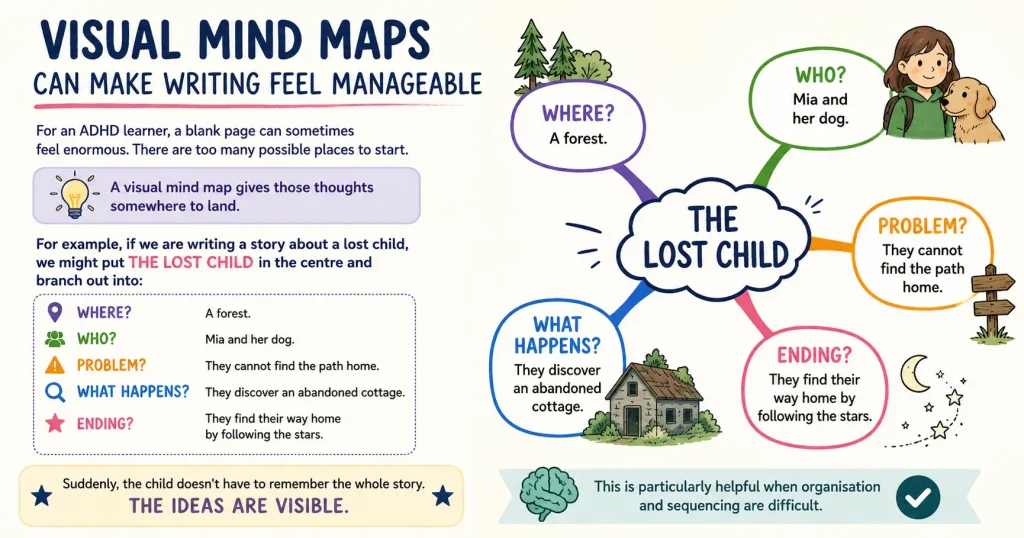
Visual mind maps can make writing feel manageable
Another strategy I regularly use is the humble mind map.
For an ADHD learner, a blank page can sometimes feel enormous. There are too many possible places to start.
A visual mind map gives those thoughts somewhere to land.
For example, if we are writing a story about a lost child, we might put THE LOST CHILD in the centre and branch out into:
Where? A forest.
Who? Mia and her dog.
Problem? They cannot find the path home.
What happens? They discover an abandoned cottage.
Ending? They find their way home by following the stars.
Suddenly, the child doesn’t have to remember the whole story.
The ideas are visible.
This is particularly helpful when organisation and sequencing are difficult.
Story planning needs to be practical
I also love using structured story planning resources. We particularly enjoy the story planning documents available through Twinkl because they can make planning feel much more engaging and manageable.
One thing I frequently notice with ADHD learners is that planning and follow-through can be two very different things.
A child might enthusiastically plan an incredible story and then struggle to actually use the plan when writing it.
This is where smaller steps can help.
Instead of saying, “Now write your story,” we might work through:
Write the opening.
Introduce the character.
Explain the problem.
Add an interesting event.
Bring the story towards an ending.
Read it back and improve one section.
The aim isn’t to make writing rigid.
It is to give the child’s ideas a little scaffolding so they don’t disappear halfway through the task.
My own love of writing eventually became my career
Writing has always been part of my life.
In my twenties, I wrote two books (Storme and Spectrum Shift) which I self-published. That experience helped me realise just how much I loved creating stories and putting ideas into words, and it ultimately contributed to me discovering my passion for becoming an English tutor.
I still write poems regularly.
For me, poetry is a particularly lovely form of expression because sometimes an emotion is complicated, messy and difficult to explain. A few carefully chosen words can somehow capture it.
I think this is one of the reasons I enjoy teaching English to children with ADHD so much.
There is something wonderful about watching a child realise that their ideas matter.
This is important because difficulties with writing can have many different causes.
A child may struggle with organising ideas because of executive functioning difficulties. Another may find spelling and written language particularly challenging because of dyslexia. Another may have excellent ideas but become overwhelmed by the process of getting everything onto the page.
This is why I don’t believe in a single “ADHD writing strategy”.
The starting point should always be the child.
What happens when they talk?
What happens when they draw?
Can they explain the story verbally?
Do they need a visual plan?
Would a mind map help?
Could they dictate their first ideas before writing them?
Once we understand where the difficulty is happening, we can start finding strategies that genuinely help.
English should help children find their voice
Ultimately, primary English isn’t just about spelling tests, handwriting and writing stories that contain the correct number of paragraphs.
It is about communication.
It is about helping children take the fascinating thoughts inside their heads and share them with somebody else.
For an ADHD child, that process may need to look slightly different.
Perhaps the story starts with a conversation.
Perhaps it begins with a drawing.
Perhaps it grows through a colourful mind map before becoming a paragraph.
Perhaps the child tells the whole story aloud first and then writes it down.
None of these approaches mean that we are lowering expectations.
We are simply giving the child a bridge between having the idea and being able to express it.
And sometimes, that bridge is exactly what a child needs to discover that they really are a writer.
Helping ADHD children become confident writers
After years of working with children with ADHD, dyslexia and other learning differences, I have become increasingly convinced that confidence is one of the most important ingredients in successful learning.
When a child repeatedly experiences writing as something they cannot do, they can quickly begin to avoid it.
But when we show them that their ideas are valuable, give them practical ways to organise those ideas and celebrate the progress they make, their attitude can change.
The child who once said, “I don’t know what to write,” may suddenly have a story to tell.
And once they have a story to tell, we can help them find the words.
Whether a child needs help organising their ideas, developing their writing, building confidence or simply discovering that English can actually be enjoyable, I believe the most important thing is to start with the child sitting in front of you.
Sometimes we just need to give their ideas a little more room to breathe.
Home education offers something that traditional schooling cannot always provide: freedom.
Freedom to slow down when something is difficult. Freedom to explore an unexpected interest. Freedom to spend a morning outside, learn through conversation or return to a subject when a child is ready.
But there can also be a funny little trap.
Once you have made the decision to home educate, it is very easy to feel that you now have to recreate school at home.
There are timetables. Worksheets. Workbooks. Spelling lists. Tests. Perhaps even a small desk in the corner which slowly begins to resemble a miniature classroom.
And whilst structure can be incredibly helpful, particularly for some children, home education does not have to feel like school.
In fact, for many children, particularly those with ADHD, dyslexia, dyscalculia, autism or low confidence, one of the greatest advantages of home education is being able to find a way of learning which feels natural to them.
Home education does not need to look like school
One of the things I love most about supporting home-educated children is the freedom to adapt learning.
Over the years, I have worked with home-educated learners across the UK and internationally, and I have seen just how different their educational journeys can be. Some children love routine and feel reassured by knowing exactly what will happen next. Others become much more engaged when learning is flexible, creative and connected to their interests.
Neither approach is wrong.
The important thing is finding what works for the child.
A child who loves dinosaurs might practise reading by exploring dinosaur facts. A child fascinated by baking can develop mathematical skills through weighing ingredients and working with fractions. Another child might discover that writing becomes much easier when they are allowed to create a story about their favourite game or animal.
The learning is still happening.
It simply does not always look like a traditional lesson.
Follow the interest
One of the simplest ways to make learning feel less like school is to pay attention to what your child is already interested in.
This does not mean abandoning the curriculum.
It means using curiosity as the doorway into it.
If your child is fascinated by space, for example, you might explore non-fiction reading, new vocabulary, descriptive writing, research skills and even mathematical problems involving planets.
If they love animals, you could read animal stories, compare sizes and measurements, write descriptions, create charts or investigate habitats.
Children are often far more willing to practise a skill when they can see a reason for using it.
This is particularly valuable for children who have previously struggled with motivation or confidence. In Kite Tutoring sessions, I regularly use games, challenges, creative activities and discussion because engagement is often the key to successful learning.
Learning through play is still learning
Sometimes parents worry that if learning is fun, it cannot possibly be rigorous.
I understand why.
We are used to thinking about education as something which happens at a desk, with a pencil in one hand and a worksheet in the other.
But children can learn an enormous amount through play, conversation and practical experiences.
A game involving money can develop mathematical reasoning. Building something can involve measurement, planning and problem-solving. Playing a word game can strengthen vocabulary and spelling. Cooking can involve fractions, sequencing and reading instructions.
For some dyslexic learners, making words physically using magnetic letters, wooden blocks or other hands-on resources can make learning much more meaningful than simply copying words from a page. Creative associations and visual approaches can also help ideas stick.
The activity may look like play.
Underneath it, there may be a great deal of learning taking place.
Do not be afraid of flexibility
One of the greatest advantages of home education is being able to learn at the child’s pace.
Perhaps your child understands fractions immediately but needs several weeks to become comfortable with spelling.
Perhaps they are full of energy in the morning but concentrate beautifully after lunch.
Perhaps they need movement between activities rather than sitting still for an hour.
Home education gives families the opportunity to respond to those differences rather than constantly asking the child to fit a predetermined timetable.
This can be especially helpful for neurodivergent learners.
Children with ADHD, for example, may benefit from movement, visual resources, interactive activities and smaller chunks of learning. Others may need additional processing time, practical examples or opportunities to revisit a concept without feeling that they have fallen behind.
The aim is not to remove structure completely.
It is to create the right structure.
Keep some routine, but leave room to breathe
Interestingly, making learning feel less like school does not necessarily mean having no routine.
Some children thrive on predictability.
A simple rhythm to the day can provide reassurance: breakfast, reading, outdoor time, maths, lunch, creative activity, perhaps some independent work.
The key is allowing the routine to breathe.
If an interesting conversation develops over breakfast, perhaps that becomes part of the day’s learning.
If your child is deeply absorbed in a project, perhaps you do not need to stop simply because the timetable says it is time to move on.
And if everyone is exhausted, sometimes the most sensible educational decision is to step away from the books.
Learning does not stop because the timetable does.
Protect confidence as carefully as you protect progress
This is something I feel particularly strongly about.
Academic progress matters, but so does the child’s relationship with learning.
Many children arrive at home education after difficult experiences in traditional educational environments. Some have begun to believe that they are “bad” at reading, maths or school generally.
That can take time to undo.
For these children, success might initially look very small.
Reading a paragraph without giving up.
Attempting a difficult maths problem.
Writing three sentences independently.
Asking for help instead of saying, “I can’t do it.”
These moments matter.
When children feel understood and supported, they are more willing to make mistakes, ask questions and take risks with their learning. Our approach at Kite Tutoring is deliberately strengths-based, with the aim of helping learners feel capable as well as developing their academic skills.
Confidence is not an optional extra.
It is part of learning.
What if my child still needs academic support?
Home education does not mean parents have to do everything alone.
Sometimes a child simply needs another person who understands their learning profile and can provide additional structure without recreating the school environment.
One-to-one tuition can be particularly useful when lessons are personalised around the child’s pace, interests and strengths. Online learning can also provide flexibility for home-educated families, including those living overseas or following British, American or international programmes.
The important thing is that additional tuition should complement home education rather than turning it into another version of school.
A good lesson might involve discussion, games, visual explanations, practical activities and plenty of encouragement alongside the academic content.
There is room for both learning and enjoyment.
Home education is allowed to be different
Perhaps the most important thing I would say to any parent beginning or continuing a home education journey is this:
You do not have to prove that your child is learning by making home look like school.
Education can happen around the kitchen table, on a walk, through a conversation, during a game, while cooking or through a subject that your child suddenly becomes completely fascinated by.
Of course, there will be times when structured learning is important. There may be qualifications to work towards, specific English or maths skills to develop, or Functional Skills assessments to prepare for.
But even then, learning does not have to become joyless.
After all, the whole point of home education is often to create an educational experience which genuinely meets the needs of the individual child.
Sometimes the most successful learning happens when we stop asking, “How can I make this look like school?” and start asking, “How can I help my child learn in a way that works for them?”
For many families, the aim is not simply to cover the curriculum. It is to help a child rediscover confidence, curiosity and enjoyment in learning.
If you are looking for additional support as part of your home education journey, we would be very happy to have a conversation about what might work for your child.
Relocating overseas is an exciting chapter for many families. Whether you’re moving to Dubai, Abu Dhabi, Riyadh, Jeddah, Singapore, Kuala Lumpur or Bangkok, the opportunity to experience different cultures and ways of life can be incredibly rewarding for children.
Alongside the excitement, however, comes a question that many parents ask:
“How can we make sure our child continues to succeed with the British Curriculum?”
It’s a question I hear regularly from families living around the world.
Having worked with British Curriculum learners for many years, both in the UK and internationally, I know that every child’s educational journey is unique. Some children settle into their new school almost immediately, whilst others need a little extra reassurance as they adjust to new teachers, classmates and routines. Some are preparing for GL Assessments, others are working towards iGCSE English Language, and many simply need someone who understands both the curriculum and the challenges of living overseas.
The encouraging news is that children are remarkably adaptable. With consistency, encouragement and the right support, they can flourish wherever they happen to be learning.
Why Families Continue with the British Curriculum Overseas
For many expatriate families, choosing a British international school provides valuable continuity during what can otherwise be a significant life change.
Moving country often means adjusting to a different climate, culture, language and way of life. Keeping a familiar curriculum helps reduce one major uncertainty and allows children to focus on settling into their new environment.
Many parents also appreciate that the British Curriculum provides a clear educational pathway from the primary years through to GCSEs, iGCSEs and A Levels. This continuity can be particularly important for families who relocate frequently or who may eventually return to the UK.
Over the years, I have supported learners attending British international schools across the UAE, Saudi Arabia and Thailand. Although each school has its own character and teaching style, they all share the same fundamental aim: helping children develop confident reading, writing, mathematical reasoning and independent thinking.
British International Schools Are Similar… But Never Identical
One of the biggest misconceptions is that every British international school teaches exactly the same content in exactly the same way.
In reality, schools have considerable flexibility.
Whilst they broadly follow the National Curriculum for England, they often introduce topics in different sequences, use different textbooks and adopt different approaches to assessment. Some schools regularly use GL Assessments to monitor progress, whilst others place greater emphasis on continuous classroom assessment or prepare students for internationally recognised qualifications such as iGCSEs.
Parents sometimes worry that changing schools will leave gaps in their child’s learning.
In my experience, these gaps are usually much smaller than families imagine.
Good teaching focuses on developing secure underlying skills rather than simply covering pages in a textbook. A child with strong reading comprehension, confident writing skills and secure mathematical understanding can usually adapt quickly, even if the order in which topics are taught changes slightly.
Settling Into a New School Takes Time
Moving schools can feel overwhelming, even for confident children.
New classmates, unfamiliar routines and different expectations all require adjustment. Children who appeared settled in their previous school may suddenly become quieter or less confident whilst they find their feet.
Parents often assume this means their child is struggling academically.
More often than not, they are simply processing a great deal of change at once.
Whenever I begin working with a child who has recently relocated overseas, my first priority is not accelerating through curriculum content. Instead, I focus on helping them rebuild confidence.
Children learn best when they feel emotionally secure.
Once they begin to feel comfortable asking questions, making mistakes and sharing ideas, academic progress often follows naturally.
Learning Doesn’t Stop When the School Day Ends
One of the greatest advantages of living overseas is that learning extends far beyond the classroom.
Visiting historical landmarks, exploring museums, experiencing different cultures and hearing new languages all contribute to a child’s education in meaningful ways.
Parents sometimes underestimate how valuable these experiences can be.
Discussing local traditions, comparing different customs or simply reading information boards together during family outings all help develop vocabulary, comprehension and curiosity.
Reading together remains one of the most powerful ways to support British Curriculum learners.
For younger children, sharing stories develops vocabulary, comprehension and a lifelong love of books.
Older learners benefit from discussing novels, newspaper articles and current affairs.
Rather than asking, “Did you enjoy the book?”, try questions such as:
Why do you think the character made that decision?
What clues helped you work that out?
Would you have handled the situation differently?
These conversations encourage the deeper thinking that sits at the heart of the British Curriculum.
Everyday Maths Is Everywhere
Parents often ask how they can support mathematics without sitting down with worksheets every evening.
Fortunately, maths appears naturally throughout daily life.
Cooking develops measurement skills.
Shopping encourages budgeting and percentages.
Travelling introduces time zones, timetables, distance and currency conversion.
Even planning family holidays creates opportunities to estimate costs, compare exchange rates and calculate journey times.
These practical experiences help children understand that mathematics is not simply something found inside textbooks.
It is part of everyday life.
Different School Calendars Can Be an Advantage
One unexpected aspect of teaching internationally is discovering how varied school calendars can be.
Whilst children in the UK may be enjoying their long summer holiday, some international schools are already preparing for a new academic year.
Likewise, there are times when UK schools are in full swing whilst many overseas students are enjoying extended holidays.
Rather than seeing these differences as a challenge, many families use quieter periods to consolidate learning.
Without the pressure of homework and busy school evenings, children often have more mental space to revisit topics they have found difficult or develop greater confidence before returning to school.
Even one lesson a week during the holidays can help maintain momentum and reduce the anxiety some children experience before a new term begins.
Preparing for GL Assessments and iGCSE English
Many British international schools use GL Assessments to monitor progress in English, mathematics and reasoning.
Parents sometimes become understandably anxious when they hear the word “assessment”.
In reality, these tests are designed to measure a child’s current attainment rather than catch them out.
The most successful preparation rarely involves endless practice papers.
Instead, children benefit from regularly reading, expanding their vocabulary, strengthening grammar and punctuation, developing mathematical reasoning and becoming familiar with the style of questions they may encounter.
Similarly, students preparing for iGCSE English Language develop confidence over time through consistent reading, thoughtful discussion and regular writing practice rather than last-minute revision.
Strong literacy skills are built gradually.
There are no shortcuts.
Supporting Neurodivergent Learners Overseas
Many international schools provide excellent SEND provision, but the level of support available can vary considerably between countries and individual schools.
There is no single approach that works for every child.
As someone diagnosed with ADHD as an adult, I know first-hand that neurodivergence looks different in everyone. Two children with the same diagnosis may learn in completely different ways, requiring entirely different strategies and levels of support.
Some learners benefit from movement breaks.
Others need visual prompts, colour coding or carefully structured routines.
Many simply need lessons delivered at a pace that allows them to process information without feeling overwhelmed.
When teaching neurodivergent learners, flexibility is often far more valuable than rigidly following a lesson plan.
Understanding the child always comes before covering the curriculum.
Why Confidence Matters More Than Perfection
One lesson I have learnt over many years of tutoring is that confidence influences academic progress far more than many people realise.
Children who believe they can succeed are willing to attempt difficult questions.
They ask for help when they need it.
They persevere when something feels challenging.
Conversely, children who begin to doubt themselves often avoid taking risks, even when they already possess the knowledge needed to solve a problem.
This is why I spend so much time celebrating progress.
Sometimes success is mastering a difficult spelling pattern.
Sometimes it’s remembering a mathematical method independently.
Sometimes it’s simply finding the confidence to say, “I don’t understand.”
These small moments often become the foundations upon which much greater achievements are built.
The Value of Consistent Online Tuition
One of the greatest advantages of online tuition is continuity.
Families relocating internationally no longer need to find a new tutor every time they move country.
Children can continue learning with someone who already understands their personality, learning style and educational history.
During the pandemic, I worked with many children who initially joined online lessons because they had little choice.
What surprised many families was how successful one-to-one online learning became.
Without the distractions of a busy classroom, many children became more engaged, asked more questions and developed greater confidence in their abilities. That experience transformed much of my own teaching and reinforced how effective personalised online tuition can be for learners around the world.
Frequently Asked Questions
Can my child return to a UK school later?
Yes. One of the strengths of following the British Curriculum overseas is that transitions back into UK schools are often much smoother than moving between entirely different educational systems.
Should we continue learning during school holidays?
Children absolutely deserve time to rest and enjoy their holidays.
However, maintaining some light reading, writing and mathematical practice can prevent skills from fading and help children feel more confident when school resumes.
Is online tuition worthwhile?
For many internationally mobile families, online tuition provides valuable consistency. Lessons can continue wherever a family moves, helping children maintain confidence and build long-term relationships with a tutor who understands both their educational journey and their individual learning needs.
Final Thoughts
Living overseas offers children extraordinary opportunities.
They develop resilience, adaptability, cultural awareness and independence alongside their academic studies.
The British Curriculum provides a familiar framework, but successful learning is about much more than following a programme of study.
It is about nurturing curiosity, encouraging confidence and helping every child discover that they are capable of achieving great things.
Whether a learner is attending a British international school in Dubai, preparing for GL Assessments in Singapore, studying iGCSE English in Malaysia or strengthening mathematics from home in Saudi Arabia, the principles remain exactly the same.
When children feel understood, supported and encouraged, they are free to thrive.
Here at Kite Tutoring, the online division of Bedford Tutor, we have supported British Curriculum learners across the UK and around the world for many years. Whether your child attends an international school in the UAE, Saudi Arabia, Singapore, Malaysia or Thailand, is preparing for GL Assessments or iGCSE English Language, or simply needs extra confidence in English or maths, we provide personalised online tuition that adapts to the individual child and helps them develop the skills they need to succeed wherever they are in the world.
To find out more, please click on the relevant link below:
If your child has dyslexia and is preparing for GL Assessments, it’s completely natural to wonder whether their diagnosis will affect their results.
Over the years, this is one of the questions I’ve been asked most often by parents whose children attend international schools. Many worry that a lower score might mean their child isn’t capable academically.
The reassuring news is this: dyslexia can affect GL Assessment scores, but it does not measure intelligence or potential.
Why can dyslexia affect GL Assessments?
Many GL Assessments include tasks involving reading, comprehension, spelling, grammar and written language. Whilst these assessments are designed to measure attainment, children with dyslexia often have to work much harder to access the questions in the first place.
Imagine two children who understand exactly the same concept.
One child reads the question quickly and begins answering almost immediately.
The other child has to spend extra time decoding unfamiliar words before they can even begin thinking about the answer.
Although both children may have the same understanding, the second child has already used valuable time and mental energy.
This is why dyslexia can sometimes affect assessment performance.
Depending on the assessment, dyslexic learners may find some sections more challenging than others.
These can include:
Reading comprehension
Grammar and punctuation
Spelling
Vocabulary
Timed written tasks
Children may know the answers but struggle to work at the same speed as their peers.
Many dyslexic learners also experience slower processing speed or reduced working memory, making timed assessments particularly demanding.
What about reasoning tests?
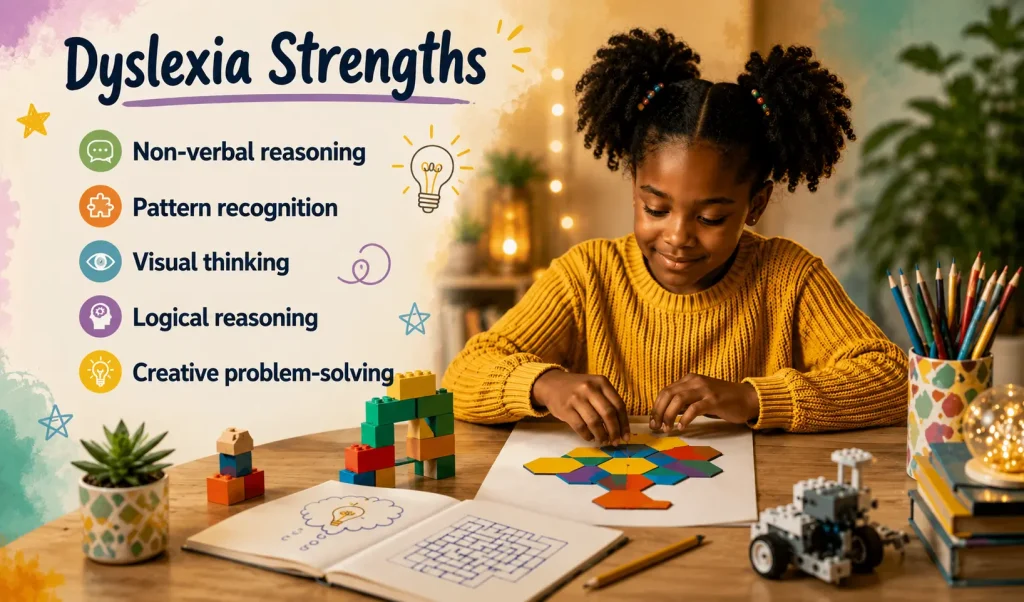
One thing I always enjoy telling parents is that dyslexia does not affect every area equally.
Many children with dyslexia perform extremely well in:
Non-verbal reasoning
Pattern recognition
Visual thinking
Logical reasoning
Creative problem-solving
In fact, many dyslexic learners have exceptional strengths in these areas.
Every child has a unique profile of strengths and challenges, which is why one assessment score should never define their ability.
Can children receive extra support?
If a child has a formal diagnosis of dyslexia, schools may be able to apply for access arrangements, depending on the type of GL Assessment being used and the school’s policies.
These might include:
Extra time
Supervised rest breaks
A reader for certain assessments
Other reasonable adjustments where appropriate
If your child has recently been diagnosed, it’s always worth speaking with their school well before the assessment date to discuss what support may be available.
Preparation is about confidence, not cramming
One of the biggest misconceptions about GL Assessments is that children need endless practice papers.
In my experience, this rarely produces the best results.
Children tend to perform much better when they understand the question styles, feel confident in their own abilities and approach assessments calmly.
For dyslexic learners, preparation often works best when it is engaging and multi-sensory.
Rather than completing worksheet after worksheet, I like to use games, discussion, visual resources and practical activities to develop reading, vocabulary and reasoning skills in an enjoyable way.
When children enjoy learning, they usually remember much more.
Remember: A score is only one snapshot
Perhaps the most important thing for parents to remember is that a GL Assessment score is simply one piece of information.
It is not a measure of intelligence.
It does not predict future success.
It certainly doesn’t define your child’s potential.
Some of the most creative, innovative and successful people in the world are dyslexic. They simply learn differently.
Every child deserves the opportunity to demonstrate what they know in a way that allows them to succeed.
Final Thoughts
If your child has dyslexia, it’s understandable to feel anxious about GL Assessments. However, with the right preparation, appropriate support and growing confidence, many dyslexic learners perform far better than they or their parents expected.
Most importantly, remember that assessments measure performance on one particular day—not your child’s worth, intelligence or future.
Here at Bedford Tutor, I have supported many children with dyslexia preparing for GL Assessments in international schools across the UK and around the world. Through personalised, multi-sensory English tuition and confidence-building lessons, I help learners develop the reading, vocabulary, spelling and reasoning skills they need to approach assessments with greater confidence and success.
To find out more, please click on the relevant links below:
 Bedford, UK