Bedford, UK


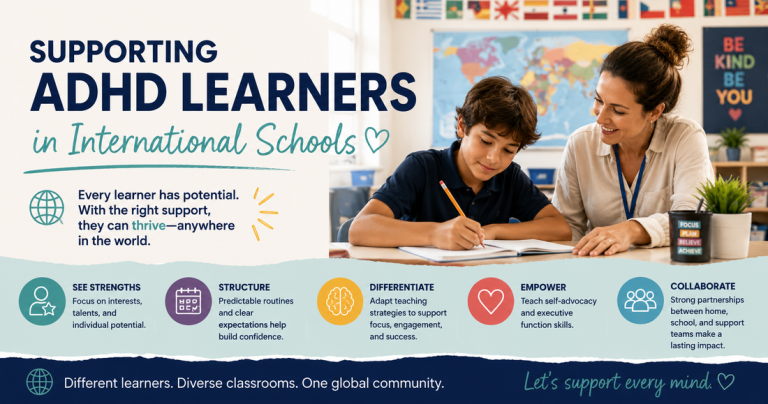
Supporting ADHD Learners in International Schools
What is ADHD?
When most people think of ADHD, they picture a child who can’t sit still, constantly interrupts and bounces from one activity to the next. Whilst that can certainly be part of the picture, ADHD is far more complex than many people realise.
Attention Deficit Hyperactivity Disorder (ADHD) is a neurodevelopmental condition which affects attention, organisation, impulse control and executive functioning. However, no two people experience it in exactly the same way.
I wasn’t diagnosed with ADHD until I was 31. Looking back, the signs were there in bright neon lights. I was energetic, excitable, impulsive and intensely curious about almost everything. I struggled with multi-step instructions, often forgot things that had been said to me moments earlier and found repetitive tasks about as appealing as watching paint dry. Yet I also did well in school, loved learning and was often described as organised and conscientious. For years, those apparent contradictions stopped me from recognising my own ADHD.
That experience taught me something important: ADHD doesn’t look the same in every child.
In international schools, where learners arrive with different languages, cultures, educational experiences and life stories, it is especially important to look beyond stereotypes. The child who constantly calls out answers may have ADHD. Equally, the child quietly staring out of the window, lost in a world of their own, may be experiencing exactly the same condition.
How Does ADHD Affect Learners?
One of the greatest misconceptions about ADHD is that it is simply a problem with paying attention. In reality, it is often a difficulty with regulating attention.
Many ADHD learners can focus brilliantly when something captures their imagination. As a child, I could happily spend hours immersed in a topic which fascinated me. If a lesson sparked my curiosity, I was fully engaged and often had more questions than anyone else in the room. However, if a task felt repetitive, disconnected from my interests or required sustained concentration, keeping my attention on it could feel like trying to hold onto a handful of sand.
ADHD can affect working memory, organisation, emotional regulation, time management and task initiation. A child may know exactly what they need to do but struggle to get started. They may understand the instructions but forget half of them by the time they reach their desk. They may desperately want to succeed whilst appearing disengaged on the surface.
Sadly, these difficulties are often misunderstood. Many ADHD learners spend years being told they are careless, lazy or not trying hard enough. I remember making mistakes which seemed obvious in hindsight and feeling frustrated because I genuinely was trying. The gap between what I knew I could do and what I actually managed to produce was often a source of anxiety.
Creating ADHD-Friendly Learning Environments
The good news is that many of the strategies which help ADHD learners also benefit other students.
Clear routines can be incredibly powerful. Predictability reduces cognitive load and frees up mental energy for learning. Visual timetables, checklists and step-by-step instructions provide useful anchors throughout the day. Breaking larger tasks into smaller chunks can transform an overwhelming mountain into a series of manageable hills.
The classroom environment also matters. ADHD learners often notice everything. A flickering light, a conversation in the corridor or a bird landing outside the window can suddenly become the most interesting thing in the universe. Simple adjustments such as thoughtful seating plans, reduced visual clutter and access to quieter workspaces can make a remarkable difference.
Movement is equally important. Throughout my own education, opportunities to move helped me concentrate far more effectively. Some of my clearest memories involve lessons where activity was built into the learning process. Children were never designed to sit perfectly still for hours on end and many ADHD learners think best when their bodies are allowed to move.
The Power of Understanding
Perhaps the most important support schools can provide is understanding.
Many ADHD learners experience frequent setbacks and begin to view themselves through the lens of their difficulties rather than their strengths. A child who hears constant corrections can eventually start believing they are the problem.
The teachers I remember most fondly were not necessarily the strictest or the most knowledgeable. They were the ones who noticed what I did well. They recognised my enthusiasm, creativity and determination. They celebrated small successes and helped me see strengths which I couldn’t always recognise in myself.
In international schools, this understanding becomes even more important. When children are learning in a language that is not their first language, attention difficulties can sometimes be confused with language barriers and vice versa. Close collaboration between teachers, families and specialists helps ensure that support is both accurate and effective.
Ultimately, supporting ADHD learners is not about fixing children. It is about understanding them.
When schools embrace neurodiversity and recognise that every brain works differently, they create environments where all learners can flourish. Sometimes the most powerful support is not a complex intervention or expensive resource. Sometimes it is simply helping a child understand that there is nothing wrong with the way their brain works and giving them the tools they need to shine.
Here at Bedford Tutor, we have been working with children who have ADHD for over fourteen years; being neurodivergent myself has helped me create a style of tuition that works to the strengths of the ADHD brain.
To find out more, please click on the link below:
Bel 😊