Bedford, UK


If your child has ADHD, you have probably experienced moments that leave you scratching your head.
They can explain a maths concept brilliantly one minute, then completely forget what they were supposed to do the next. They may start tidying their bedroom, become distracted by a toy they haven’t seen for weeks, and somehow end up building a Lego model instead. They might listen carefully to your instructions, yet still return five minutes later asking, “What was I meant to do again?”
To many parents, it can look as though their child isn’t concentrating or simply isn’t trying.
In reality, these are often signs of difficulties with executive functioning.
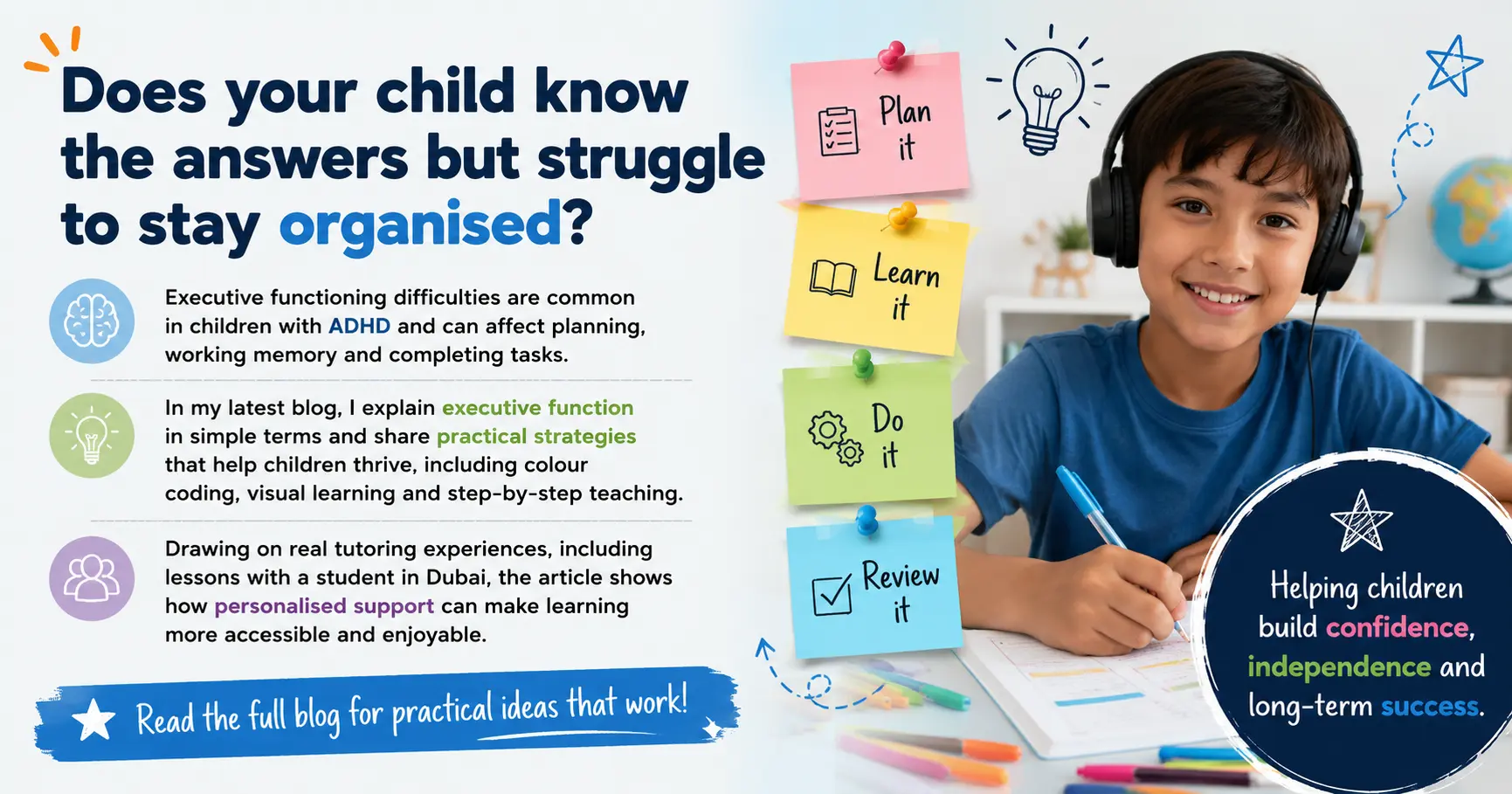
Executive function is sometimes described as the brain’s management system. It helps us plan, organise, remember instructions, manage our time, regulate our emotions and complete tasks. For many children with ADHD, these skills develop differently, making everyday activities far more challenging than they appear from the outside.
The good news is that, with the right support, children with ADHD can absolutely thrive.
What Is Executive Function?
Executive function isn’t one single skill. Instead, it is a collection of mental processes that help us manage daily life.
These include:
- Working memory
- Organisation
- Planning
- Time management
- Flexible thinking
- Emotional regulation
- Task initiation
- Sustaining attention
Many people assume ADHD is simply about paying attention, but it is often more accurate to think of it as a difficulty managing attention alongside these executive functioning skills.
As someone diagnosed with ADHD myself, I know first-hand that these challenges are not a reflection of intelligence. In fact, many children with ADHD are incredibly bright, creative and curious. The difficulty often lies in organising their thoughts, remembering multiple pieces of information and deciding where to begin.
Every ADHD brain is different, and one strategy will never suit every child. That is something I have written about previously, and it remains one of the most important things parents can understand.
Working Memory: The Invisible Challenge
One of the biggest difficulties I see in children with ADHD is working memory.
Working memory is like the brain’s temporary notepad. It allows us to hold information in our minds whilst using it.
Imagine asking your child to:
- Collect their maths book.
- Open it to page 24.
- Find a pencil.
- Write today’s date.
- Complete questions 1–5.
For many children, those five instructions are manageable.
For a child with ADHD, however, by the time they have found their maths book, they may already have forgotten the remaining four steps.
This isn’t because they weren’t listening.
Their brain has simply become overloaded.
Reducing the amount of information children need to hold in their minds allows them to focus far more of their energy on the learning itself.
The Power of Visual Learning
One of the boys I currently tutor online in Dubai demonstrates this beautifully.
Like many children with ADHD, he is bright, inquisitive and eager to learn. However, if information is presented as lengthy verbal explanations or large blocks of text, he can quickly become overwhelmed.
Over time, we discovered something that transformed his confidence.
He is an incredibly visual learner.
Rather than relying on long explanations, we now use colourful diagrams, pictorial examples and carefully colour-coded notes throughout our online lessons.
Different grammatical features are highlighted using different colours. Mathematical methods are organised visually so each stage is easy to follow. Important information is grouped together using diagrams rather than lengthy written instructions.
Instead of expecting him to remember every stage of a task, each step remains visible on the screen throughout the lesson.
The difference has been remarkable.
Tasks that once felt overwhelming have become manageable because he no longer has to rely entirely on his working memory. He can simply follow each visual step in turn, allowing him to think more clearly and work far more confidently.
It is a wonderful reminder that online learning is not simply “school on a screen.” For some children, it can actually remove many of the barriers they experience in a busy classroom.
Breaking Learning Into Small Steps
This is a strategy I use with many of the children I teach, both online and in person.
Rather than giving several instructions all at once, I break activities into small, achievable stages.
For example, instead of saying:
“Read the text, answer the questions, underline the verbs and correct your spellings.”
We might work through the task like this:
Step 1: Read the first paragraph.
Step 2: Highlight unfamiliar words in yellow.
Step 3: Answer Question 1.
Step 4: Tick it off.
Only then do we move on to the next stage.
By reducing the number of decisions children need to make at once, learning becomes far less overwhelming.
Colour Coding Creates Clarity
One of the simplest but most effective strategies I use is colour coding.
Children with ADHD are often trying to process huge amounts of information simultaneously. Colour provides clear visual anchors that help organise that information.
For example, during English lessons we might:
- Highlight nouns in blue.
- Verbs in green.
- Adjectives in orange.
- Fronted adverbials in red.
In maths, different colours can separate each stage of a calculation or distinguish between known information and what we need to work out.
Suddenly, the page no longer looks like one overwhelming wall of writing.
Instead, it becomes organised, structured and much easier to navigate.
Many children begin spotting patterns almost immediately because the colours provide an additional layer of meaning.
Building Confidence Through Structure
One thing I’ve learnt over many years of tutoring is that children rarely lack ability.
More often, they lack a system that works for their brain.
Clear routines, visual prompts, checklists and predictable lesson structures reduce the mental effort needed simply to stay organised.
That frees up valuable brainpower for learning.
When children know exactly what comes next, anxiety often decreases and confidence begins to grow.
I regularly see children who initially describe themselves as “bad at maths” or “not very good at English” begin tackling increasingly difficult work once they are given the right structure.
The learning hasn’t become easier.
It has simply become clearer.
Small Changes Can Make a Big Difference
Parents sometimes worry they need expensive resources or specialist equipment to support executive functioning.
In reality, many of the most effective strategies are wonderfully simple.
Writing checklists.
Breaking tasks into smaller chunks.
Using coloured highlighters.
Keeping instructions short.
Allowing children to tick off completed steps.
Using pictures alongside words.
These approaches don’t lower expectations.
They simply provide the scaffolding children need to demonstrate what they already know.
Final Thoughts
Children with ADHD are not disorganised because they are lazy.
They are often working far harder than other children simply to organise their thoughts, remember instructions and stay focused on the task in front of them.
When we understand executive functioning, we stop asking, “Why won’t they do it?” and start asking, “What support would help them succeed?”
Sometimes that support is as simple as a colourful diagram, a clear checklist or breaking one large task into several smaller ones.
When we adapt learning to suit the child, rather than expecting the child to adapt to one fixed way of learning, remarkable things can happen.
Here at Bedford Tutor, I have supported children with ADHD, executive functioning difficulties and other neurodivergent learning profiles across the UK and around the world for many years. Whether lessons take place online or in person, I use highly visual, structured and personalised approaches that help children build confidence whilst developing the English and maths skills they need to thrive. From colour coding and pictorial learning to carefully sequenced, step-by-step teaching, every lesson is adapted to the individual child.
To find out more, please click on the relevant link below:
Bel 😊