British Curriculum: Reasons It’s Trusted Worldwide

A diverse group of children studying together online in a bright, welcoming learning space using laptops, books and educational resources inspired by the British Curriculum. A globe and world map subtly highlight global connections between Riyadh, Jeddah, Dubai and Bangkok, creating an inspiring international learning environment.

For families living overseas, choosing the right school is one of the biggest educational decisions they will make. Whether relocating for work, joining an international community or planning for university, many parents spend time exploring the different international curricula available, with the British Curriculum often being one of the most widely recognised.

Having worked with children following the British Curriculum for many years, I can certainly understand why. From supporting students attending international schools in Riyadh and Jeddah in Saudi Arabia to working with learners in Dubai and Bangkok, I have seen first-hand how this curriculum provides children with a consistent, well-structured and highly respected education, regardless of where in the world they happen to live.

So, what makes the British Curriculum such a popular choice for families across the globe?

An Internationally Respected Education

One of the biggest reasons families choose the British Curriculum is its outstanding international reputation.

British international schools can now be found throughout the world, particularly in countries such as Saudi Arabia, the UAE, Thailand, Singapore and Malaysia. For expatriate families, this offers something incredibly valuable: continuity.

When parents relocate between countries, children often experience enough change already. Moving home, making new friends and adapting to a different culture can all feel overwhelming. Remaining within the same educational framework helps make that transition much smoother.

Many students can move from one British international school to another with relatively little disruption, allowing them to continue developing their knowledge and skills without having to adapt to an entirely different curriculum.

A Clear Structure That Builds Confidence

One of the strengths of the British Curriculum is its logical progression.

Each year builds upon the previous one, helping children gradually develop their understanding rather than rushing through concepts before they are fully secure.

This structured approach allows teachers to identify any gaps in learning early whilst giving students the confidence that each new topic builds naturally on what they already know.

As a tutor, I find this particularly helpful. Whether I am supporting a Year 4 pupil with reading comprehension or an older student preparing for iGCSE English Language, it is usually very clear where they are within the curriculum and which skills need further development.
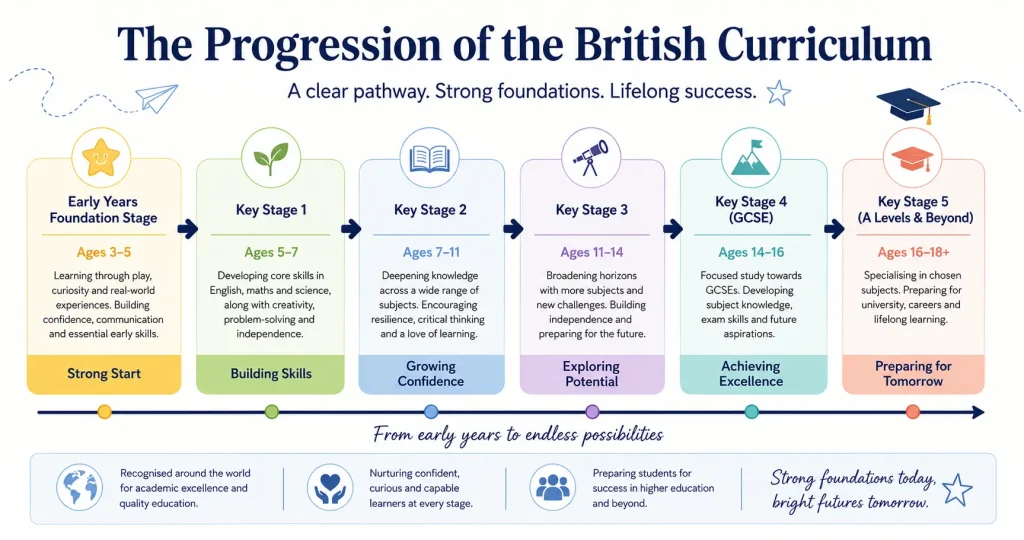
Infographic showing the progression of the British Curriculum from Early Years Foundation Stage to A Levels.

Strong Foundations in English and Mathematics

The British Curriculum places considerable importance on literacy and numeracy.

Children are encouraged not only to read fluently and write accurately but also to think critically, explain their ideas and communicate with confidence.

Similarly, mathematics focuses on developing genuine understanding rather than simply memorising procedures. Children learn to solve problems, explain their reasoning and apply mathematical concepts in unfamiliar situations.

These skills form the foundation for success across every other subject and remain valuable long after children leave school.

Preparing Students for Recognised Qualifications

Another reason the British Curriculum remains so popular is its internationally recognised qualifications.

Many students progress towards GCSEs and iGCSEs before continuing to A Levels, qualifications that are respected by schools, colleges and universities across the world.

Several of my older students are currently preparing for Cambridge and Pearson Edexcel iGCSE English Language, whilst many younger learners are developing the reading, grammar, vocabulary and mathematical skills that will support them throughout their educational journey.

I also work with children preparing for GL Assessments, which are widely used by British international schools to monitor progress and, in some cases, support admissions. Helping students prepare for these assessments has given me a valuable insight into the expectations of many international schools.

Supporting Families Across Saudi Arabia, the UAE and Thailand

One of the aspects of my work that I enjoy most is supporting families living overseas.

I currently teach students attending British international schools in Riyadh and Jeddah (Saudi Arabia), Dubai (UAE) and Bangkok (Thailand). Although these children live in different countries, speak different first languages and experience different cultures, they are all following the same British Curriculum.

It is fascinating to see how the curriculum provides a common educational framework whilst allowing schools to embrace the culture of the country in which they are based.

One lesson might involve helping a student in Riyadh strengthen their grammar before a school assessment. Later that day I may be supporting a child in Dubai with reading comprehension or helping a learner in Bangkok build confidence with mathematics.

Despite the different time zones, the learning objectives are often remarkably similar.

This consistency is one of the reasons online tuition works so well for international families. Wherever a child happens to live, they can receive personalised support that complements what they are learning in school.

A Curriculum That Encourages Independent Thinking

One of my favourite aspects of the British Curriculum is its emphasis on developing independent learners.

Children are encouraged to ask questions, explain their thinking, evaluate evidence and solve problems for themselves rather than simply memorising information.

These habits help develop curiosity and resilience—qualities that become increasingly important as children move through secondary school and eventually into higher education.

Confidence grows when children realise that learning is about understanding, not simply remembering facts.

Supporting Every Learner

Although the British Curriculum provides an excellent educational framework, no two children learn in exactly the same way.

Over the years, I have supported many learners with ADHD, dyslexia, dyscalculia, autism and other additional learning needs. My experience has taught me that successful learning depends far more on adapting lessons to suit the individual child than following any curriculum rigidly.

Some children benefit from visual resources. Others learn best through discussion, games or practical activities. Some need additional time to process information, whilst others thrive when challenged with extension work.

The curriculum provides the destination, but every child deserves a learning journey that suits them.

Why Parents Continue to Choose the British Curriculum

There is no single reason why the British Curriculum has become one of the world’s most popular educational systems.

Its success comes from combining clear academic progression with internationally recognised qualifications, strong foundations in English and mathematics, and an approach that encourages children to become thoughtful, confident and independent learners.

Having supported students studying the British Curriculum in Saudi Arabia, the UAE and Thailand, I have seen how effectively it prepares children for future learning whilst providing consistency for families living internationally.

Wherever children are learning—whether in Riyadh, Jeddah, Dubai, Bangkok or here in the UK—the ultimate goal remains the same: helping them develop the confidence, knowledge and skills they need to succeed both inside and outside the classroom.


Wondering How We Can Help?

Whether you’re exploring tuition options, looking for specialist support or simply have a question, we’d love to hear from you. Tell us a little about your child and what you’re looking for, and we’ll be in touch as soon as possible.


Current Availability

Super Summer Learning (August): Good availability throughout the holiday

Weekday daytime tuition (from September): Good availability for international students, home-educated learners and families with flexible schedules

🗓️ After-school, Saturday & Sunday morning tuition (from September): Waiting list currently in operation


Please include Area Code if Outside UK

Related Posts

Related Blog Posts

  • Primary Maths Confidence: Powerful Ways to Help Children

    Confidence and maths don’t always seem to go hand in hand.

    Over the years, I’ve met countless children who happily tackle a tricky reading comprehension but freeze the moment they see a page of calculations. Some will quietly whisper, “I’m just not good at maths,” whilst others become anxious before we’ve even looked at the first question.

    The interesting thing is that very few of these children actually lack mathematical ability.

    More often than not, what they’re lacking is confidence.

    Once children begin believing they “can’t do maths”, that belief can quickly become the biggest obstacle to their progress. Fortunately, confidence isn’t something children either have or don’t have. Like mathematical skills themselves, it can be developed with the right support, encouragement and experiences.

    Why Maths Confidence Matters

    Primary school is where children build the foundations for future mathematical learning.

    Whether they’re learning number bonds, multiplication tables, fractions or problem-solving, every new concept builds on previous knowledge. When confidence is low, children often avoid taking risks, rush through questions or give up before they’ve really started.

    I’ve found that many children who struggle in maths aren’t afraid of numbers themselves. They’re afraid of making mistakes.

    That fear can become surprisingly powerful.

    A child who worries about getting an answer wrong may stop volunteering answers in class, avoid challenging questions or rely heavily on adults for reassurance. Over time, this can create the impression that maths is simply “not their subject”, when in reality they’re capable of much more than they realise.

    Celebrate Effort, Not Just Correct Answers

    One of the most effective ways to build confidence is to praise effort rather than perfection.

    Imagine two children tackling the same problem. One gets the correct answer immediately. The other makes several mistakes but perseveres until they finally understand the method.

    Which child has learnt more?

    Quite often, it’s the second.

    Learning maths involves making mistakes. Every incorrect answer provides information about what a child understands and what still needs developing.

    When children realise mistakes are a normal part of learning rather than something to fear, they become much more willing to have a go.

    Simple comments such as:

    • “I really like how you kept trying.”
    • “You chose a good strategy.”
    • “Let’s work out together where it went wrong.”

    can have a far greater impact than simply saying, “Well done.”

    Make Maths Practical

    Young children naturally learn through doing.

    Abstract numbers on a worksheet can sometimes feel confusing, but place the same mathematical concept into a real-life situation and everything suddenly becomes much clearer.

    Cooking together provides wonderful opportunities to explore measurement, fractions and weighing.

    Shopping encourages children to estimate costs, compare prices and calculate change.

    Building with bricks develops understanding of shape, patterns and spatial reasoning.

    Even setting the table can become an opportunity to practise counting, multiplication and sharing equally.

    When maths becomes part of everyday life, children begin to see that it has purpose beyond the classroom.

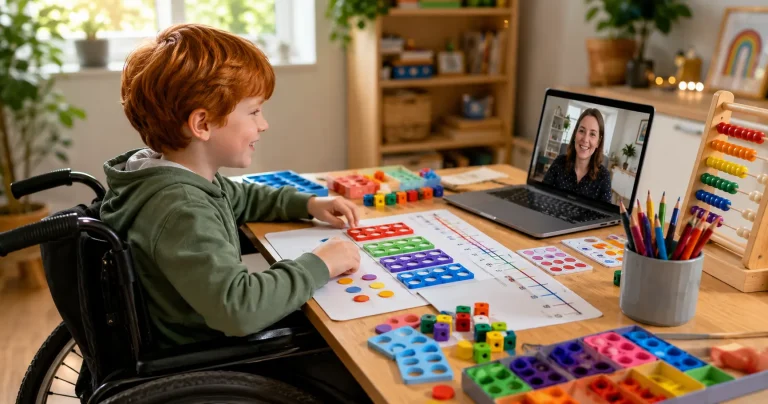
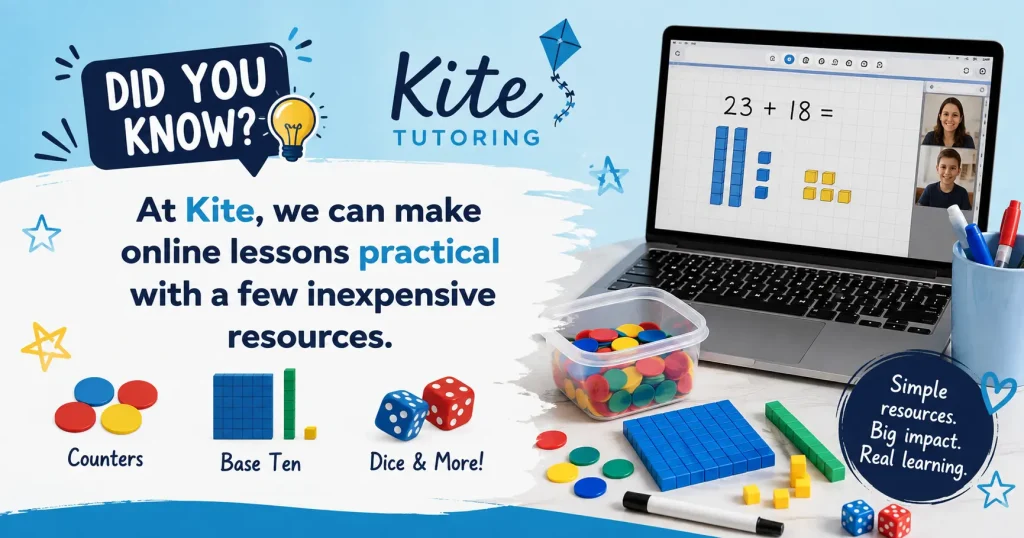
    Did You Know? promotional graphic for Kite Tutoring showing that online lessons can be practical with a few inexpensive resources. A laptop displays a maths lesson using virtual base ten blocks while physical counters, base ten equipment, dice and whiteboard pens are arranged on the desk, illustrating how simple hands-on resources support engaging online learning.

    Build Confidence Through Small Successes

    One of the biggest mistakes adults sometimes make is moving on too quickly.

    Children need opportunities to experience success.

    If every activity feels just beyond their current ability, confidence gradually begins to fade.

    Instead, try to create a series of achievable challenges.

    Perhaps today your child confidently adds two-digit numbers.

    Tomorrow they might tackle three-digit numbers with support.

    Next week they may begin solving simple word problems using the same skills.

    These small successes gradually build into genuine mathematical confidence.

    I’ve often seen children who initially describe themselves as “bad at maths” completely change their attitude after a few weeks of carefully structured learning. Nothing magical has happened. They’ve simply experienced enough success to start believing in themselves.

    Keep Learning Enjoyable

    One of my favourite ways to teach primary maths is through games.

    Children often don’t realise how much mathematical thinking they’re doing when they’re enjoying themselves.

    Card games encourage number recognition and quick mental calculations.

    Board games develop counting, strategy and logical thinking.

    Dice games build fluency with addition, subtraction and multiplication.

    Even simple treasure hunts can involve measuring distances, following coordinates or solving mathematical clues.

    When learning feels fun, children become much more willing to tackle new challenges.

    This is particularly true for many neurodivergent learners, including children with ADHD, dyscalculia and autism, who often respond brilliantly to interactive, engaging activities rather than repetitive worksheets. Creating enjoyable learning experiences has always been central to my approach because motivation and confidence often grow together.

    Encourage Mathematical Talk

    Sometimes children know far more than they realise.

    Instead of immediately asking for the answer, ask questions such as:

    • “How did you work that out?”
    • “Can you explain your thinking?”
    • “Is there another way to solve it?”
    • “How do you know your answer makes sense?”

    Talking through mathematical thinking helps children organise their ideas whilst giving adults valuable insight into any misconceptions.

    It also reinforces an important message:

    Maths isn’t just about getting the right answer.

    It’s about understanding.

    Every Child Learns Differently

    As someone who has worked with many children with ADHD, dyscalculia, dyslexia and autism, I’ve learnt that no two learners approach maths in exactly the same way.

    Some children benefit from visual models.

    Others need practical resources they can physically move.

    Some need learning broken into smaller chunks, whilst others thrive when mathematical concepts are linked to their favourite interests.

    The key is flexibility.

    Rather than expecting every child to learn through one method, we should adapt our teaching to suit the learner sitting in front of us. This personalised, strengths-based approach is something I’ve found particularly valuable when supporting children with additional learning needs.

    Confidence Lasts Longer Than Correct Answers

    One thing I often remind parents is that confidence isn’t built in a single lesson.

    It develops gradually through hundreds of positive learning experiences.

    Each encouraging conversation.

    Each problem solved.

    Each moment when a child says, “I did it!”

    Those moments matter far more than many people realise.

    After all, children who believe they can succeed are far more likely to persevere when learning becomes challenging.

    And that resilience will support them long after they’ve forgotten how to calculate fractions or complete long multiplication.


    Wondering How We Can Help?

    Whether you’re exploring tuition options, looking for specialist support or simply have a question, we’d love to hear from you. Tell us a little about your child and what you’re looking for, and we’ll be in touch as soon as possible.


    Current Availability

    Super Summer Learning (August): Good availability throughout the holiday

    Weekday daytime tuition (from September): Good availability for international students, home-educated learners and families with flexible schedules

    🗓️ After-school, Saturday & Sunday morning tuition (from September): Waiting list currently in operation


    Please include Area Code if Outside UK

    Related Posts

  • Educating at Home: What are the Benefits?

    Home education is a journey that looks different for every family.

    Over the years, I have worked with many home-educated learners across the UK and around the world, and one thing has become increasingly clear: there is no single “right” way to educate a child. What matters most is finding an approach that works for the individual learner.

    Some children thrive when learning follows a structured timetable. Others flourish when lessons are shaped around their interests, curiosity and natural pace of development. One of the greatest strengths of home education is the flexibility it offers families to create a learning experience that truly meets their child’s needs.

    Every Child Learns Differently

    One of my favourite things about supporting home-educated students is seeing how unique each learner really is.

    I have worked with children who can discuss complex scientific ideas for hours yet need additional support with writing. I have taught students who excel in mathematics but lack confidence when reading aloud. I have also supported many neurodivergent learners whose strengths and challenges don’t always fit neatly into traditional educational expectations.

    As someone with ADHD myself, I understand that learning differences can sometimes make education feel challenging. However, I also know that when children are given the right support and encouragement, those same differences can become incredible strengths.

    Home education allows parents to build learning around the child rather than expecting the child to fit into a predetermined system.

    Building Confidence in English

    For many home-educated learners, confidence is just as important as academic progress.

    English can feel overwhelming for children who struggle with reading, spelling or writing. This is particularly true for learners with dyslexia, ADHD or autism, who may have experienced frustration in previous educational settings.

    I often tell parents that reading confidence develops much like growing a plant. Progress can sometimes seem slow at first, but with consistent nurturing, encouragement and patience, remarkable growth begins to appear.

    One of the most effective ways to develop English skills is through genuine enjoyment. Children who discover books, stories and topics that genuinely interest them are often far more motivated to read. Whether it’s a book about dinosaurs, space, animals or computer games, enthusiasm is a powerful learning tool.

    Writing confidence also improves when children feel safe making mistakes. Some of the best creative writing I’ve seen has come from students who were encouraged to focus on expressing their ideas before worrying about perfect spelling and punctuation.

    Making Maths Less Intimidating

    Mathematics can sometimes create anxiety for both children and parents.

    I frequently meet learners who believe they are “bad at maths” when, in reality, they simply haven’t found an approach that works for them yet.

    Home education provides the opportunity to slow down when necessary and revisit concepts without the pressure of keeping pace with a large class. This can be particularly beneficial for learners with dyscalculia or those who need additional time to process mathematical ideas.

    I often use practical examples, games and visual resources to help children understand mathematical concepts. When maths becomes something children can see, touch and relate to everyday life, it often feels far less intimidating.

    One student I worked with struggled to understand fractions until we began using pizza slices and baking activities as part of our lessons. Suddenly, the abstract concept became something tangible and meaningful.

    Moments like these remind me that successful teaching is often about finding the explanation that clicks.

    Supporting Neurodivergent Home-Educated Learners

    Many families choose home education because traditional school environments have not fully met their child’s needs.

    For learners with ADHD, autism, dyslexia or dyscalculia, personalised education can be transformative.

    Some children benefit from movement breaks and highly interactive lessons. Others need information presented visually or broken into smaller, manageable chunks. Many simply need the freedom to learn at a pace that reduces anxiety and allows confidence to grow naturally.

    The beauty of home education is that these adaptations can become part of everyday learning rather than special exceptions.

    The Power of Personalised Learning

    One of the greatest advantages of home education is the opportunity to celebrate progress without comparison.

    Children develop at different rates, and learning is rarely a straight line. There will be periods of rapid progress and moments when things feel slower. Both are completely normal.

    When children feel understood, valued and supported, they become more willing to take risks, ask questions and persevere through challenges.

    That confidence often becomes the foundation for long-term success in both English and maths.

    After all, education isn’t simply about covering curriculum content. It’s about helping children develop the skills, knowledge and self-belief they need to thrive.

    Here at Bedford Tutor, I have supported home-educated learners across the UK and around the world for many years. Whether a child needs help developing confidence in English, strengthening mathematical understanding, preparing for Functional Skills qualifications or accessing personalised support for ADHD, dyslexia, dyscalculia or autism, I aim to create engaging lessons that meet learners where they are and help them move forward with confidence.

    To find out more, please click on the relevant link below:

    Bel 😊



    Related Posts

  • Moving Abroad With an ADHD Child: How to Support a Smooth Transition

    Moving abroad is an exciting adventure. New countries, new cultures, new opportunities and experiences can open doors for children in remarkable ways.

    However, when your child has ADHD, an international move can bring additional challenges that are sometimes overlooked.

    Over the years, I have worked with many families who have relocated overseas, particularly to countries such as the UAE, Saudi Arabia, Singapore, Malaysia and Thailand. Whilst every family’s journey is unique, one theme appears time and time again: children with ADHD often need more support with transitions than people realise.

    As someone with ADHD myself, I completely understand why.

    Why Moving Abroad Can Feel Overwhelming

    Many children with ADHD thrive on familiarity, even if they appear adventurous on the surface.

    A move overseas often involves:

    • Leaving friends behind
    • Starting a new school
    • Adapting to different routines
    • Navigating cultural differences
    • Managing uncertainty

    For neurotypical children, these changes can be challenging enough. For an ADHD child, they can feel like someone has shaken up every part of their world at once.

    I often compare it to trying to complete a jigsaw puzzle whilst somebody keeps changing the picture on the box.

    Many ADHD children work incredibly hard to stay organised, manage emotions and navigate everyday life. When familiar structures disappear, it can temporarily increase anxiety, emotional outbursts, forgetfulness and difficulties with concentration.

    Remember: Every ADHD Child Is Different

    One of the biggest misconceptions about ADHD is that all children experience it in the same way.

    They don’t.

    Some children become highly anxious before a move. Others seem completely relaxed until several weeks later when the reality begins to sink in. Some throw themselves into new experiences immediately, whilst others need time to observe and adjust before they feel comfortable.

    This is something I feel strongly about because ADHD is incredibly diverse. No two ADHD children are exactly alike, and understanding your individual child is always more important than following generic advice.

    Preparing Before You Move

    One of the most effective ways to reduce anxiety is to involve your child in the process early.

    Talk openly about:

    • Where you are moving
    • What their new school looks like
    • What daily life might be like
    • The exciting opportunities ahead

    Many ADHD learners benefit from visual preparation.

    Photos, videos, maps and virtual tours can help transform an unknown destination into something more familiar and manageable.

    If possible, create a countdown calendar so your child can clearly see when different events will happen. Predictability often helps reduce uncertainty.

    Supporting School Transitions

    Starting a new school can be one of the biggest worries for ADHD learners.

    International schools can vary significantly in their approach to supporting neurodivergent students. Before moving, it can be helpful to discuss:

    • Available SEND support
    • Classroom accommodations
    • Communication systems
    • Homework expectations
    • Pastoral care

    The earlier these conversations happen, the smoother the transition is likely to be.

    Many families also find that maintaining some educational continuity through online tuition can provide reassurance during this period. Having one familiar adult, one familiar routine and one consistent learning space can make a tremendous difference when everything else feels new.

    Expect an Adjustment Period

    One mistake parents sometimes make is assuming that a child who appears happy has adjusted immediately.

    In reality, ADHD children can take time to process major life changes.

    I often tell families that settling into a new country is a marathon, not a sprint.

    There may be emotional ups and downs along the way.

    Your child may initially love their new environment and then suddenly miss home several months later. This is completely normal.

    Give them space to talk about their feelings without trying to “fix” everything straight away.

    Sometimes children simply need someone to listen.

    Focus on Confidence First

    Whenever I support a child through a significant transition, confidence becomes my priority.

    Academic progress is important, but confidence is often the foundation that makes everything else possible.

    When children feel safe, understood and capable, they are far more likely to engage with learning, build friendships and embrace new experiences.

    Small successes matter.

    • Making one new friend.
    • Finding their way around school.
    • Trying a new activity.
    • Completing a piece of work independently.

    These moments gradually build a sense of belonging.

    Final Thoughts

    Moving abroad with an ADHD child can feel daunting, but it can also be an incredible opportunity for growth.

    With patience, preparation and understanding, many ADHD learners develop remarkable resilience through international experiences.

    The goal is not to remove every challenge.

    The goal is to provide enough support that your child feels confident navigating those challenges for themselves.


    After all, children with ADHD are often wonderfully adaptable, creative and resourceful. Sometimes they simply need a little extra time and reassurance whilst finding their feet in a brand-new world.

    Here at Bedford Tutor, I have supported many children with ADHD who have relocated overseas or attend international schools across the UAE, Saudi Arabia, Singapore, Malaysia and Thailand. Through personalised English and maths tuition, confidence-building support and ADHD-friendly learning strategies, I help students navigate educational transitions whilst continuing to develop the skills they need to thrive.

    To find out more, please click on the relevant link below:

    Bel 😊


    Related Posts

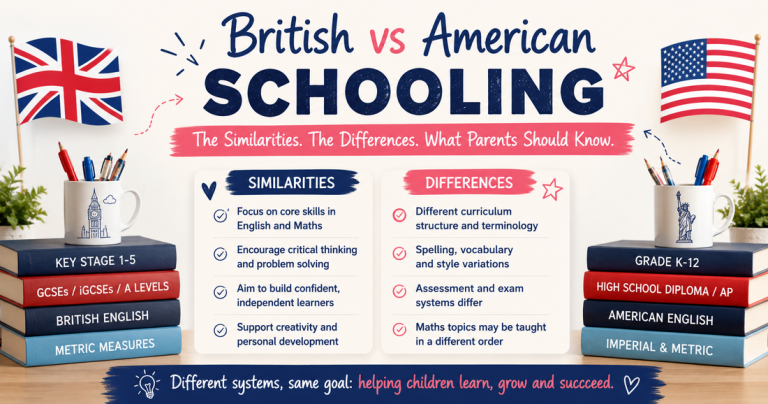
  • British Curriculum vs American Curriculum: What Parents Living Abroad Should Know


    One of the questions I am frequently asked by parents living overseas is whether there is a significant difference between the British and American curricula.

    The short answer is yes… and no!

    Having taught children following both educational systems for many years in countries such as the UAE and Thailand, I am often surprised by how similar they really are. Whilst there are certainly some differences in terminology, assessment and curriculum content, both ultimately aim to help children develop the same core skills: confidence in reading, competence in writing and a secure understanding of mathematics. That being said, there are some important distinctions which can occasionally catch families by surprise, particularly when children move between schools or educational systems.​

    One of the most obvious differences appears in English.

    Although British English and American English are essentially the same language, there are some spelling variations which can occasionally cause confusion. For example, a child attending a British school may write colour, favourite and centre, whilst a child following the American curriculum will be expected to write color, favorite and center.

    I often teach both British and American English and one of the first things I reassure children about is that neither version is “wrong”. The important thing is consistency. If a child is studying within an American school, they should use American spellings. If they are following the British curriculum, British spellings are usually expected.

    Fortunately, children tend to adapt remarkably quickly once they understand the differences.

    Over the years, I have also gained extensive experience preparing students for the GL Assessments used by many international schools. These assessments often form an important part of school entry procedures and provide valuable information about a child’s strengths and areas for development. Supporting children through these assessments has given me a strong understanding of the skills many international schools expect students to demonstrate.

    Alongside this, I regularly support students studying iGCSE English Language. I particularly enjoy helping learners develop their reading, writing and analytical skills whilst building the confidence needed to tackle longer pieces of writing and examination questions.

    My experience is not limited to the British curriculum, however.

    I have also worked with students in countries such as Saudi Arabia who follow Common Core English and Mathematics programmes, and regularly support children studying both the British and American curricula. Over the years, working across different educational systems has taught me that successful teaching is rarely about the curriculum itself. More often, it is about understanding the child sitting in front of you and adapting your approach to suit the way they learn best.​

    Mathematics is perhaps where some of the most noticeable differences occur.

    When I first began supporting a student studying the American mathematics curriculum over a longer period of time, I quickly realised that certain concepts were approached differently. The methods were not necessarily better or worse, but they were sometimes presented in a different order or explained using different terminology.

    One area which particularly expanded my own knowledge was the use of imperial measurements.

    Whilst British children are often familiar with miles and occasionally encounter other imperial units, the American curriculum tends to make much greater use of feet, inches, yards, pounds and gallons. Supporting students with these concepts helped me become far more confident teaching measurement systems which are not always covered in depth within the British curriculum.

    Experiences like these have been invaluable because they have allowed me to become more adaptable as a tutor.

    Perhaps the biggest lesson I have learnt is that children are often far more flexible than adults give them credit for. Whether they are learning colour or color, converting centimetres or inches, preparing for GL Assessments or studying iGCSE English Language, the underlying goal remains exactly the same: helping them become confident, capable learners.

    Curricula may vary from country to country, but curiosity, confidence and a love of learning are universal.

    As someone who works with children from a wide range of countries and educational backgrounds, I genuinely enjoy helping students navigate these differences and discover that, regardless of which curriculum they follow, they are capable of achieving great things.

    Here at Bedford Tutor, I have supported children following both the British and American curricula for many years. From GL Assessments and iGCSE English Language to Common Core English and Mathematics, working with learners from different educational systems has helped me develop a flexible approach that allows every child to build confidence whilst developing the skills they need to succeed.

    To find out more, please click on the link below:

    Bel 😊


    Related Posts

  • Should My Child Have Tuition Over The Summer Holidays?

    Is Summer Holiday Tuition Worth It?

    As the summer holidays approach, many parents begin asking the same question:

    ​Should my child have tuition over the summer?

    It’s an interesting debate and one which doesn’t really have a universal answer.

    For many families, summer is a precious opportunity to slow down. After months of early mornings, homework, packed lunches and busy schedules, children deserve time to relax, recharge and simply enjoy being children. Looking back at my own school holidays, some of my happiest memories involve long days outdoors, building dens, reading books and becoming completely absorbed in whatever strange obsession had captured my imagination that particular week.

    Summer should never feel like an extension of school.

    However, there is another side to the story.

    Teachers often talk about the “summer slump”, that period during the long break when some children forget skills they worked hard to develop during the academic year. This is completely normal. In fact, many schools spend the first few weeks of the autumn term revisiting previous learning before introducing new concepts.

    For some children, particularly those who have struggled with confidence or have gaps in their learning, a small amount of support over the summer can make a surprisingly big difference.

    Learning Doesn’t Have To Feel Like School

    When people hear the word “tuition”, they often imagine children sitting at a desk completing worksheets while everyone else is outside enjoying the sunshine.

    Thankfully, good summer tuition looks very different.

    Some of the most effective holiday learning happens through games, creative challenges, discussion activities and hands-on tasks. Without the pressure of school assessments and deadlines, children often feel more relaxed and willing to take risks in their learning.

    In many ways, summer provides an opportunity to revisit skills at a gentler pace.

    Whether a child needs support with reading, writing, spelling, times tables or mathematical fluency, a few well-planned sessions can help keep important skills ticking over without dominating the holiday period.

    What About Children With SEND?

    For children with SEND, summer tuition can sometimes be particularly valuable.

    Many neurodivergent children thrive on routine and predictability. Whilst a complete break from school can be beneficial, six weeks without any structured learning can feel unsettling for some children.

    As someone with ADHD, I understand this feeling well. Although I desperately needed breaks from school, I also found comfort in having something meaningful to focus on. Too much structure felt restrictive, but no structure at all often left my thoughts bouncing around like pinballs in an arcade machine.

    Every child is different, but many children with ADHD, autism, dyslexia and other learning differences benefit from maintaining a small amount of routine during the summer months.

    The quieter pace of the holidays also allows tutors to spend more time exploring how a child learns best. Without the demands of the school timetable, sessions can focus on building confidence, strengthening key skills and developing strategies which can later be transferred back into the classroom.

    So, Is It Worth It?

    The honest answer is: sometimes.

    Not every child needs summer tuition and not every family wants it. Holidays should still be holidays.
    However, if your child has gaps in learning, struggles with confidence, is preparing for a transition to a new school or simply benefits from additional support, summer tuition can be a valuable investment.

    The most successful summer learning programmes are flexible, enjoyable and tailored to the individual child. They don’t aim to replace summer adventures with worksheets and timetables. Instead, they provide just enough support to help children return to school feeling confident, capable and ready for a new academic year.

    After all, the goal isn’t to fill every moment of the holidays with learning.

    It’s to ensure children begin September believing they can succeed.​

    If you are considering summer tuition in Bedford or online, our Super Summer Learning sessions provide personalised support for children aged 5-16 in a fun, engaging, and encouraging environment.

    ​To find out more, please click on the link below:

    Bel 😊


    Related Posts

  • Building Strong Number Sense: Powerful Primary Maths Strategies

    When parents ask me what the most important part of primary maths is, my answer is almost always the same: number sense.

    Before children can confidently tackle fractions, algebra or problem solving, they need to develop a deep understanding of numbers themselves. Just as we wouldn’t expect a child to build a house without solid foundations, we shouldn’t expect them to master more complex mathematics until they truly understand the basics.

    Over the years, I’ve found that children make their greatest progress when we slow down, build confidence and make sure those mathematical foundations are secure before moving on.

    What Is Number Sense?

    Number sense is far more than simply being able to count or memorise times tables.

    It is a child’s intuitive understanding of how numbers work and how they relate to one another. Children with strong number sense can estimate, recognise patterns, spot relationships and approach problems flexibly rather than relying on memorised procedures.

    For example, instead of seeing 8 + 7 as a calculation to memorise, a child with good number sense might think:

    “I know 8 needs 2 to make 10, so I’ll take 2 from the 7. That makes 10 + 5 = 15.”

    That kind of thinking demonstrates genuine mathematical understanding rather than simple recall.

    Moving from Concrete to Visual to Abstract

    One of the principles I use throughout my primary maths tuition is moving from concrete, to visual, and finally to abstract learning.

    This progression allows children to build understanding gradually rather than expecting them to work with abstract numbers before they’re ready.

    Concrete Learning

    Children first explore mathematical ideas using real objects they can touch and move.

    These might include:

    • Counters
    • Cubes
    • Numicon
    • Bead strings
    • Base ten equipment
    • Dice
    • Coins
    • Dominoes

    Physically manipulating objects helps children see what addition, subtraction, multiplication and division actually mean.

    Instead of simply hearing that 4 + 3 = 7, they can build it, move it around and discover it for themselves.

    Visual Learning

    Once children understand a concept using physical resources, we gradually introduce visual representations.

    This might include:

    • Number lines
    • Bar models
    • Arrays
    • Ten frames
    • Part-whole models
    • Number bonds

    The concrete objects slowly become pictures and diagrams, allowing children to visualise mathematics without needing physical equipment every time.

    Abstract Learning

    Only when those foundations are secure do we move towards abstract calculations using numbers and symbols alone.

    By this stage, the maths isn’t simply something they’ve memorised.

    It’s something they genuinely understand.

    Most importantly, we move through these stages at the child’s pace, not according to a timetable.

    Some children are ready to move quickly.

    Others benefit enormously from spending longer exploring concrete resources.

    There is no prize for rushing.

    Strong foundations almost always save time later.

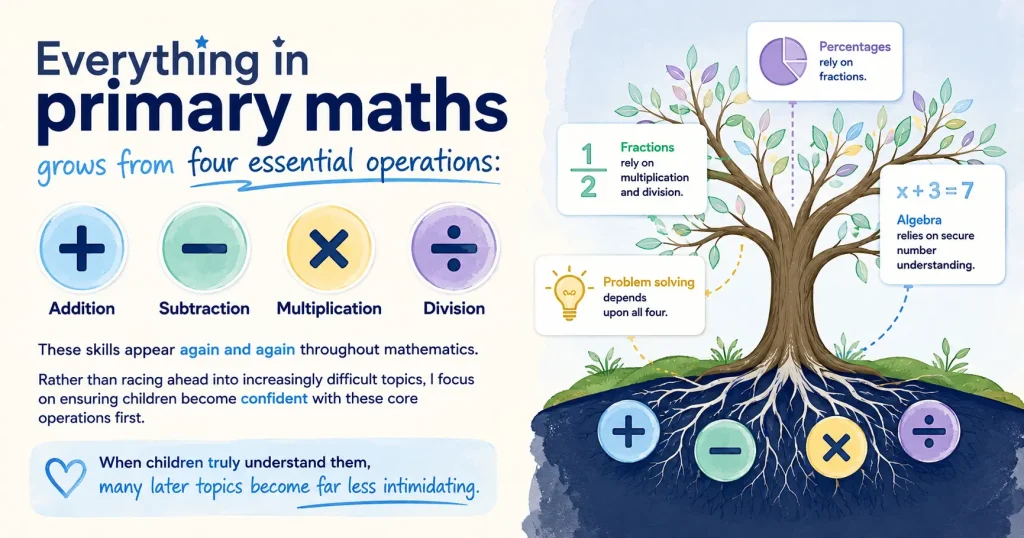
    Mastering the Four Core Operations

    Everything in primary maths grows from four essential operations:

    • Addition
    • Subtraction
    • Multiplication
    • Division

    These skills appear again and again throughout mathematics.

    Fractions rely on multiplication and division.

    Percentages rely on fractions.

    Algebra relies on secure number understanding.

    Problem solving depends upon all four.

    Rather than racing ahead into increasingly difficult topics, I focus on ensuring children become confident with these core operations first.

    When children truly understand them, many later topics become far less intimidating.

    Illustration showing how all areas of primary maths grow from the four operations: addition, subtraction, multiplication and division, with a tree linking these skills to fractions, percentages, algebra and problem solving.

    Using Real-World Maths

    One question children ask surprisingly often is:

    “When am I ever going to use this?”

    It’s a fair question.

    That’s why I try to teach mathematics through situations children can relate to.

    We might calculate the cost of shopping, work out change in a café, divide slices of pizza, measure ingredients while baking or compare football scores and statistics.

    Suddenly maths becomes something useful rather than something that only exists inside exercise books.

    Children begin to realise they already use mathematics every single day.

    Learning Through Socratic Questioning

    One of my favourite teaching approaches is Socratic questioning.

    Rather than immediately showing children how to solve a problem, I ask carefully chosen questions which help them discover the solution themselves.

    Questions such as:

    “What do you notice?”

    “Can you think of another way?”

    “Why do you think that worked?”

    “Does your answer make sense?”

    These conversations encourage children to think mathematically rather than simply follow instructions.

    The confidence that comes from discovering an answer independently is often far more powerful than being shown the method from the beginning.

    Online Maths Can Still Be Practical

    Some parents worry that online maths lessons can’t be hands-on.

    Fortunately, that hasn’t been my experience.

    For a number of years, I’ve been supporting one primary maths student living in Saudi Arabia, alongside another wonderful student in Thailand. Although we meet online, our lessons remain highly interactive and practical.

    With just a few inexpensive resources at home, children can still manipulate objects, build numbers and explore mathematical ideas exactly as they would during face-to-face lessons.

    Simple resources such as counters, cubes, playing cards, dice, Numicon or even dried pasta can make an enormous difference.

    Children love being able to pick things up, move them around and physically demonstrate their thinking.

    Technology allows us to share screens, draw diagrams and play interactive games, whilst tactile resources provide the hands-on learning that many children still benefit from.

    It really can be the best of both worlds.

    Maths Should Feel Like Solving a Puzzle

    Perhaps the most important thing I try to achieve in every lesson is making maths enjoyable.

    Many children come to me believing they “aren’t maths people.”

    Very often, they simply haven’t been given enough time to build secure foundations.

    I encourage children to think of maths as a giant puzzle.

    Every question is simply another mystery waiting to be solved.

    Sometimes we solve it quickly.

    Sometimes we need to try several different strategies.

    Sometimes we make mistakes before finding the answer.

    That’s all part of learning.

    When children stop fearing mistakes and begin enjoying the challenge, something remarkable happens.

    Their confidence grows.

    Their curiosity increases.

    And mathematics becomes something they look forward to rather than something they dread.

    After all, children learn best when they’re having fun.

    Final Thoughts

    Strong number sense doesn’t develop overnight.

    It grows through curiosity, exploration, conversation and plenty of opportunities to play with numbers.

    By moving from concrete experiences to visual representations and finally to abstract thinking, children develop genuine mathematical understanding that lasts far beyond primary school.

    When we teach through real-world examples, encourage mathematical discussion using Socratic questioning, and make learning enjoyable, maths becomes much more than a school subject.

    It becomes an exciting puzzle waiting to be explored.


    Wondering How We Can Help?

    Whether you’re exploring tuition options, looking for specialist support or simply have a question, we’d love to hear from you. Tell us a little about your child and what you’re looking for, and we’ll be in touch as soon as possible.


    Current Availability

    Super Summer Learning (August): Good availability throughout the holiday

    Weekday daytime tuition (from September): Good availability for international students, home-educated learners and families with flexible schedules

    🗓️ After-school, Saturday & Sunday morning tuition (from September): Waiting list currently in operation


    Please include Area Code if Outside UK

    Related Posts